
IPC Alert flags rising Famine risk in Sudan's Darfur and Kordofan
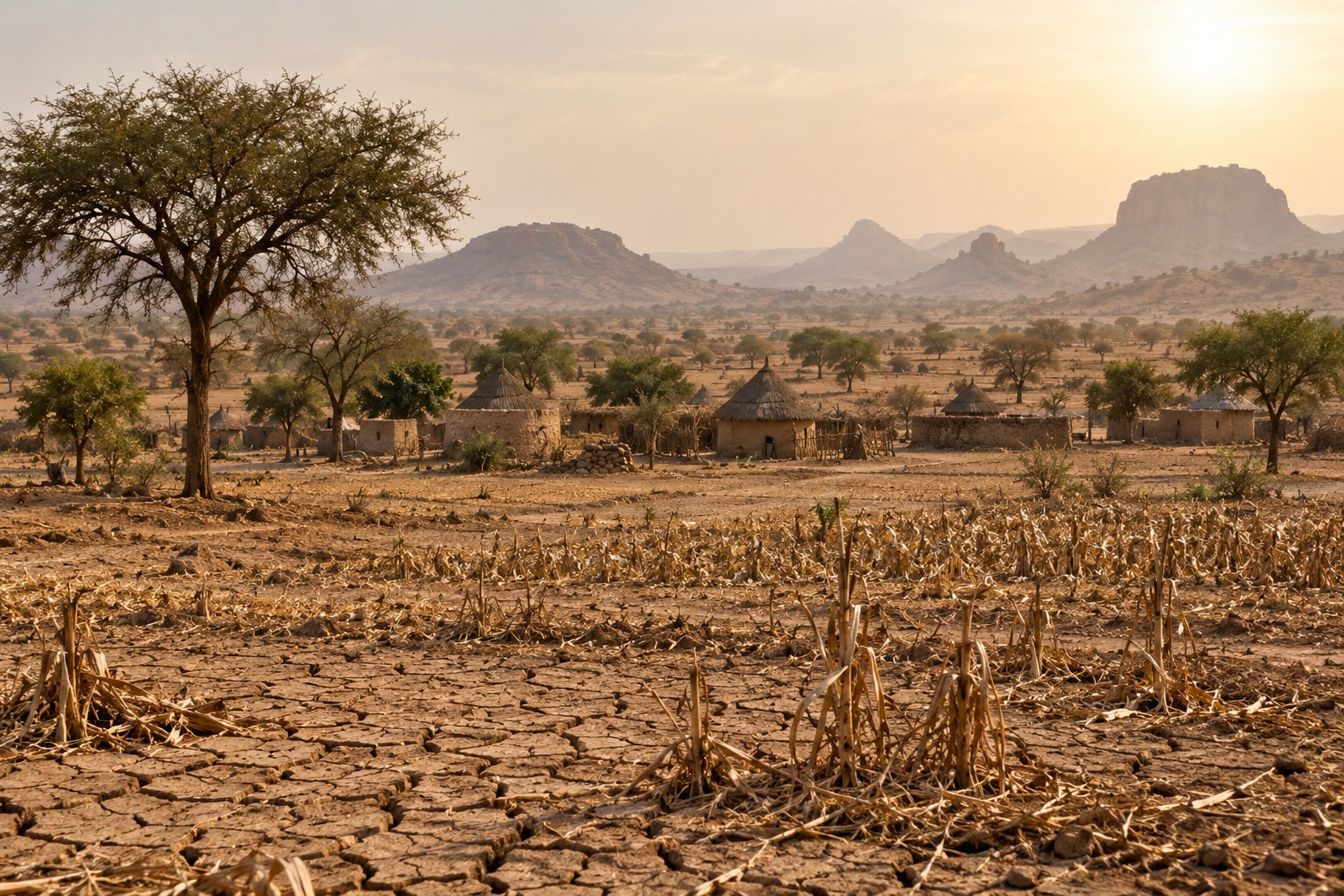
The Integrated Food Security Phase Classification (IPC) issued an Alert on 12 October 2026 warning that conflict, displacement and El Niño-induced drought are raising the risk of Famine in parts of Greater Darfur and Greater Kordofan, Sudan. Its Famine Review Committee backed the Alert but found survey data too thin for a full analysis, so no Famine is classified.
Syllabus: Prelims · Current Affairs & IR; GS2 · Poverty & Hunger; GS3 · Disaster Management
Why this matters for UPSC
GS2 (international institutions; poverty and hunger) and GS3 (food security, disasters). Prelims can ask the IPC's five phases, its three Famine thresholds and the Famine Review Committee's role; Mains, about conflict-driven hunger and humanitarian access.
Why it matters
For a displaced family in a Darfur camp, the Alert means hunger, disease and deaths are climbing while help shrinks. As of August 2026, only 26% of expected cases of severe acute malnutrition with medical complications had been treated, per the Alert, and up to two-thirds of the untreated children could die. September rains came too late for most cereal crops, so food prices are likely to keep rising. No Famine is classified, yet the Alert gives donors an early warning to act before thresholds are crossed. The larger issue is conflict-driven hunger: fighting blocks farms, markets and aid convoys, so food deliveries alone cannot end it.
Prelims pointers
- Integrated Food Security Phase Classification (IPC): multi-partner initiative developed by FAO during a 2004 crisis in Somalia; WFP and FAO are partners; it collects no data itself.
- IPC phases: 1 Minimal, 2 Stress, 3 Crisis, 4 Emergency, 5 Famine for an area (people in Phase 5 face Catastrophe); IPC maps colour areas by phase.
- Famine thresholds: 20% of households with an extreme lack of food; 30% of children acutely malnourished by weight-for-height (or 15% by MUAC); two non-trauma deaths per 10,000 daily.
- Famine Likely: applied when data are insufficient for a Famine classification but available evidence indicates Famine is likely occurring or will occur.
- Famine Review Committee: four to six independent international experts; its review is mandatory for any Famine or Famine Likely classification.
- IPC Alert: an exceptional, last-resort product issued when a full analysis cannot be done in time; it gives no new classification or population estimates.
- Declaration versus projection: Famine is declared only when current evidence meets the thresholds; it is projected when an analysis expects them to be met later.
- FAO and WFP are United Nations agencies and IPC partners; the Famine Early Warning Systems Network (FEWS NET) uses the IPC system to classify acute food insecurity.
Practise a UPSC-style question
With reference to the Integrated Food Security Phase Classification (IPC), consider the following statements:
1. It was developed by the Food and Agriculture Organization during a food crisis in Somalia.
2. It collects its own field data through survey teams it deploys in each country.
3. It classifies areas on a five-phase scale whose highest phase is Famine.
Which of the statements given above are correct?
- (a) 1 and 2 only
- (b) 2 and 3 only
- (c) 1 and 3 only
- (d) 1, 2 and 3
Show the answer
Answer: (c) 1 and 3 only
1 is correct: UN News records that FAO developed the IPC during the Somalia crisis of 2004. 2 is incorrect: the IPC collects no data itself; its information comes from humanitarian partners on the ground. 3 is correct: Famine (IPC Phase 5) is the highest phase of the IPC's acute food insecurity scale.
More from the 13 October 2026 edition
- India wants terrorist acts in UN crimes against humanity convention World & IR
- NHAI makes independent proof-checking of complex highway designs mandatory Economy
- UNGA adopts pandemic declaration; WHO Pandemic Agreement awaits PABS annex World & IR
- IMF's World Economic Outlook lifts India's 2026-27 growth forecast to 7% Economy
- Tribal Affairs Ministry launches financial literacy drive for PVTG villages National
- ECI publishes Punjab's final electoral roll after Special Intensive Revision Polity
- RSETIs get uniform training standards under MoRD pact with RUDSETI academy Economy
- Lakshadweep declared fully literate under ULLAS literacy scheme National
- IMD dedicates WebGIS cyclone and marine warning system to the nation Sci-Tech
- Army signs five-year MoU with Food Corporation of India, launches Bharat Rice National
- PM-SETU: AM/NS India pacts to upgrade nine ITIs in Surat, Visakhapatnam Economy
- RDI Fund clears first 19 fund managers, commits ₹7,131 crore Sci-Tech