
IMD dedicates WebGIS cyclone and marine warning system to the nation
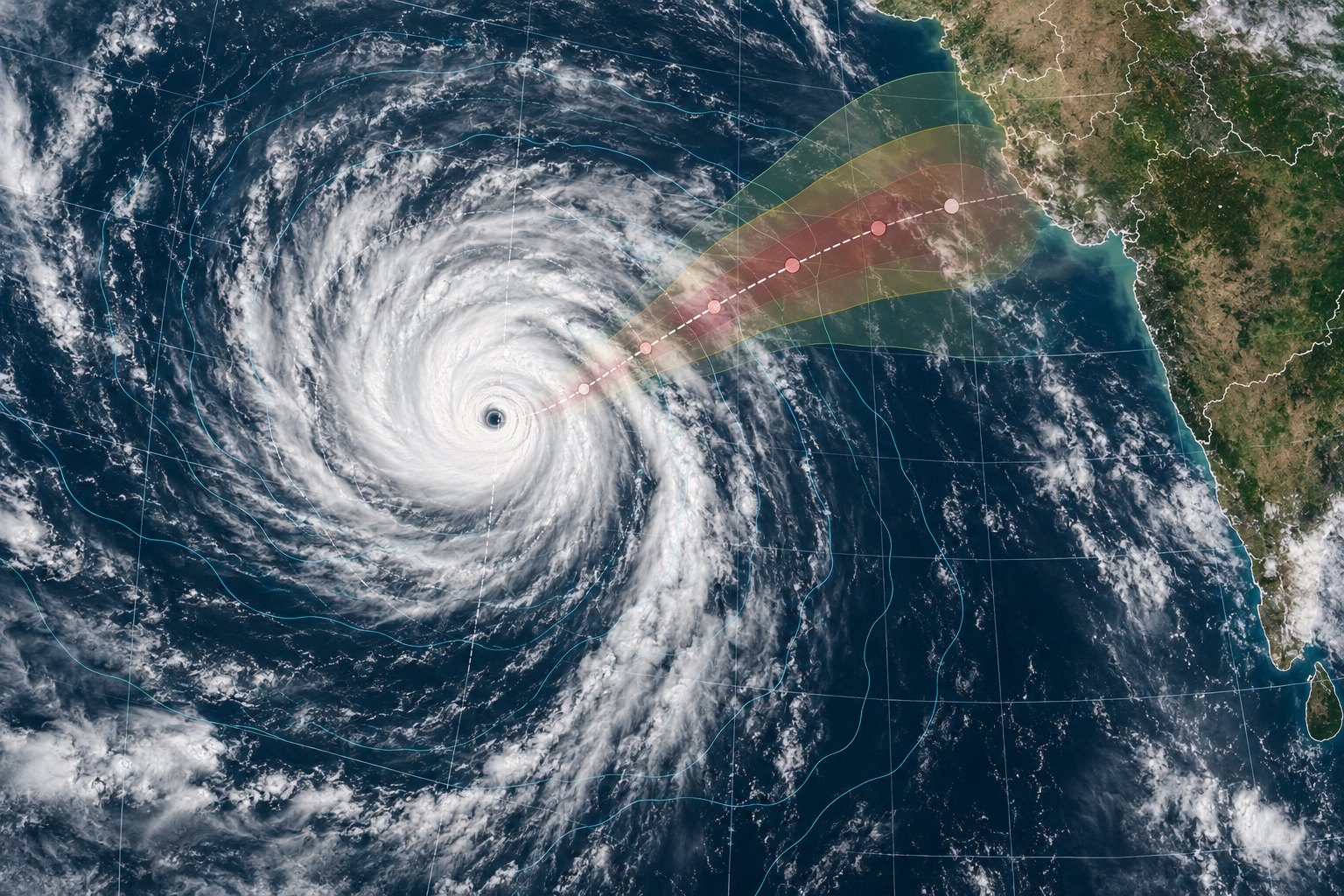
The India Meteorological Department on 12 October 2026 dedicated its Cyclone Warning and Marine Weather Services Decision Support System, a WebGIS platform, to the nation. It maps cyclone tracks and intensity with a cone of uncertainty, winds, storm surge and district-wise rainfall warnings. It was launched at the pre-cyclone exercise meeting for the October-December season.
Syllabus: Prelims · Geography; GS1 · Geophysical Phenomena; GS3 · Disaster Management
Why this matters for UPSC
GS1 (cyclones) and GS3 (disaster management, early warning): Prelims can ask what RSMC New Delhi and the WMO do, how IMD grades cyclones and what storm surge is; Mains, how forecasts become timely action on the ground.
Why it matters
A fisherman in Odisha or a district collector in Andhra Pradesh needs more than a bulletin saying a cyclone is coming. They need to know whether their own coast lies inside the likely path, how high the sea may rise and which districts face heavy rain. The new platform puts all of that on one map. A collector can then decide earlier which villages to evacuate, and fishing boats can be called back before the sea turns. Cyclones kill mostly through storm surge and flooding, so an earlier and clearer local warning saves lives. The larger issue is the last mile of disaster management: an accurate forecast helps only when the people who must act can read it.
Prelims pointers
- RSMC New Delhi: run by IMD, one of the WMO-designated Regional Specialised Meteorological Centres for tropical cyclones; covers the Bay of Bengal and the Arabian Sea.
- Cyclone names in the North Indian Ocean come from a list contributed by member countries of the WMO/ESCAP Panel on Tropical Cyclones; RSMC New Delhi assigns them.
- IMD scale: Depression, Deep Depression, Cyclonic Storm (34-47 knots), Severe, Very Severe (64-89 knots), Extremely Severe, Super Cyclonic Storm (120 knots or more).
- A system is named when it becomes a Cyclonic Storm, with maximum sustained winds of 34 knots (62 km/h) or more.
- Storm surge: sea water raised above the predicted tide by a cyclone's winds and low pressure; worst on shallow coasts such as the Bay of Bengal's head.
- The Bay of Bengal produces more cyclones than the Arabian Sea; October-December is the main cyclone season of the North Indian Ocean.
- World Meteorological Organization: a UN specialised agency headquartered in Geneva; with UNEP it set up the IPCC in 1988.
- NDMA (chaired by the Prime Minister) and NDRF were set up under the Disaster Management Act, 2005.
Practise a UPSC-style question
With reference to the Regional Specialised Meteorological Centre (RSMC) New Delhi, consider the following statements:
1. It is run by the India Meteorological Department as a centre designated by the World Meteorological Organization for tropical cyclones.
2. Its area of responsibility covers both the Bay of Bengal and the Arabian Sea.
3. It names cyclones in its region from a list contributed by member countries of the WMO/ESCAP Panel on Tropical Cyclones.
Which of the statements given above is/are correct?
- (a) 1 and 2 only
- (b) 2 and 3 only
- (c) 1 and 3 only
- (d) 1, 2 and 3
Show the answer
Answer: (d) 1, 2 and 3
1 is correct: IMD runs RSMC New Delhi, one of the WMO-designated centres for tropical cyclones. 2 is correct: its area is the North Indian Ocean, that is, the Bay of Bengal and the Arabian Sea. 3 is correct: names come from a list contributed by the member countries of the WMO/ESCAP Panel on Tropical Cyclones, and RSMC New Delhi assigns them in turn.
More from the 13 October 2026 edition
- India wants terrorist acts in UN crimes against humanity convention World & IR
- NHAI makes independent proof-checking of complex highway designs mandatory Economy
- UNGA adopts pandemic declaration; WHO Pandemic Agreement awaits PABS annex World & IR
- IPC Alert flags rising Famine risk in Sudan's Darfur and Kordofan World & IR
- IMF's World Economic Outlook lifts India's 2026-27 growth forecast to 7% Economy
- Tribal Affairs Ministry launches financial literacy drive for PVTG villages National
- ECI publishes Punjab's final electoral roll after Special Intensive Revision Polity
- RSETIs get uniform training standards under MoRD pact with RUDSETI academy Economy
- Lakshadweep declared fully literate under ULLAS literacy scheme National
- Army signs five-year MoU with Food Corporation of India, launches Bharat Rice National
- PM-SETU: AM/NS India pacts to upgrade nine ITIs in Surat, Visakhapatnam Economy
- RDI Fund clears first 19 fund managers, commits ₹7,131 crore Sci-Tech