
PRASHAST inclusion module reaches over 60,000 schools
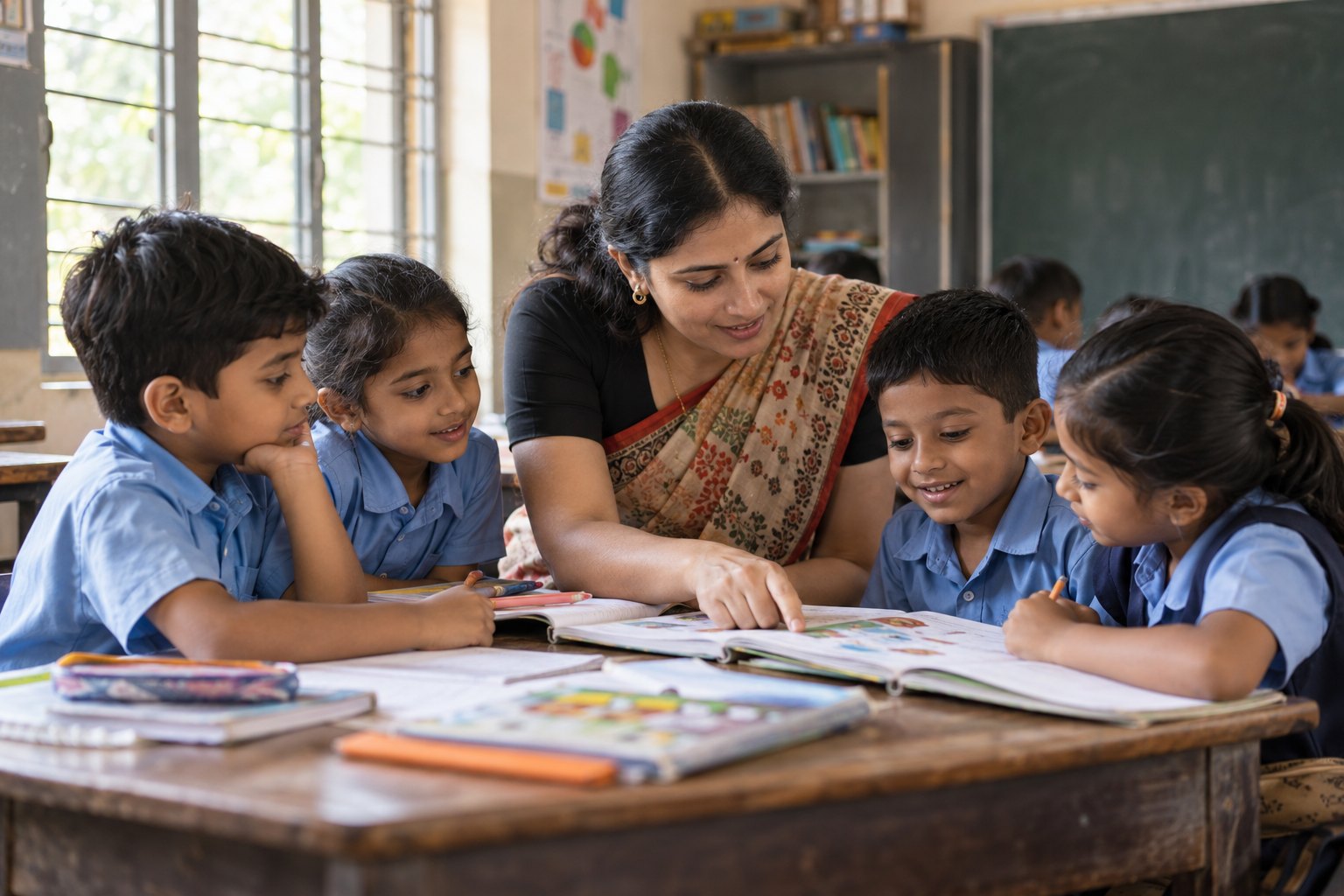
The Education Ministry said on 8 October 2026 that over 60,000 schools joined a nationwide viewing of a 30-minute inclusive-education module on its PRASHAST portal, a tool for spotting children with probable disabilities under the Rights of Persons with Disabilities Act, 2016. More than 72 lakh teachers have been sensitised through the module, which runs in 12 Indian languages.
Syllabus: GS2 · Government Policies; Prelims; GS2 · Welfare of Vulnerable Sections
Why it matters
A child with a hearing or learning disability can be enrolled in school and still be left out: by a teacher who misses the difficulty, a driver who does not wait, or a clerk who turns a parent away. Training every adult in the school, not teachers alone, is meant to close those gaps. Early screening matters as well. A teacher who spots a probable disability can send the child for assessment and certification; a certified child with a benchmark disability is entitled to free books and assistive devices up to eighteen, and examinations can be adapted with extra time or a scribe. The test of the drive is whether viewing turns into referrals, support and children who stay in school.
Prelims pointers
- Rights of Persons with Disabilities Act, 2016: recognises 21 disabilities, up from seven under the 1995 Act; benchmark disability means at least 40% of a specified disability.
- RPwD Act reservation: at least 5% of seats in government and government-aided higher education institutions, with five years' upper age relaxation; at least 4% of government job vacancies.
- RPwD Act, Section 31: every child with a benchmark disability aged 6 to 18 has a right to free education in a neighbourhood school or special school of choice.
- Article 21A, inserted by the 86th Amendment, 2002, makes free and compulsory education for children aged 6 to 14 a Fundamental Right; the RTE Act, 2009 gives it effect.
- Article 41, among the Directive Principles of State Policy: the State shall, within its economic capacity, secure the right to education and public assistance in cases of disablement.
- The 42nd Amendment, 1976 moved education from the State List to the Concurrent List; 'relief of the disabled and unemployable' remains a State List entry.
- Disability certificates: issued by certifying authorities designated by the appropriate Government, after assessment under Central Government guidelines; valid across the country.
- Sustainable Development Goals (SDGs): Goal 4 calls for inclusive and equitable quality education and lifelong learning opportunities for all.
Practise a UPSC-style question
With reference to PRASHAST, the disability screening checklist for schools, consider the following statements:
1. Part-1 is filled by regular class teachers to screen every student in a class.
2. Part-2 is meant for special educators, counsellors or school heads to carry out second-level screening.
3. Part-2 lists probable disabilities against the seven disability categories recognised by the Rights of Persons with Disabilities Act, 2016.
Which of the statements given above is/are correct?
- (a) 1 and 2 only
- (b) 2 and 3 only
- (c) 1 and 3 only
- (d) 1, 2 and 3
Show the answer
Answer: (a) 1 and 2 only
1 is correct: class teachers, helped by subject teachers, use Part-1 for first-level screening of all students in a class. 2 is correct: special educators, counsellors or school heads use Part-2 to validate the first screening and list probable disabilities. 3 is incorrect: the RPwD Act, 2016 recognises 21 disability conditions, and Part-2 uses all 21; seven was the count under the 1995 Act.
More from the 9 October 2026 edition
- Article 21 speedy trial: victims may move High Court, Supreme Court rules Polity
- UNESCO GEM report puts rural India's upper-secondary gender parity at 0.59 National
- London Convention and Protocol parties adopt marine geoengineering assessment frameworks Environment
- Ravi Canal carries 400 cusecs; J&K seeks Rs 534 crore National
- Indian Railways electrifies 99.7% of broad gauge; 191 route km remain Economy
- Coral bleaching in 2024 hit Lakshadweep's reefs hardest, study finds Environment
- Gold imports by banks lose GST exemption, attract 3% IGST Economy
- Coal stock at domestic-coal power plants falls 66% in six months Economy
- Mines Ministry launches auction of two Andaman Sea offshore mineral blocks Economy
- Centre launches ₹23,731-crore GOBARdhan scheme for compressed biogas Economy
- Andhra Pradesh declares early Kharif drought in 388 mandals, 21 districts Environment
- BNSS does not define detention; Article 22 safeguards apply on arrest Polity