
Punjab storage crunch deepens as new paddy meets old stocks
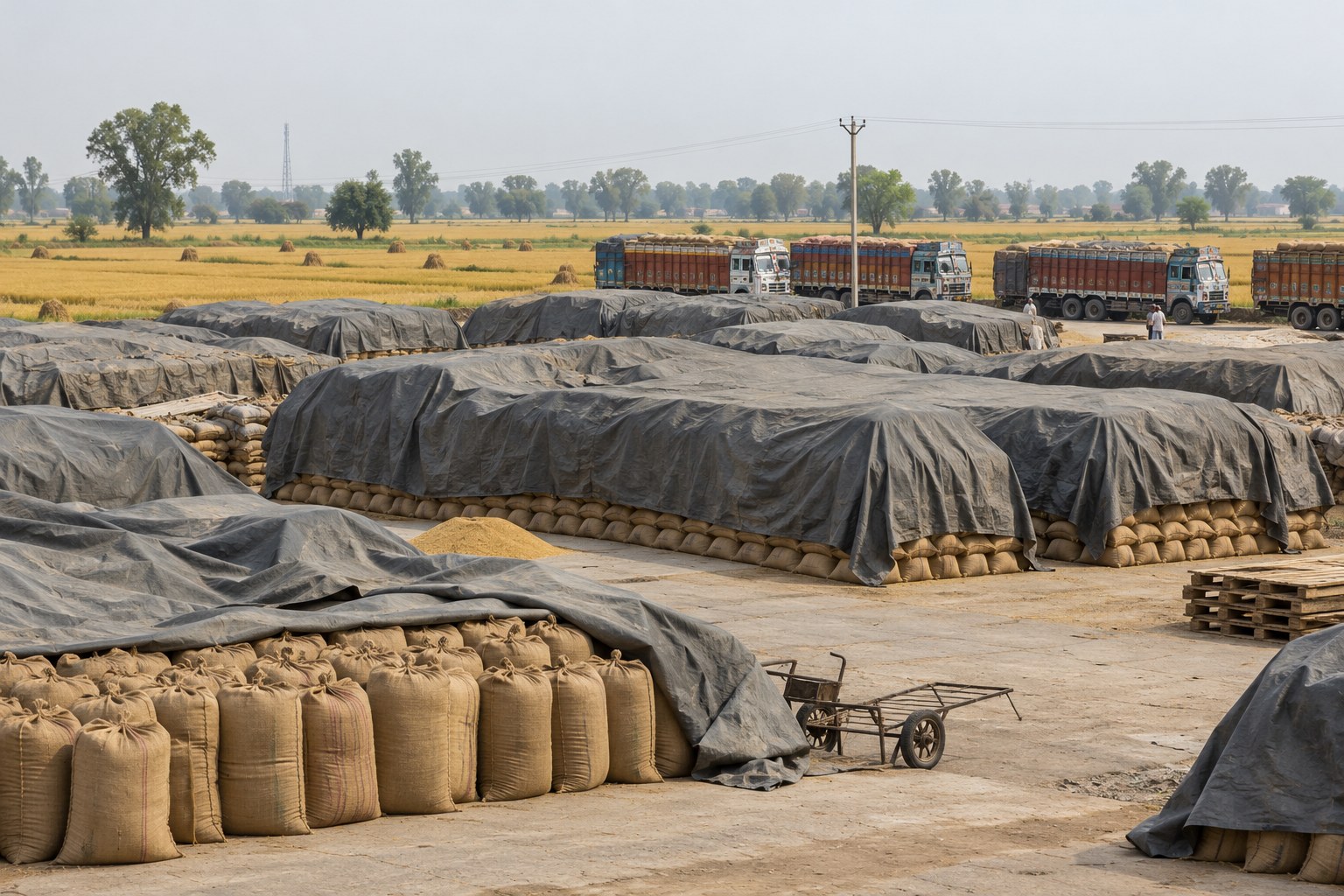
Punjab's grain storage crisis has returned as fresh paddy arrives. On September 29, nearly 6 lakh tonnes of 2025-26 Custom Milled Rice was undelivered and nearly 17 lakh tonnes of wheat lay in rice mills and mandi yards. With a 180-lakh-tonne paddy target, Chief Minister Bhagwant Mann has asked the Centre to move 21 lakh tonnes of grain in October.
Syllabus: GS3 · Agriculture & Irrigation; GS3 · MSP, Subsidies & Food Security
Why it matters
A farmer bringing paddy to a Punjab mandi this month needs room to unload it and a mill ready to take it. The Chief Minister's letter says wheat still lying in mandi yards could stop farmers from unloading, while rice mills holding that wheat would not have enough space for paddy. Millers who have not finished delivering last season's rice may decline this season's crop. The grain is bought for the central pool, which feeds the public distribution system, so a jam in Punjab matters far beyond the state. The Centre has started sending more rakes to carry older grain to other states. How fast that grain moves will decide how smoothly procurement runs.
Prelims pointers
- Custom milling: rice mills mill paddy bought by government agencies and deliver the rice, Custom Milled Rice (CMR), to the Food Corporation of India for the central pool.
- Kharif Marketing Season (KMS): the season in which paddy is procured; KMS 2026-27 opened on October 1, 2026. Wheat is procured in the Rabi Marketing Season (RMS).
- Cover and Plinth (CAP) storage: grain kept in the open on raised plinths, with wooden crates as dunnage; in Punjab it is used for wheat.
- Covered storage: fully roofed and walled structures such as godowns, warehouses and silos; milled rice in Punjab goes into covered godowns.
- Food Corporation of India: a statutory body set up under the Food Corporations Act, 1964; it procures, stores and moves food grains for the central pool.
- The FCI comes under the Department of Food and Public Distribution in the Ministry of Consumer Affairs, Food and Public Distribution.
- Central pool: food grains procured by the FCI and State government agencies, used for the public distribution system, welfare schemes and buffer stocks.
- Minimum support price (MSP): the price at which the FCI and State agencies buy paddy and wheat from farmers for the central pool.
Practise a UPSC-style question
With reference to the procurement and custom milling of paddy for the central pool, consider the following statements:
1. The season in which paddy is procured for the central pool is called the Rabi Marketing Season.
2. Government agencies buy paddy and store it in rice mills, which mill it on their behalf.
3. The mills deliver the milled rice, called Custom Milled Rice, to the agencies for the central pool.
Which of the statements given above is/are correct?
- (a) 1 and 2 only
- (b) 2 and 3 only
- (c) 1 and 3 only
- (d) 1, 2 and 3
Show the answer
Answer: (b) 2 and 3 only
1 is incorrect: paddy is a kharif crop and is procured in the Kharif Marketing Season (KMS), which opens on October 1; wheat is procured in the Rabi Marketing Season. 2 is correct: in custom milling, the agencies buy the paddy and house it in rice mills. 3 is correct: the mills return the rice to the agencies as Custom Milled Rice (CMR), and it becomes part of the central pool.
More from the 7 October 2026 edition
- NCAHP notifies autonomous boards, central assessment committee for allied health National
- India, EU formally launch Green Shipping Corridor industry coalition Environment
- First self-stabilising thorium-229 nuclear clock runs in Vienna Sci-Tech
- Defence Ministry eases industry access to DRDO and military test ranges Defence
- MoSPI releases 2026–2030 roadmap for environmental-economic accounting Environment
- Farm workers moving to cities land in low-productivity informal jobs: study Economy
- India readies NSAM 2.0 after 3D-printing push trains 1.54 lakh people Sci-Tech
- Navy's first Fleet Support Ship, FSS-1, launched at Visakhapatnam Defence
- Projectile strikes ship in Strait of Hormuz, injuring 11 Indian crew World & IR
- India, Switzerland sign mobility pacts, widen defence and nuclear cooperation World & IR
- MoSPI plans to widen monthly services index to 78.4% of services GVA Economy
- Seven-judge SC bench closes legislative privilege case, keeps free-speech questions open Polity