
Why power discoms lose money: AT&C losses, UDAY and RDSS
Why in news: The CAG has begun a single audit of 39 State-owned discoms and five power departments, reported on 13 November 2026.
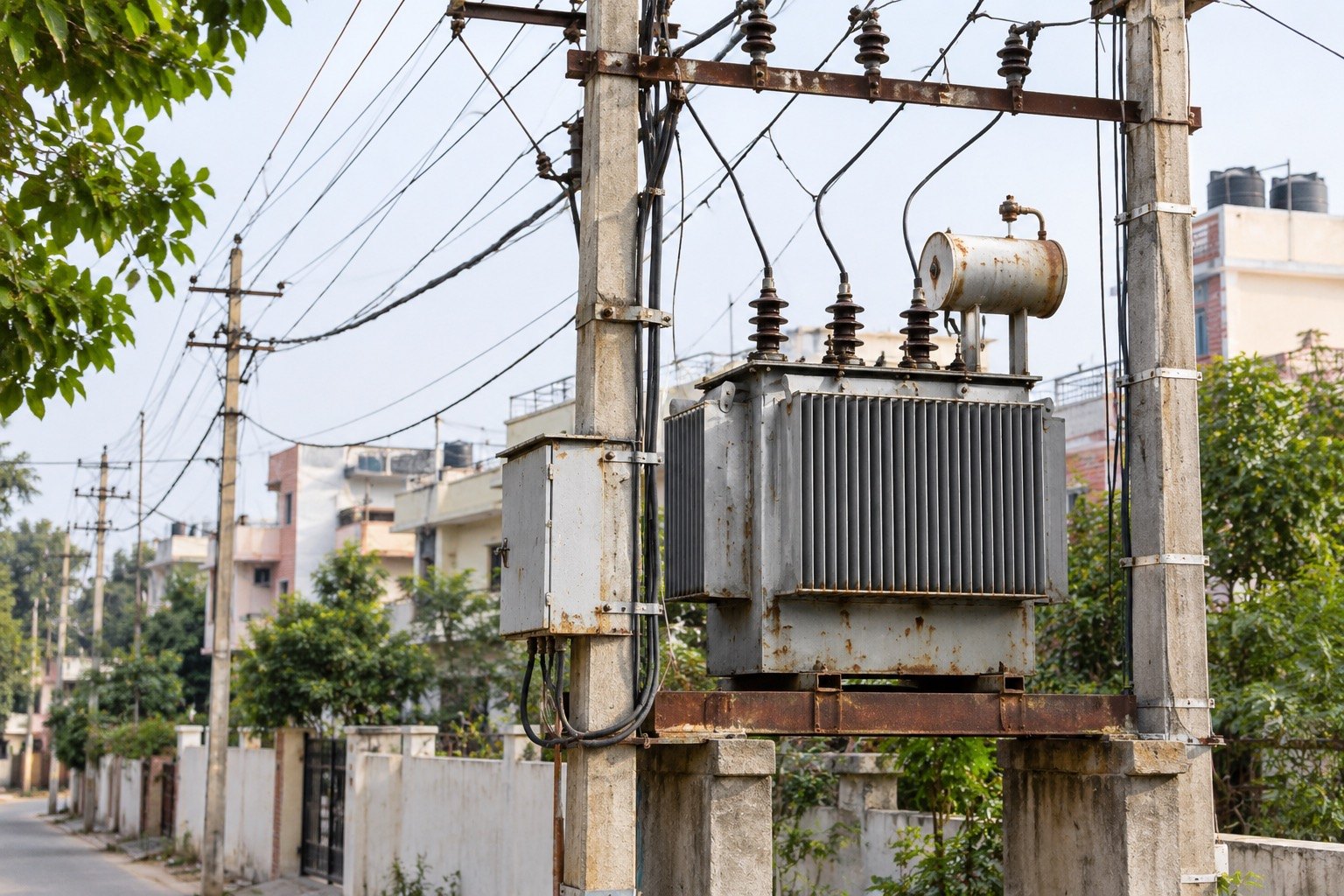
Power distribution companies (discoms) are licensees under the Electricity Act, 2003. They buy electricity and supply it to consumers in their area. They lose money when power goes unbilled or unpaid, or when each unit costs more than it earns. The Comptroller and Auditor General (CAG) has reportedly begun one audit of 39 State-owned discoms.
Syllabus: GS3 · Indian Economy & Growth; GS3 · Government Budgeting; GS2 · Constitutional Bodies
Why this matters for UPSC
GS3 infrastructure and economy: power distribution, discom finances and reform schemes. Prelims can ask UDAY and RDSS features; Mains, why discoms stay in debt.
In short
Discoms are State-owned or private licensees under the Electricity Act, 2003 that supply power to consumers; their losses and debt make distribution the power sector's weakest link.
Debt takeovers only reset the clock; discoms recover when metering, billing and purchase planning let revenue cover the full cost of supply.
Why it matters
A shopkeeper facing evening power cuts, or a farmer waiting for daytime supply, depends on a discom that can pay its own bills. When a discom collects less than it spends on each unit, it falls behind on payments to the companies that generate power and borrows to keep going. Interest then eats money that could have gone into new lines, transformers and meters. When the debt grows too large, State governments have stepped in and taken it over, so taxpayers carry the cost of losses they never saw. Cleaner billing, honest meters and timely payment are meant to break this loop, and an audit that covers every State-owned discom together can show which ones still buy costly power or leave consumers unhappy.
Prelims pointers
- Article 149 lets Parliament fix the CAG's duties and powers by law; Parliament did so through the Comptroller and Auditor General's (Duties, Powers and Conditions of Service) Act, 1971.
- Under the Companies Act, 2013, a Government company's annual report goes before the legislature with the auditors' report and the CAG's comments on it.
- UDAY (2015) moved discom debt to States and set loss targets for 2018-19; RDSS (2021) pays for supply infrastructure and smart meters against targets for 2024-25.
- RDSS leaves out private sector discoms; REC and PFC are its nodal agencies; agricultural connections get feeder meters, not prepaid consumer smart meters.
- Under UDAY, debt a State took over was kept out of its fiscal deficit for 2015-16 and 2016-17, and joining the scheme was optional.
- The CAG's commercial audit covers Government companies, deemed Government companies, statutory corporations and departmentally managed undertakings.
- The Ministry of Power treats mounting power purchase dues to generating companies as a key sign of discom financial distress.
Practise a UPSC-style question
With reference to the Ujwal DISCOM Assurance Yojana (UDAY), consider the following statements:
1. Discom debt taken over by States under the scheme was to be counted in their fiscal deficit for 2015-16 and 2016-17.
2. States were to take over 75% of discom debt outstanding on 30 September 2015, over two years.
3. The scheme was to work through a tripartite agreement among the Ministry of Power, the State government and the discom.
Which of the statements given above is/are correct?
- (a) 1 and 2 only
- (b) 2 and 3 only
- (c) 1 and 3 only
- (d) 1, 2 and 3
Show the answer
Answer: (b) 2 and 3 only
Answer: (b) 2 and 3 only. UDAY shifted most discom debt to States outside their deficit and ran through three-way agreements.
Statement 1: incorrect. The Centre agreed not to include the debt States took over under UDAY (2015) in their fiscal deficit for 2015-16 and 2016-17.
Statement 2: correct. States were to absorb 75% of discom debt held on 30 September 2015: 50% in 2015-16 and 25% in 2016-17.
Statement 3: correct. UDAY was put into effect through a tripartite agreement of the Ministry of Power, the State and its discom.
Eliminate: statement 1 is false, since the debt was kept out of the deficit. Out: (a), (c), (d).
Trap: Reversed direction. The fiscal treatment is turned around: a takeover looks as if it must swell the deficit, but UDAY kept it out for two years.
Remember: UDAY 2015: 75% of discom debt to States, outside their fiscal deficit for two years.
More Explainers
- CDRI: India's coalition for disaster-resilient infrastructure Environment
- Pichwai painting of Nathdwara, Rajasthan National
- Kerch Strait: the sea link between the Black Sea and Azov World & IR
- Wind energy in India: potential, offshore wind and the policy push Economy
- Pallikaranai marsh: a Chennai Ramsar site and its zone of influence Environment
- Andaman cobra: India's only island cobra, Endangered and endemic Environment
- International Coconut Community and India's Coconut Development Board World & IR
- Real Estate (Regulation and Development) Act, 2016: how it protects homebuyers Polity
- Open correctional institutions and the Supreme Court's 2026 directions Polity
- ICTP, Trieste: the UNESCO-IAEA centre for physics and mathematics Sci-Tech
- PJ.2.1 and how new Covid variants are classified and tracked Sci-Tech
- Berlin Conference of 1884-85 and the rules for colonising Africa World & IR