
Train derailments and railway safety: the CAG audit, RRSK and CRS
Why in news: The engine and five coaches of the Kolkata-Sairang Express derailed near Digaru in Assam's Kamrup district on 11 November 2026.
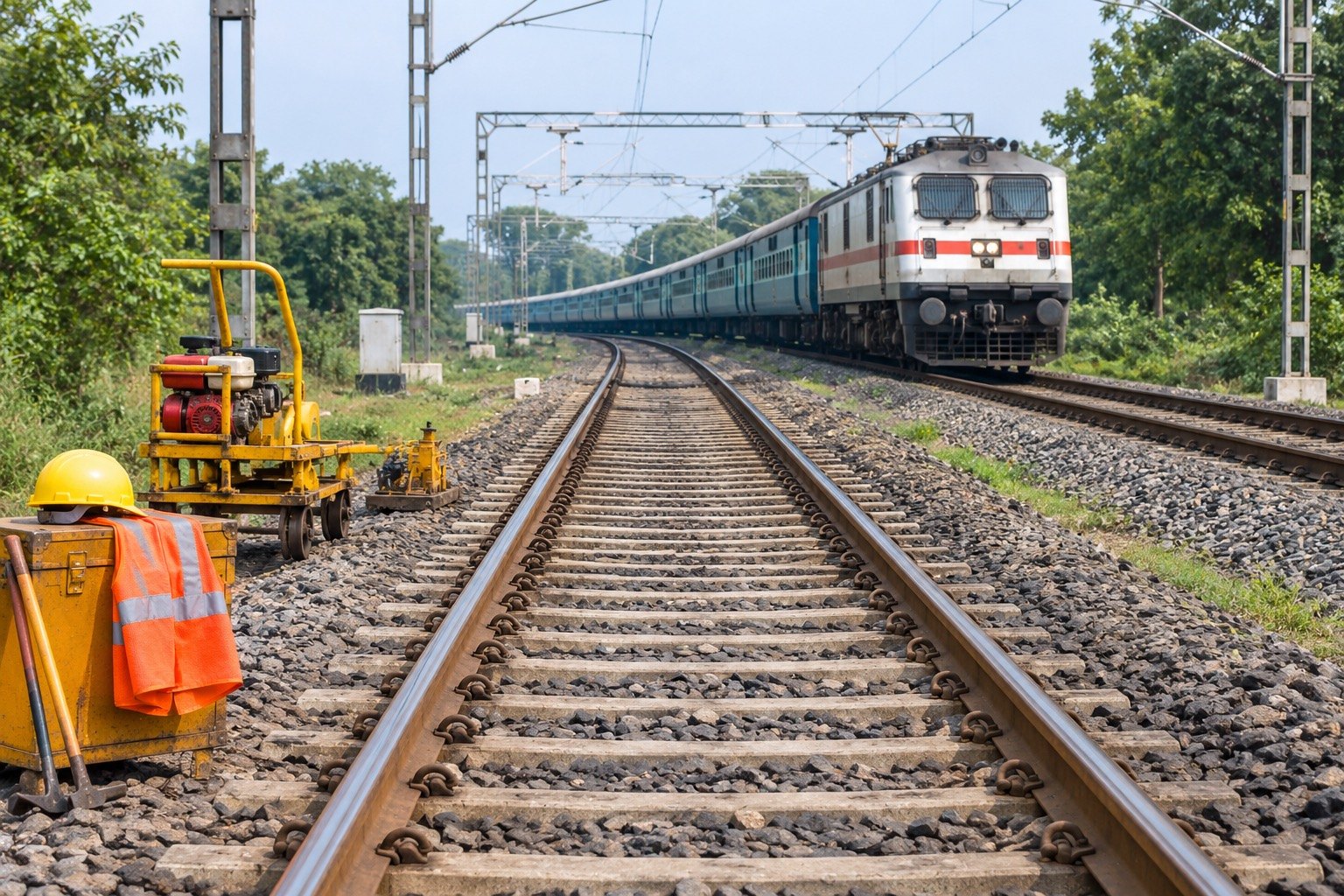
Derailments made up about 75% of the 217 consequential train accidents on Indian Railways between 2017-18 and 2020-21, the Comptroller and Auditor General (CAG) of India found in a 2022 audit. Track maintenance led its list of causes. On 11 November 2026, the engine and five coaches of the Kolkata-Sairang Express derailed near Digaru in Assam.
Syllabus: GS2 · Statutory & Regulatory Bodies; GS3 · Infrastructure; GS3 · Disaster Management
Why this matters for UPSC
GS3 infrastructure: railway safety, its funding and its audit. Prelims can ask about the CRS, RRSK and Kavach; Mains, why derailments persist.
In short
A derailment is a train leaving its rails. On Indian Railways it is the commonest serious accident, bound up with track upkeep, safety funding and how accidents are inquired into.
Kavach and falling accident counts help, but derailments will persist unless track renewal gets protected money and inquiry findings are acted on in time.
Why it matters
A passenger on any express train depends on rails, sleepers and ballast that someone must inspect, renew and pay for. When money meant for track renewal goes elsewhere, worn track stays in service longer and the chance of a wheel leaving the rail rises. When inquiry reports arrive late, the fix for one accident reaches other lines only after the same fault has had time to repeat. A derailment also shuts the line, so goods and other trains wait. The larger question is how a railway pays for safety work every year, and how its accidents are examined by a commission that answers to a different ministry from the one that runs the trains.
Prelims pointers
- Under the 1998 inquiry rules, the CRS's brief preliminary narrative report must be factual and must not refer to persons implicated.
- The RRSK's Rs 20,000 crore yearly outlay was split Rs 15,000 crore from Gross Budgetary Support and Rs 5,000 crore from the Railways' internal resources.
- The Commission of Railway Safety reports to the Ministry of Civil Aviation, while the Railway Board belongs to the Ministry of Railways.
- Under the 1998 inquiry rules, an accident to a passenger train causing a passenger's death or grievous hurt counts as a 'serious train accident'.
- If the Centre appoints a commission under the Commission of Inquiry Act, 1952 into a rail accident, the CRS halts its own inquiry and hands over the evidence.
- Kavach was adopted as India's national ATP system in July 2020; it needs the highest grade of safety certification, SIL-4.
- The Consequential Accident Index is consequential accidents divided by train kilometres run, counted in millions; PIB put it at 0.11 in 2014-15 and 0.01 in 2025-26.
Practise a UPSC-style question
With reference to the Commission of Railway Safety, consider the following statements:
1. The Commission of Railway Safety functions under the administrative control of the Ministry of Railways.
2. Its functions include authorising the opening of new railway lines and gauge conversion works.
3. It investigates serious railway accidents, besides carrying out statutory inspection of railways.
Which of the statements given above is/are correct?
- (a) 1 and 2 only
- (b) 2 and 3 only
- (c) 1 and 3 only
- (d) 1, 2 and 3
Show the answer
Answer: (b) 2 and 3 only
Answer: (b) 2 and 3 only. The CRS inspects, authorises and investigates, but it sits under another ministry.
Statement 1: incorrect. The Commission of Railway Safety works under the Ministry of Civil Aviation, not the Ministry of Railways that runs the trains.
Statement 2: correct. Authorising new railway lines, doubling of lines and gauge conversion works is among its listed functions.
Statement 3: correct. Among its tasks are statutory inspection of railways and rolling stock and the investigation of serious railway accidents.
Eliminate: statement 1 is the parent-ministry swap, so any option with 1 goes. Out: (a), (c), (d).
Trap: Swapped attribution. A railway body seems to belong to the Railway Ministry, so the question pins the CRS on it.
Remember: CRS: Ministry of Civil Aviation; Railway Board: Ministry of Railways.
More Explainers
- CDRI: India's coalition for disaster-resilient infrastructure Environment
- Pichwai painting of Nathdwara, Rajasthan National
- Kerch Strait: the sea link between the Black Sea and Azov World & IR
- Wind energy in India: potential, offshore wind and the policy push Economy
- Pallikaranai marsh: a Chennai Ramsar site and its zone of influence Environment
- Andaman cobra: India's only island cobra, Endangered and endemic Environment
- International Coconut Community and India's Coconut Development Board World & IR
- Real Estate (Regulation and Development) Act, 2016: how it protects homebuyers Polity
- Open correctional institutions and the Supreme Court's 2026 directions Polity
- ICTP, Trieste: the UNESCO-IAEA centre for physics and mathematics Sci-Tech
- PJ.2.1 and how new Covid variants are classified and tracked Sci-Tech
- Berlin Conference of 1884-85 and the rules for colonising Africa World & IR