
Taiwan Strait: the waterway, the island and the status quo
Why in news: The G7 foreign ministers' declaration of 11 November 2026 said China's activities east of Taiwan threaten regional stability and shipping safety.
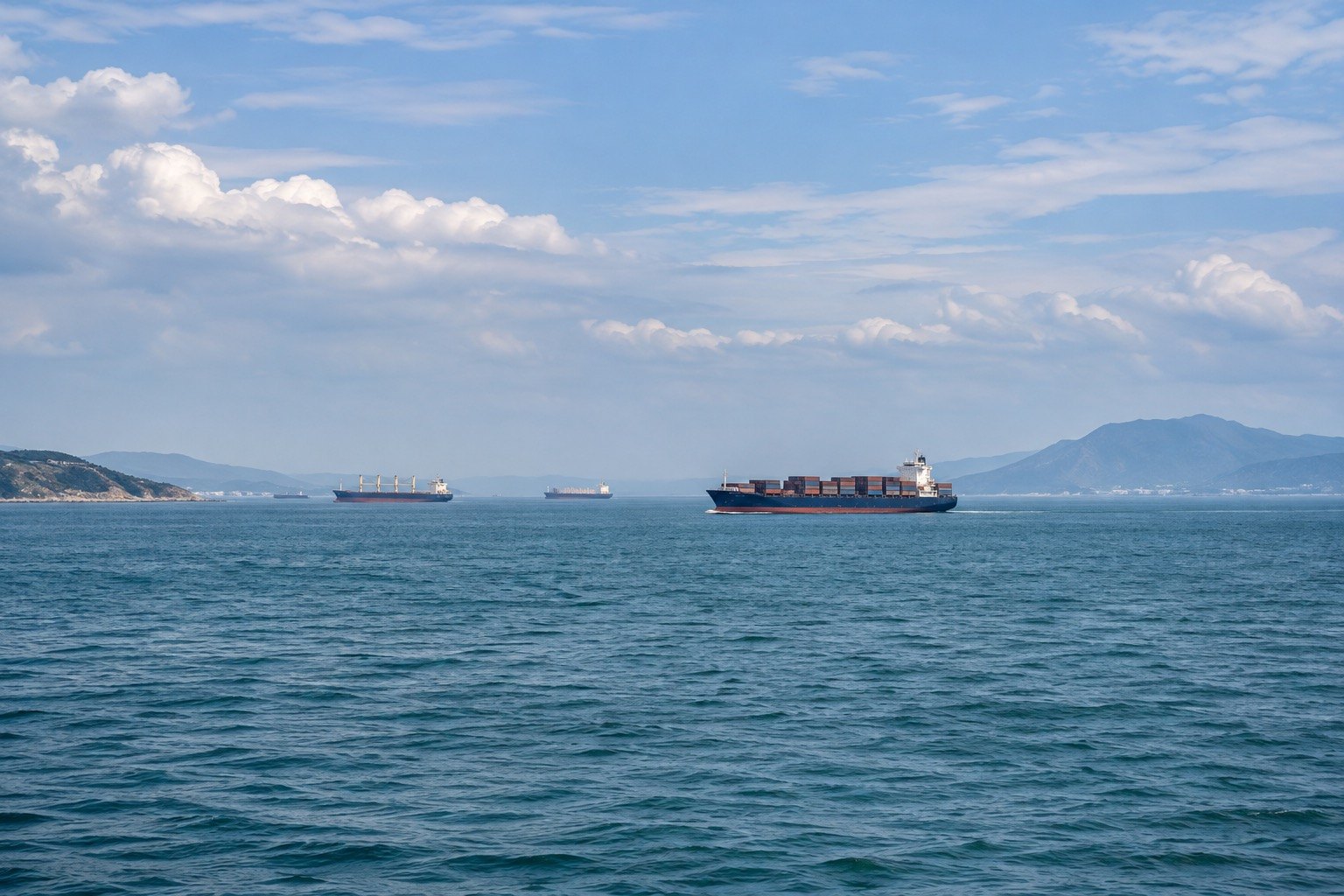
The Taiwan Strait is the sea between the island of Taiwan and mainland China. Beijing treats Taiwan as part of China, a claim Taipei rejects. In 1971 the UN General Assembly gave China's seat to the People's Republic. The G7 has now warned that Chinese activity in the waters east of the island endangers shipping.
Syllabus: Prelims · Current Affairs & IR; Prelims · Geography; GS2 · Foreign Policies & the Diaspora
Why this matters for UPSC
GS2 international relations: the Indo-Pacific, the G7 and the UN's China seat. Prelims can ask what Resolution 2758 decided; Mains, freedom of navigation near Taiwan.
In short
The Taiwan Strait divides Taiwan from mainland China. Beijing claims the island; Taipei disputes it. A peaceful status quo there is central to Indo-Pacific stability.
Peace across the Taiwan Strait rests on restraint at sea: patrols must not harden into a blockade, and disputes belong in dialogue under maritime law.
Why it matters
A ship captain carrying goods through East Asia depends on calm seas and predictable rules. If patrols near Taiwan turn into a blockade, cargo could be stopped, rerouted or insured at much higher cost, and supply chains far from the island would feel it. For the people of Taiwan, the eastern waters are a lifeline in a crisis, since help from partners would come that way. For governments, the question is whether a dispute over territory is settled by talks or by pressure. That choice shapes peace across the whole Indo-Pacific, where many countries rely on open sea lanes.
Prelims pointers
- The G7 comprises Canada, France, Germany, Italy, Japan, the United Kingdom and the United States; the European Union's High Representative joins its foreign ministers' meetings.
- Resolution 2758 was a General Assembly resolution, not a Security Council one; it settled who represents China, while admitting a new member needs a Security Council recommendation.
- Bhutan joined the UN on 21 September 1971, at the same twenty-sixth session that later adopted Resolution 2758; Bahrain, Qatar and Oman were also admitted then.
- The People's Republic of China is one of the five permanent members of the UN Security Council, a status Resolution 2758 recorded.
- The G7 cites the United Nations Convention on the Law of the Sea (UNCLOS) as reflecting States' duties at sea, including freedom of navigation and overflight.
- In its Indo-Pacific section the G7 calls the Arbitral Tribunal award of 12 July 2016 final and legally binding on the parties to those proceedings.
Practise a UPSC-style question
Consider the following statements about the Group of Seven (G7):
1. Canada, Italy and Japan are among its members.
2. Russia sits in the G7 as a full member alongside the United States.
3. Italy holds the grouping's rotating presidency for the year 2026.
Which of the statements given above is/are correct?
- (a) 1 only
- (b) 2 only
- (c) 3 only
- (d) 1, 2 and 3
Show the answer
Answer: (a) 1 only
Answer: (a) 1 only. Only the first statement matches the G7's membership and its 2026 presidency.
Statement 1: correct. The G7 foreign ministers represent Canada, France, Germany, Italy, Japan, the United Kingdom and the United States.
Statement 2: incorrect. Russia is not listed; the seven members are Canada, France, Germany, Italy, Japan, the UK and the US.
Statement 3: incorrect. The ministers met in Paris under the 2026 French G7 Presidency, so France, not Italy, holds it.
Eliminate: statement 2 is wrong because Russia is not among the seven. Out: (b), (d).
Eliminate: statement 3 is wrong because France holds the 2026 presidency. Out: (c).
Trap: Swapped attribution. The presidency is pinned on another member, Italy, which is a real G7 country, so the statement sounds plausible.
Remember: G7 = Canada, France, Germany, Italy, Japan, UK, US; France presided in 2026.
More Explainers
- CDRI: India's coalition for disaster-resilient infrastructure Environment
- Pichwai painting of Nathdwara, Rajasthan National
- Kerch Strait: the sea link between the Black Sea and Azov World & IR
- Wind energy in India: potential, offshore wind and the policy push Economy
- Pallikaranai marsh: a Chennai Ramsar site and its zone of influence Environment
- Andaman cobra: India's only island cobra, Endangered and endemic Environment
- International Coconut Community and India's Coconut Development Board World & IR
- Real Estate (Regulation and Development) Act, 2016: how it protects homebuyers Polity
- Open correctional institutions and the Supreme Court's 2026 directions Polity
- ICTP, Trieste: the UNESCO-IAEA centre for physics and mathematics Sci-Tech
- PJ.2.1 and how new Covid variants are classified and tracked Sci-Tech
- Berlin Conference of 1884-85 and the rules for colonising Africa World & IR