
Rice fortification: fortified kernels, FSSAI standards and welfare schemes
Why in news: CSIR-CFTRI, Mysuru, held the NutriQA-2026 colloquium on 13 November 2026 to harmonise laboratory testing of iron, vitamin B9 and vitamin B12 in fortified rice.
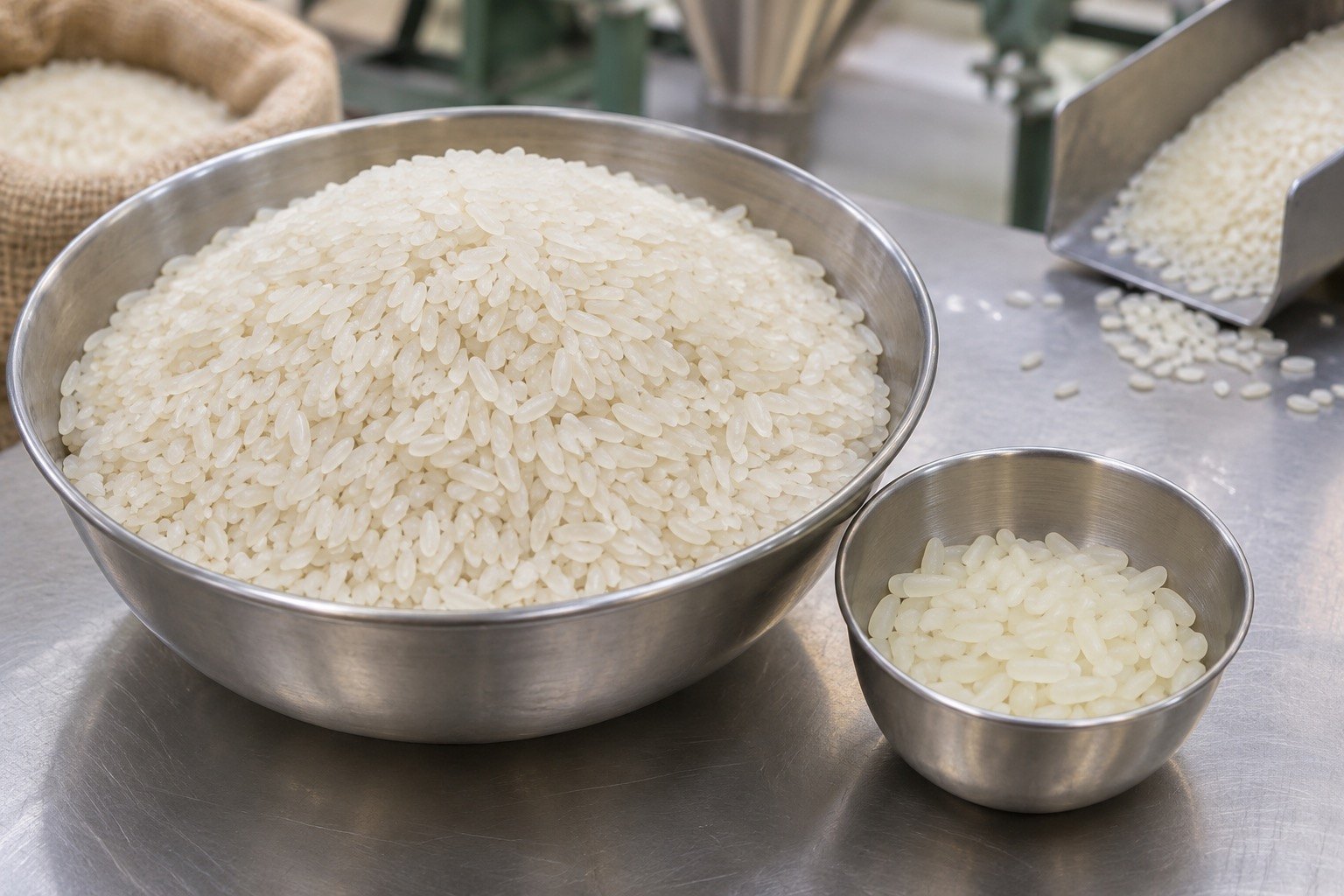
Rice fortification adds iron, folic acid and vitamin B12 to rice by blending Fortified Rice Kernels with ordinary milled rice at 1% by weight, to standards set by FSSAI. The Centre supplies such rice through TPDS, ICDS and PM POSHAN, fully funded until December 2028. A Mysuru colloquium on 13 November 2026 sought uniform laboratory testing of these nutrients.
Syllabus: GS3 · MSP, Subsidies & Food Security; GS2 · Welfare of Vulnerable Sections; GS2 · Health, Education & Human Resources
Why this matters for UPSC
GS2 welfare schemes and GS3 food security and the Public Distribution System. Prelims asks fortified rice's nutrients, FSSAI's role and funding; Mains, its place against anaemia.
In short
Rice fortification adds iron, folic acid and vitamin B12 to a staple eaten by about 65% of Indians. FSSAI's 2018 Regulations fix its standards; central welfare schemes carry it.
Rice fortification is a sound complementary tool against anaemia; its worth now rests on uniform laboratory testing, transparent safety evidence and tracking of health outcomes.
Why it matters
A child eating a school meal, a mother at an anganwadi and a family collecting ration rice now receive iron, folic acid and vitamin B12 without changing what they cook or eat. That matters because anaemia and vitamin deficiencies remain common across ages and incomes, sapping energy at school and at work. Because the extra nutrients travel through grain the state already hands out, the reach is wide at little added effort for the household. The benefit holds only if each batch actually carries the promised dose: a kernel short of iron, or a laboratory that measures it wrongly, quietly defeats the purpose. Fortification is one of several tools against hidden hunger, alongside a varied diet and health care.
Prelims pointers
- The Food Authority may specify mandatory fortification of any staple food on the direction of the Government of India, under the 2018 Fortification Regulations.
- Where iron is added as a nutrient, heme iron may not be used in any form in any article of food.
- Fortified rice may also carry zinc, vitamin A and the vitamins B1, B2, B3 and B6, singly or in combination, as optional nutrients.
- Iodised salt fortified with iodine is exempt from the rule that a fortified pack must carry the "fortified with" words and the logo.
- Look-alike: the 2019-20 pilot was a Centrally Sponsored Pilot Scheme; since July 2024 rice fortification runs as a central sector initiative with 100% central funding.
- Iron as ferric pyrophosphate is added at a higher level than sodium iron EDTA to make up for its lower bioavailability.
- PM POSHAN, which carries fortified rice into school meals, was earlier the Mid-Day Meal Scheme.
Practise a UPSC-style question
With reference to the Food Safety and Standards (Fortification of Foods) Regulations, 2018, consider the following statements:
1. Rice, when fortified, must contain added iron, folic acid and vitamin B12 within prescribed ranges.
2. Heme iron is a permitted source of iron for fortifying rice under these Regulations.
3. The Food Authority may make fortification of a staple food mandatory on the direction of the Government of India.
Which of the statements given above is/are correct?
- (a) 1 and 2 only
- (b) 2 and 3 only
- (c) 1 and 3 only
- (d) 1, 2 and 3
Show the answer
Answer: (c) 1 and 3 only
Answer: (c) 1 and 3 only. The Regulations fix rice's three nutrients and let the Food Authority mandate fortification; heme iron is barred.
Statement 1: correct. FSSAI's 2018 Regulations set per-kilogram ranges for iron, folic acid and vitamin B12 in fortified rice.
Statement 2: incorrect. The Regulations bar heme iron in any form in any article of food where iron is used as a nutrient.
Statement 3: correct. The Food Authority may specify mandatory fortification of any staple food when the Government of India directs it.
Eliminate: statement 2 is the surest; the ban on heme iron is explicit. Out: (a), (b), (d).
Trap: Sounds right. Heme iron sounds like a natural, harmless iron source, but the Regulations exclude it in any form.
Remember: Fortified rice = iron + folic acid + B12; heme iron is never allowed.
More Explainers
- CDRI: India's coalition for disaster-resilient infrastructure Environment
- Pichwai painting of Nathdwara, Rajasthan National
- Kerch Strait: the sea link between the Black Sea and Azov World & IR
- Wind energy in India: potential, offshore wind and the policy push Economy
- Pallikaranai marsh: a Chennai Ramsar site and its zone of influence Environment
- Andaman cobra: India's only island cobra, Endangered and endemic Environment
- International Coconut Community and India's Coconut Development Board World & IR
- Real Estate (Regulation and Development) Act, 2016: how it protects homebuyers Polity
- Open correctional institutions and the Supreme Court's 2026 directions Polity
- ICTP, Trieste: the UNESCO-IAEA centre for physics and mathematics Sci-Tech
- PJ.2.1 and how new Covid variants are classified and tracked Sci-Tech
- Berlin Conference of 1884-85 and the rules for colonising Africa World & IR