
Pradhan Mantri Janjatiya Vikas Mission: Van Dhan Kendras and MSP for MFP
Why in news: PIB published a backgrounder on PMJVM on 14 November 2026, ahead of Janjatiya Gaurav Diwas on 15 November, Birsa Munda's birth anniversary.
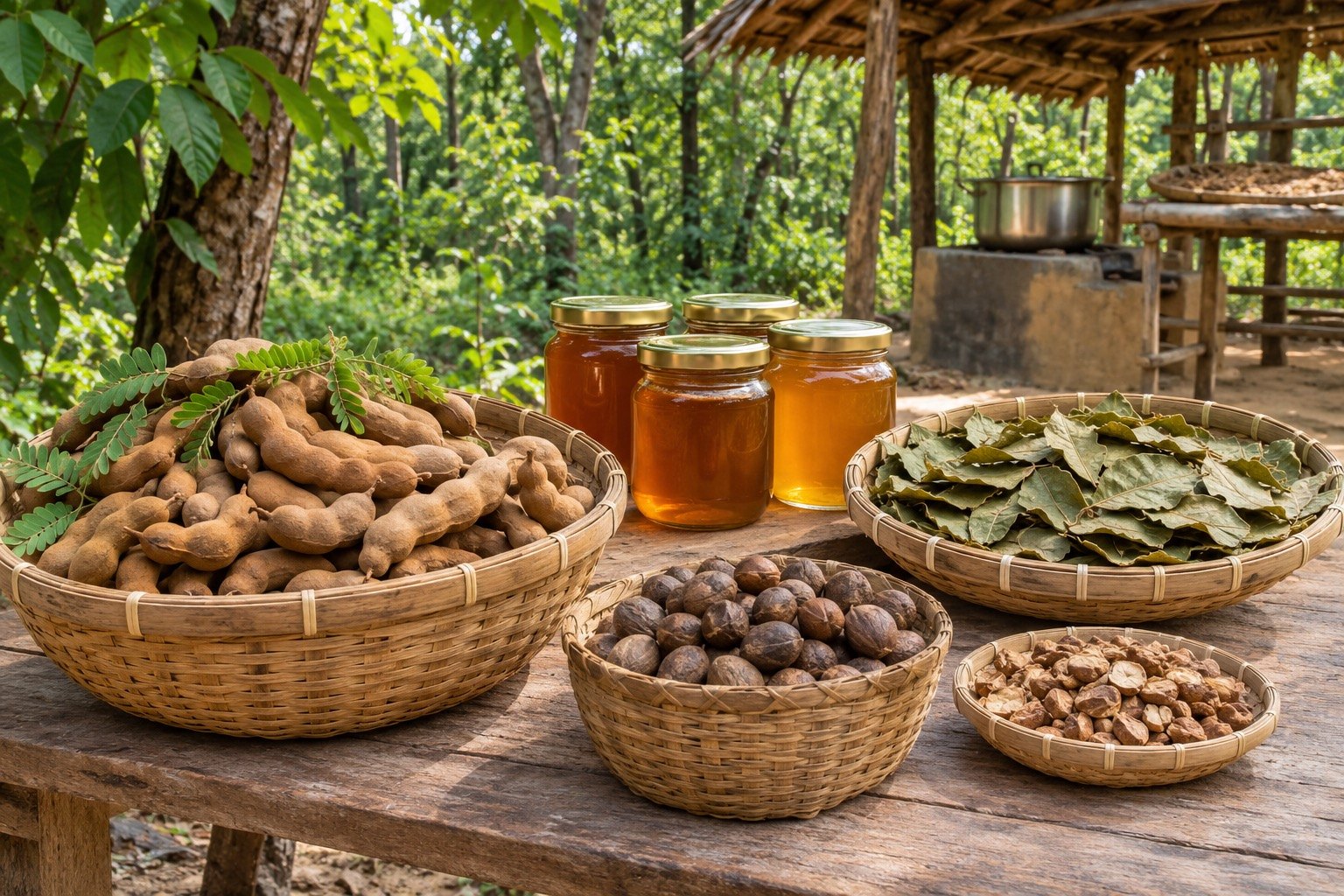
The Pradhan Mantri Janjatiya Vikas Mission (PMJVM), a Ministry of Tribal Affairs scheme run through TRIFED since 2021-22, buys minor forest produce from tribal gatherers at a minimum support price. It also groups them into Van Dhan Vikas Kendras that process and sell the produce. PIB set out the mission on 14 November 2026, ahead of Janjatiya Gaurav Diwas.
Syllabus: GS3 · MSP, Subsidies & Food Security; GS2 · NGOs, SHGs & Civil Society; GS2 · Welfare of Vulnerable Sections
Why this matters for UPSC
GS2 welfare schemes for vulnerable sections and GS3 minimum support prices: PMJVM and minor forest produce. Prelims asks the ministry, TRIFED's role and the VDVK model; Mains asks about tribal livelihoods and forest rights.
In short
The Pradhan Mantri Janjatiya Vikas Mission (PMJVM) is the Ministry of Tribal Affairs' tool for turning tribal ownership of minor forest produce into assured prices and enterprise income.
PMJVM can make forest rights pay only if MSP buying is timely and sanctioned kendras become working enterprises that tribal women own and run.
Why it matters
A tribal woman who gathers tamarind or mahua flowers has often had to accept whatever a passing trader offered. A notified floor price gives her a fallback: when traders bid low, a State agency is meant to buy at the set rate, so one buyer no longer decides her season's earnings. When her self-help group cleans, dries and packs the produce at a Van Dhan centre, the group keeps the margin a middleman used to take. PIB notes that women do most of the collecting and selling, so the extra money reaches them directly. The wider question is whether the forest rights written into law turn into steady income, or stay on paper while traders hold the market.
Prelims pointers
- The Forest Rights Act, 2006 protects the MFP right for produce traditionally gathered within or outside village boundaries, and covers both Scheduled Tribes and other traditional forest dwellers.
- Look-alike laws: the Forest Rights Act, 2006 recognises forest dwellers' right to own and sell MFP; PESA, 1996 vests MFP ownership in Gram Panchayats in Scheduled Areas.
- MSP for MFP covers non-nationalised, non-timber produce; it is a reactive floor, used when market prices fall below the notified price.
- Losses on MSP procurement are made good by the Ministry of Tribal Affairs and the State in a 75:25 ratio; any profit goes to the ST gatherers.
- The MSP-for-MFP programme began in 2013-14; its Van Dhan Yojana component was launched on 14 April 2018.
- Van Dhan Producer Enterprises are profit-oriented legal entities formed by VDVK members, supported on the pattern of the Agriculture Ministry's Farmer Producer Organisation scheme.
- TRIFED markets tribal produce and runs PMJVM; the National Scheduled Tribes Finance and Development Corporation (NSTFDC) is a channel for VDVK working capital.
Practise a UPSC-style question
With reference to the Pradhan Mantri Janjatiya Vikas Mission (PMJVM), consider the following statements:
1. It is implemented by the Ministry of Rural Development through the National Rural Livelihoods Mission.
2. It is a Central Sector Scheme in which the Centre gives full grant-in-aid to TRIFED.
3. It was formed by merging the MSP-for-MFP value-chain scheme with institutional support for tribal products.
Which of the statements given above is/are correct?
- (a) 1 and 2 only
- (b) 2 and 3 only
- (c) 1 and 3 only
- (d) 1, 2 and 3
Show the answer
Answer: (b) 2 and 3 only
Answer: (b) 2 and 3 only. PMJVM belongs to the Ministry of Tribal Affairs, which runs it through TRIFED.
Statement 1: incorrect. The Ministry of Tribal Affairs implements PMJVM, with TRIFED as the central nodal agency working through State agencies.
Statement 2: correct. The PMJVM guidelines call it a Central Sector Scheme with 100% grant-in-aid from the Government of India to TRIFED.
Statement 3: correct. The guidelines say PMJVM was conceived by merging the MSP-for-MFP and value-chain scheme with the Institutional Support for Development and Marketing of Tribal Products.
Eliminate: Statement 1 credits the wrong ministry. Out: (a), (c), (d).
Trap: Swapped attribution. A livelihood mission sounds like Rural Development's work, but PMJVM is a Tribal Affairs scheme delivered by TRIFED.
Remember: PMJVM = Ministry of Tribal Affairs + TRIFED, Central Sector, 2021-22 to 2025-26.
More Explainers
- CDRI: India's coalition for disaster-resilient infrastructure Environment
- Pichwai painting of Nathdwara, Rajasthan National
- Kerch Strait: the sea link between the Black Sea and Azov World & IR
- Wind energy in India: potential, offshore wind and the policy push Economy
- Pallikaranai marsh: a Chennai Ramsar site and its zone of influence Environment
- Andaman cobra: India's only island cobra, Endangered and endemic Environment
- International Coconut Community and India's Coconut Development Board World & IR
- Real Estate (Regulation and Development) Act, 2016: how it protects homebuyers Polity
- Open correctional institutions and the Supreme Court's 2026 directions Polity
- ICTP, Trieste: the UNESCO-IAEA centre for physics and mathematics Sci-Tech
- PJ.2.1 and how new Covid variants are classified and tracked Sci-Tech
- Berlin Conference of 1884-85 and the rules for colonising Africa World & IR