
Pax Silica: US-led coalition for secure chip and mineral supply chains
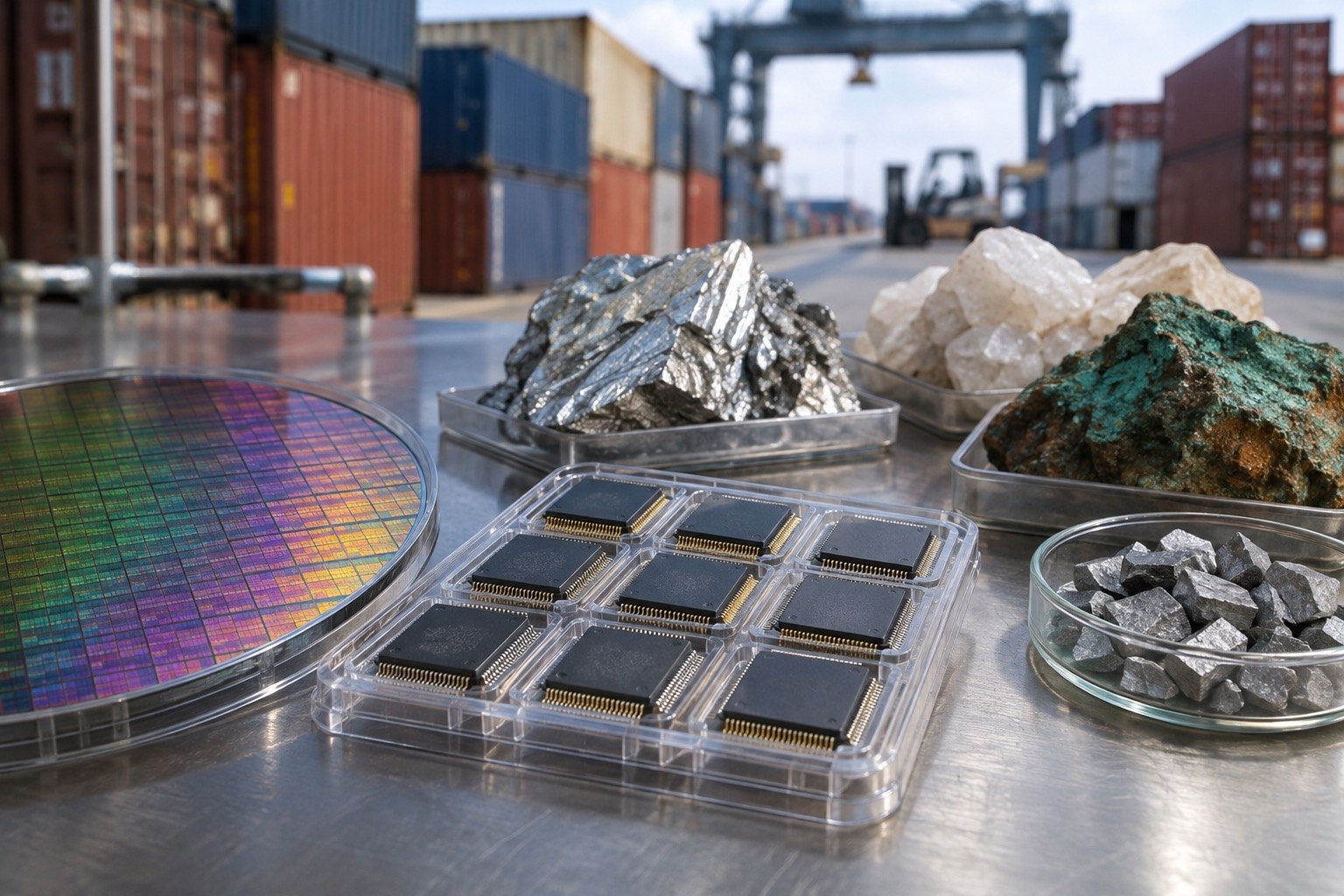
Pax Silica is a US-led coalition whose members sign a declaration to secure the supply chains behind artificial intelligence, from critical minerals and energy to semiconductors and logistics. India signed on 20 February 2026 as its tenth signatory. Its Declaration also stresses protecting sensitive technologies from undue access, influence or control.
Syllabus: GS3 · Indian Economy & Growth; Prelims · Current Affairs & IR; GS3 · Science & Technology
Why this matters for UPSC
GS2 international relations and GS3 technology: groupings on semiconductors, AI and critical minerals. Prelims can ask Pax Silica's members and aims; Mains, India's supply-chain security.
In short
Pax Silica is a US-led coalition, built on a signed declaration, that seeks to secure the supply chains of artificial intelligence, from critical minerals and energy to semiconductors.
Pax Silica can anchor India's chip and mineral ambitions, but its worth rests on building capacity at home while guarding strategic autonomy.
Why it matters
A phone assembler, a data-centre builder or a start-up training an AI model all rely on chips and minerals whose supply sits in few hands. When one supplier controls a step, it can cut supply or use it as pressure, and factories elsewhere stall. Pax Silica tries to spread that risk across trusted partners, so that a shock in one place does not halt production everywhere. For India, a seat in the coalition can bring investment, technology and partners for mineral deals, and help draw chip plants home. It also draws India closer to US-led technology rules, a choice that carries costs as well as gains for its strategic autonomy.
Prelims pointers
- The State Department explains 'Pax' as a historical term for peace, stability and prosperity, applied here to the foundations of modern computing.
- Canada was named among countries gathering for the December 2025 Pax Silica Summit but is not on the signatory list as of 13 November 2026.
- Pax Silica spans minerals to AI infrastructure; the separate US-led Mineral Security Partnership, which India's Ministry of Mines joined, focuses on critical-mineral supply chains.
- Khanij Bidesh India Ltd (KABIL) draws its equity from three Central PSUs: National Aluminium Company, Hindustan Copper and Mineral Exploration and Consultancy Ltd.
- India Semiconductor Mission projects are cleared by the Union Cabinet; it had 12 approved projects worth about Rs 1.64 lakh crore as of May 2026.
- Signatories range beyond the West: Qatar, the United Arab Emirates, Kazakhstan, the Philippines and Latin American states such as Chile and Panama are listed.
Practise a UPSC-style question
With reference to Pax Silica, consider the following statements:
1. It is described by the United States Department of State as a US-led initiative on supply-chain security.
2. The State Department announced its December 2025 launch summit for Tokyo, hosted by Japan.
3. The European Union is listed among the signatories of the Pax Silica Declaration.
Which of the statements given above is/are correct?
- (a) 1 and 2 only
- (b) 2 and 3 only
- (c) 1 and 3 only
- (d) 1, 2 and 3
Show the answer
Answer: (c) 1 and 3 only
Answer: (c) 1 and 3 only. The State Department leads Pax Silica and lists the EU as a signatory; the launch summit was set for Washington.
Statement 1: correct. The State Department's own page calls Pax Silica a U.S. led initiative and its flagship effort on supply-chain security.
Statement 2: incorrect. The State Department's notice of 11 December 2025 placed the Pax Silica Summit in Washington, D.C., not Tokyo; Japan was one of the partners.
Statement 3: correct. The signatory list on the State Department's page, as of 13 November 2026, names the European Union beside individual countries.
Eliminate: Statement 2 is wrong because the summit was in Washington, D.C. Out: (a), (b), (d).
Trap: Swapped attribution. Japan is a founding partner, so a Tokyo venue looks natural; the host and venue were the United States.
Remember: Pax Silica is US-led, launched in Washington, D.C., and the EU signs as a bloc.
More Explainers
- CDRI: India's coalition for disaster-resilient infrastructure Environment
- Pichwai painting of Nathdwara, Rajasthan National
- Kerch Strait: the sea link between the Black Sea and Azov World & IR
- Wind energy in India: potential, offshore wind and the policy push Economy
- Pallikaranai marsh: a Chennai Ramsar site and its zone of influence Environment
- Andaman cobra: India's only island cobra, Endangered and endemic Environment
- International Coconut Community and India's Coconut Development Board World & IR
- Real Estate (Regulation and Development) Act, 2016: how it protects homebuyers Polity
- Open correctional institutions and the Supreme Court's 2026 directions Polity
- ICTP, Trieste: the UNESCO-IAEA centre for physics and mathematics Sci-Tech
- PJ.2.1 and how new Covid variants are classified and tracked Sci-Tech
- Berlin Conference of 1884-85 and the rules for colonising Africa World & IR