
Gondhal: Maharashtra's ritual folk performance
Why in news: The Marathi film Gondhal, built around the ritual, is India's official Oscar entry for Best International Feature Film (14 November 2026).
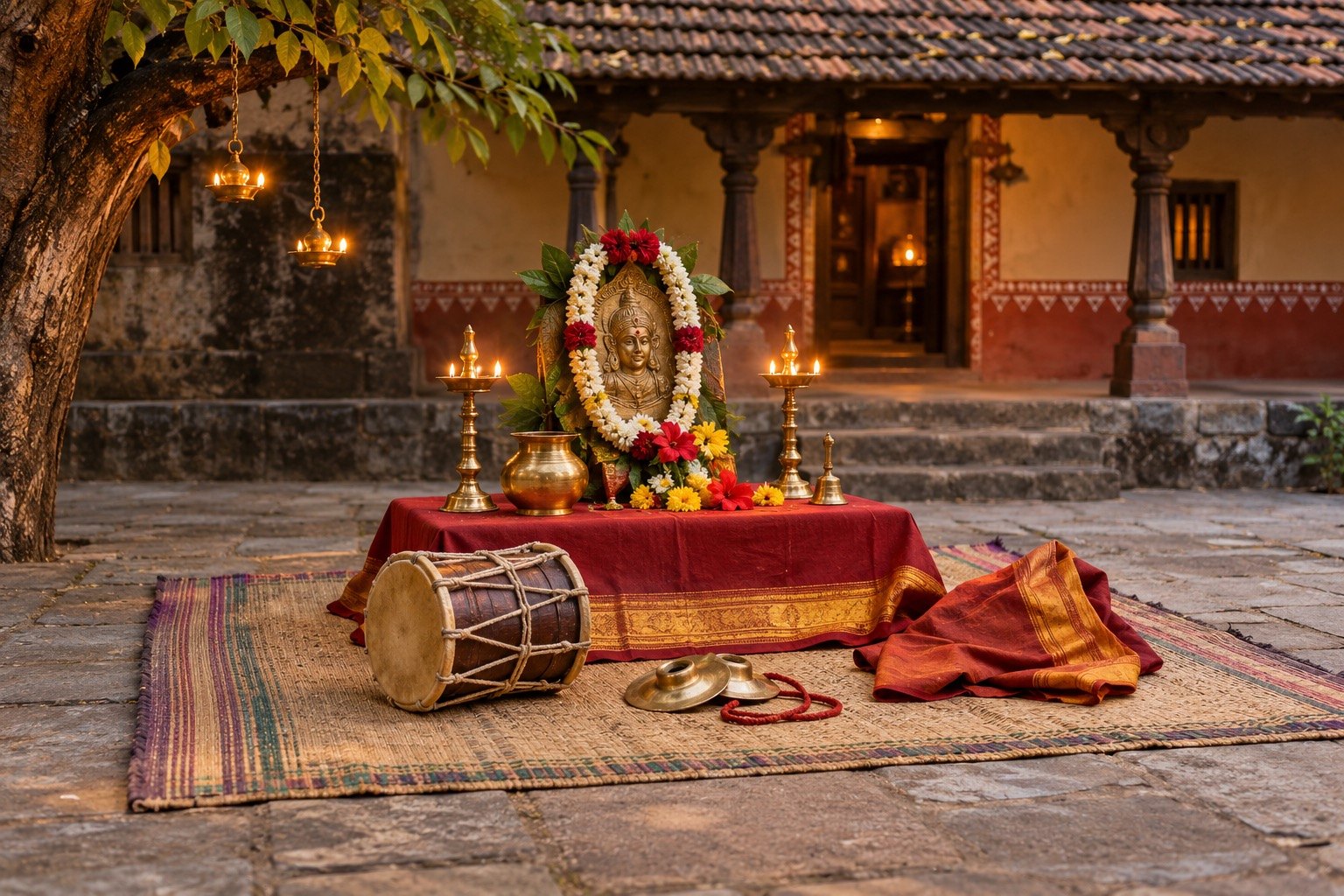
Gondhal is a devotional folk ritual of Maharashtra, performed by Gondhalis for local deities. A household hosts it to mark an important family event, and by custom it lasted from evening until dawn. It is in the news because a Marathi film set around the ritual has been chosen as India's entry for the Oscars.
Syllabus: GS1 · Art & Culture; Prelims · Current Affairs & IR; GS1 · Indian Society & Diversity
Why this matters for UPSC
GS1 Indian culture: the folk performing arts of Maharashtra and their ritual setting. Prelims can ask Gondhal's deities, performers and region; Mains, how folk traditions survive.
In short
Gondhal is a devotional ritual performance of Maharashtra in which Gondhalis sing, dance and play folk instruments to invoke deities such as Goddess Bhavani and Khandoba.
Gondhal lasts where families and temples keep inviting Gondhalis; screen fame helps, but the night-long ritual needs hosts, records and performers to survive.
Why it matters
A family in Maharashtra that invites Gondhalis to mark a special occasion keeps a whole night of worship, song and dance alive in its courtyard. When that night shrinks to a few hours, parts of the performance that need time are the first to go, and younger listeners hear less of what their elders heard. Temples help: at Tuljapur, couples and families still take part in the ceremony for Goddess Bhavani. A film on a world stage can bring new attention, yet the ritual lasts only while families keep hosting it. The larger issue is how India keeps living folk traditions alive when the occasions that sustain them change.
Prelims pointers
- Maharashtra's Department of Tourism lists Gondhal among the folk music of Latur district, alongside Bhajans and Abhangas.
- Look-alikes: in Latur, Gondhal is classed as folk music, while Lavani and Dhangari Gaja are classed as traditional dance forms.
- Navratri, celebrated over nine nights, is the most significant festival at the Tulja Bhavani temple; Kojagiri Purnima, Makar Sankranti and Gudi Padwa are also marked there.
- Daily worship at the Tulja Bhavani temple opens with the Kakad Aarti; Abhishek, Oti Bharan and Naivedya follow through the day.
- Gondhal is performed in the Nashik region of Maharashtra, including Sinnar in Nashik district.
Practise a UPSC-style question
With reference to Gondhal, consider the following statements:
1. By custom, a Gondhal started at dawn and closed by evening.
2. Gondhal combines music, dance and devotional singing, and families hold it to mark special occasions.
Which of the statements given above is/are correct?
- (a) 1 only
- (b) 2 only
- (c) Both 1 and 2
- (d) Neither 1 nor 2
Show the answer
Answer: (b) 2 only
Answer: (b) 2 only. The ritual ran through the night, and it is a family occasion with music, dance and song.
Statement 1: incorrect. A Gondhal traditionally began in the evening and continued through the night until dawn.
Statement 2: correct. Music, dance and devotional singing come together in it, and households host it for special family events.
Eliminate: Statement 1 reverses the timing of the ritual. Out: (a), (c).
Eliminate: Statement 2 matches the ritual's form and occasion. Out: (d).
Trap: Reversed direction. Statement 1 keeps the right span of a whole night but turns it round, so a student recalling only its length may tick it.
Remember: Gondhal is an evening-to-dawn ritual held for family occasions.
More Explainers
- CDRI: India's coalition for disaster-resilient infrastructure Environment
- Pichwai painting of Nathdwara, Rajasthan National
- Kerch Strait: the sea link between the Black Sea and Azov World & IR
- Wind energy in India: potential, offshore wind and the policy push Economy
- Pallikaranai marsh: a Chennai Ramsar site and its zone of influence Environment
- Andaman cobra: India's only island cobra, Endangered and endemic Environment
- International Coconut Community and India's Coconut Development Board World & IR
- Real Estate (Regulation and Development) Act, 2016: how it protects homebuyers Polity
- Open correctional institutions and the Supreme Court's 2026 directions Polity
- ICTP, Trieste: the UNESCO-IAEA centre for physics and mathematics Sci-Tech
- PJ.2.1 and how new Covid variants are classified and tracked Sci-Tech
- Berlin Conference of 1884-85 and the rules for colonising Africa World & IR