
Birsa Munda's Ulgulan, khuntkatti land rights and Janjatiya Gaurav Divas
Why in news: Janjatiya Gaurav Divas falls on 15 November, the date the Union Cabinet declared on 10 November 2021 for Birsa Munda's birth anniversary.
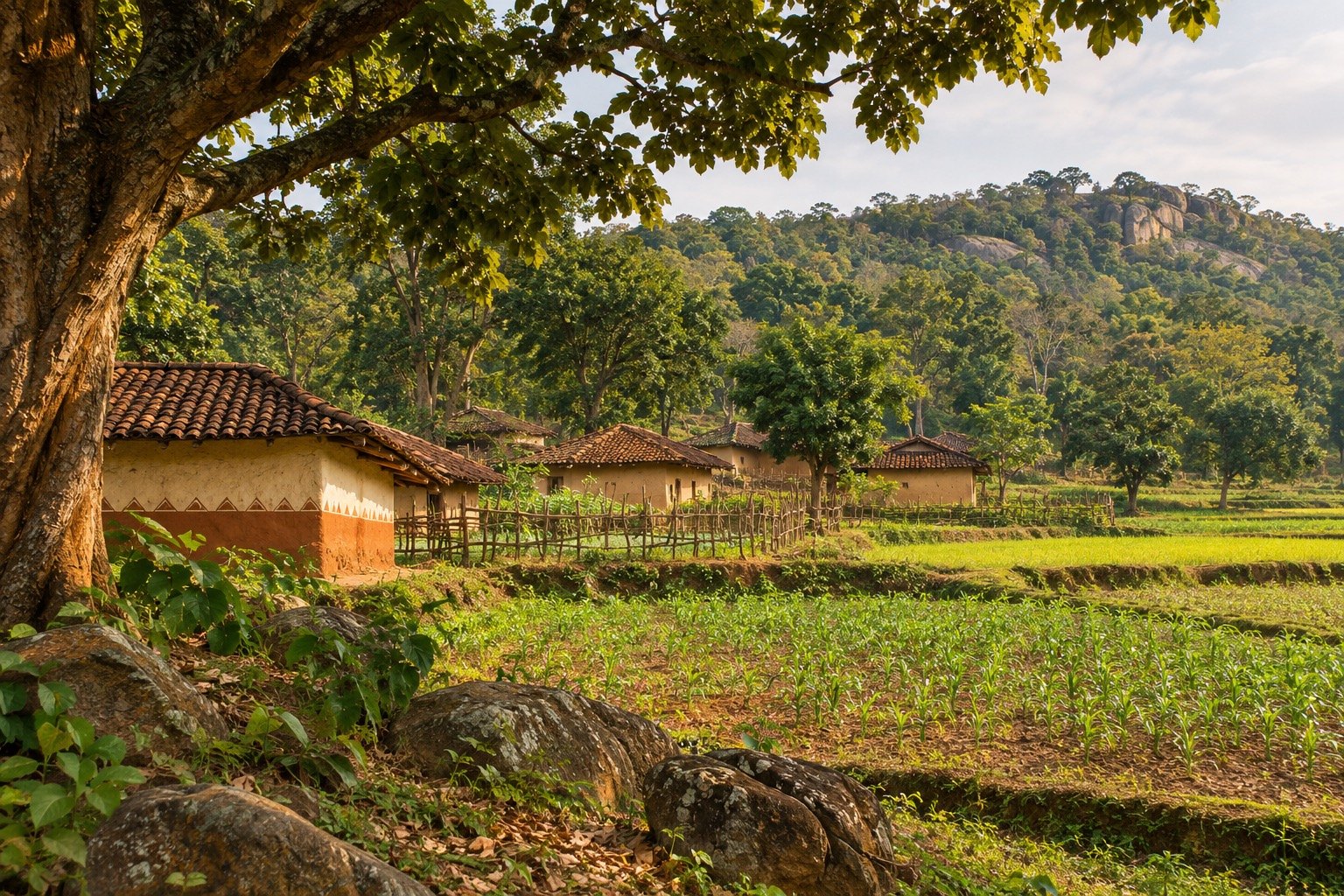
Birsa Munda led the Ulgulan, or Great Rebellion, of 1899-1900, rallying the Munda tribes to oppose colonial land laws and landlord oppression. The British captured him, and he died in Ranchi Jail at 25. His birth anniversary, 15 November, is observed every year as Janjatiya Gaurav Divas, Tribal Pride Day.
Syllabus: GS1 · Modern Indian History; Prelims · History & Culture; GS1 · Freedom Struggle
Why this matters for UPSC
GS1 modern history: tribal revolts against British rule and their leaders. Prelims can match revolts to leaders or ask about khuntkatti; Mains, colonial land policy.
In short
Birsa Munda's Ulgulan of 1899-1900 was a Munda rising that opposed colonial land laws and landlord oppression, demanding tribal self-rule and the return of khuntkatti community land rights.
The Ulgulan shows that tribal resistance grew from land and self-rule; honouring it means securing tribal land rights, not commemoration alone.
Why it matters
A Munda family whose forebears cleared a village's forest holds that land as khuntkatti, a claim that rests on descent from the founders. Birsa Munda turned such community rights into a political demand, and the 1908 tenancy law protects them through its rules on rent, so a landlord cannot raise that rent freely. The story also corrects a common picture of the freedom struggle. Resistance to British rule came from tribal communities too, and much of it is still little known. Janjatiya Gaurav Divas brings these leaders into public memory, which matters because the Cabinet itself said most people knew little about them.
Prelims pointers
- The Santhal Hul of 1855 was led by Sidhu-Kanhu and Chand-Bhairav; the Munda Ulgulan of 1899-1900 was led by Birsa Munda.
- Under the CNT Act, 1908, a Mundari khunt-kattidar holds jungle land to cultivate it with male family members; the right passes to heirs in the male line.
- The CNT Act, 1908 extends to the North Chotanagpur, South Chotanagpur and Palamau Divisions.
- The Bhumkal Kranti was led by Gundadhur and Lal Kalindra Singh; Veer Narayan Singh led a separate rising from Sonakhan.
- Mangarh Dham, in Rajasthan's Banswara district, marks the killing of over 1,500 Bhil freedom fighters by the British in 1913.
- The Ministry of Tribal Affairs funds tribal freedom fighter museums through its Support to Tribal Research Institutes scheme; the Ranchi museum opened on 15 November 2021.
- Raja Shankar Shah and his son Kunwar Raghunath Shah, of the Gond royal line, were executed by the British in 1858.
Practise a UPSC-style question
With reference to Birsa Munda, consider the following statements:
1. He died in Raipur Jail after the British captured him at the end of the Ulgulan.
2. He was born at Ulihatu, a village in present-day Jharkhand.
3. The Ulgulan he led sought the restoration of khuntkatti, the community land rights of the Mundas.
Which of the statements given above is/are correct?
- (a) 1 and 2 only
- (b) 2 and 3 only
- (c) 1 and 3 only
- (d) 1, 2 and 3
Show the answer
Answer: (b) 2 and 3 only
Answer: (b) 2 and 3 only. Statements 2 and 3 are correct; statement 1 names the wrong jail.
Statement 1: incorrect. PIB records that Birsa Munda was captured and died in Ranchi Jail, aged 25; a tribal freedom fighter museum now stands at Ranchi.
Statement 2: correct. PIB gives his birth as 15 November 1875 at Ulihatu, in present-day Jharkhand.
Statement 3: correct. PIB describes the Ulgulan of 1899-1900 as a fight to bring back khuntkatti, the Mundas' community land rights, and to win self-rule.
Eliminate: Statement 1 is the surest call: the jail was at Ranchi, not Raipur. Out: (a), (c), (d).
Trap: Swapped attribution. Raipur also has a tribal freedom fighters museum, for Veer Narayan Singh, so the city sounds familiar in this context.
Remember: Born at Ulihatu, died in Ranchi Jail: both places lie in present-day Jharkhand.
More Explainers
- CDRI: India's coalition for disaster-resilient infrastructure Environment
- Pichwai painting of Nathdwara, Rajasthan National
- Kerch Strait: the sea link between the Black Sea and Azov World & IR
- Wind energy in India: potential, offshore wind and the policy push Economy
- Pallikaranai marsh: a Chennai Ramsar site and its zone of influence Environment
- Andaman cobra: India's only island cobra, Endangered and endemic Environment
- International Coconut Community and India's Coconut Development Board World & IR
- Real Estate (Regulation and Development) Act, 2016: how it protects homebuyers Polity
- Open correctional institutions and the Supreme Court's 2026 directions Polity
- ICTP, Trieste: the UNESCO-IAEA centre for physics and mathematics Sci-Tech
- PJ.2.1 and how new Covid variants are classified and tracked Sci-Tech
- Berlin Conference of 1884-85 and the rules for colonising Africa World & IR