
Adichanallur: Iron Age urn burials on the Tamirabarani
Why in news: In November 2026 the ASI told the Madurai Bench of the Madras High Court that Adichanallur's flood-damaged 'C' site was being restored.
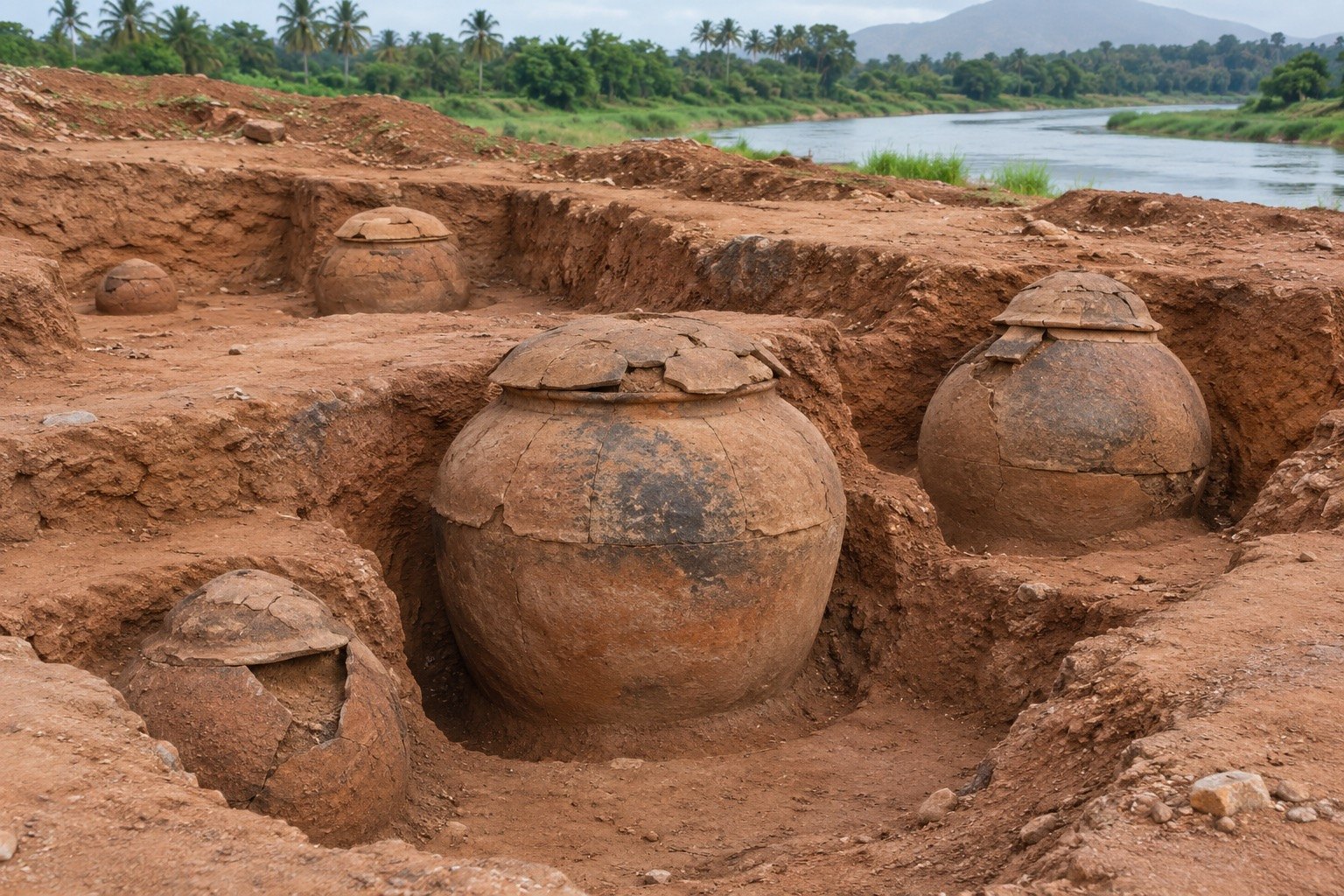
Adichanallur is an Iron Age urn-burial site on the right bank of the Tamirabarani in Thoothukudi district, Tamil Nadu. The ASI has protected its 114 acres since 1921, and its report on a 2004-05 dig dates the burials to about 850-650 BCE. In November 2026, the ASI told the Madras High Court that its flood-hit 'C' site was being restored.
Syllabus: GS1 · Art & Culture; Prelims · Current Affairs & IR; Prelims · History & Culture
Why this matters for UPSC
GS1 culture and ancient history: Iron Age urn burials of Tamil Nadu. Prelims can ask Adichanallur's river, district, finds and the iconic sites; Mains, site museums and dating.
In short
Adichanallur, on the Tamirabarani in Thoothukudi district, is an Iron Age urn-burial site whose ASI-dated graves anchor the study of early burial culture in Tamil Nadu.
Adichanallur's value lies in recorded context, so conservation of the open burials and a site museum that keeps finds in place must go together.
Why it matters
A student of early South Indian history usually meets the Iron Age through stray pots in museum cases. Adichanallur gives a dated, recorded cemetery instead: graves, urns, iron tools and the skeletons of the people buried there. The ASI report treats its dates as a reference point for urn burials across Tamil Nadu and South India, so scholars can compare other southern burial sites against it. Because the early finds went to Berlin and Chennai with weak records, a museum built at the site lets visitors and researchers see burials where they lie. The December 2023 floods showed the cost of open trenches: protected ground still needs sheds, drainage and steady upkeep to survive.
Prelims pointers
- The other four iconic sites of Budget 2020-21 are Rakhigarhi (Haryana), Hastinapur (Uttar Pradesh), Shivsagar (Assam) and Dholavira (Gujarat).
- Korkai lies about 9 km south of Adichanallur; Alexander Rea suggested it may have become the area's seaport once the sea receded.
- Rea placed the settlement linked to the burials at Kongarayankuruchi, on the northern bank of the river.
- Burial phases: early, red ware urns with primary burials; middle, both wares with primary and secondary burials; late, only secondary burials.
- The habitation area showed a floor level, a potter's kiln and a bead industry, signs of settled life; plant remains point to rice and green gram farming.
- Thermoluminescence dates on the pottery, from Manipur University, varied by hundreds of years, so the ASI report treats them with caution.
- Jagor's 1876 finds went to Berlin; the collections of Rea and Louis Lapicque are held at the Government Museum, Egmore, Chennai.
Practise a UPSC-style question
With reference to Adichanallur, consider the following statements:
1. It is an Iron Age burial site on the banks of the Vaigai river in Madurai district.
2. Its finds were first collected in 1876 by F. Jagor, who took them to Berlin.
3. An area of 114 acres at the site was protected by the Archaeological Survey of India in 1921.
Which of the statements given above is/are correct?
- (a) 1 and 2 only
- (b) 2 and 3 only
- (c) 1 and 3 only
- (d) 1, 2 and 3
Show the answer
Answer: (b) 2 and 3 only
Answer: (b) 2 and 3 only. The site sits on the Tamirabarani in Thoothukudi district, not on the Vaigai.
Statement 1: incorrect. The ASI report places Adichanallur on the right bank of the Tamirabarani (Porunai) in Srivaikuntam taluk of Thoothukudi district.
Statement 2: correct. F. Jagor of Berlin found the site in 1876, gathered pots, iron implements and bones, and deposited them in a Berlin museum.
Statement 3: correct. The ASI protected the 114-acre site in 1921 under a 1904 law for preserving ancient monuments.
Eliminate: statement 1 is the surest; the river is the Tamirabarani and the district Thoothukudi. Out: (a), (c), (d).
Trap: Look-alike names. Two southern Tamil Nadu rivers and districts are swapped, so a student who recalls only 'south Tamil Nadu' picks the Vaigai.
Remember: Adichanallur, Tamirabarani (Porunai), Thoothukudi district.
More Explainers
- CDRI: India's coalition for disaster-resilient infrastructure Environment
- Pichwai painting of Nathdwara, Rajasthan National
- Kerch Strait: the sea link between the Black Sea and Azov World & IR
- Wind energy in India: potential, offshore wind and the policy push Economy
- Pallikaranai marsh: a Chennai Ramsar site and its zone of influence Environment
- Andaman cobra: India's only island cobra, Endangered and endemic Environment
- International Coconut Community and India's Coconut Development Board World & IR
- Real Estate (Regulation and Development) Act, 2016: how it protects homebuyers Polity
- Open correctional institutions and the Supreme Court's 2026 directions Polity
- ICTP, Trieste: the UNESCO-IAEA centre for physics and mathematics Sci-Tech
- PJ.2.1 and how new Covid variants are classified and tracked Sci-Tech
- Berlin Conference of 1884-85 and the rules for colonising Africa World & IR