
Road ministry decides five-times-fee penalty for masked plates at MLFF tolls
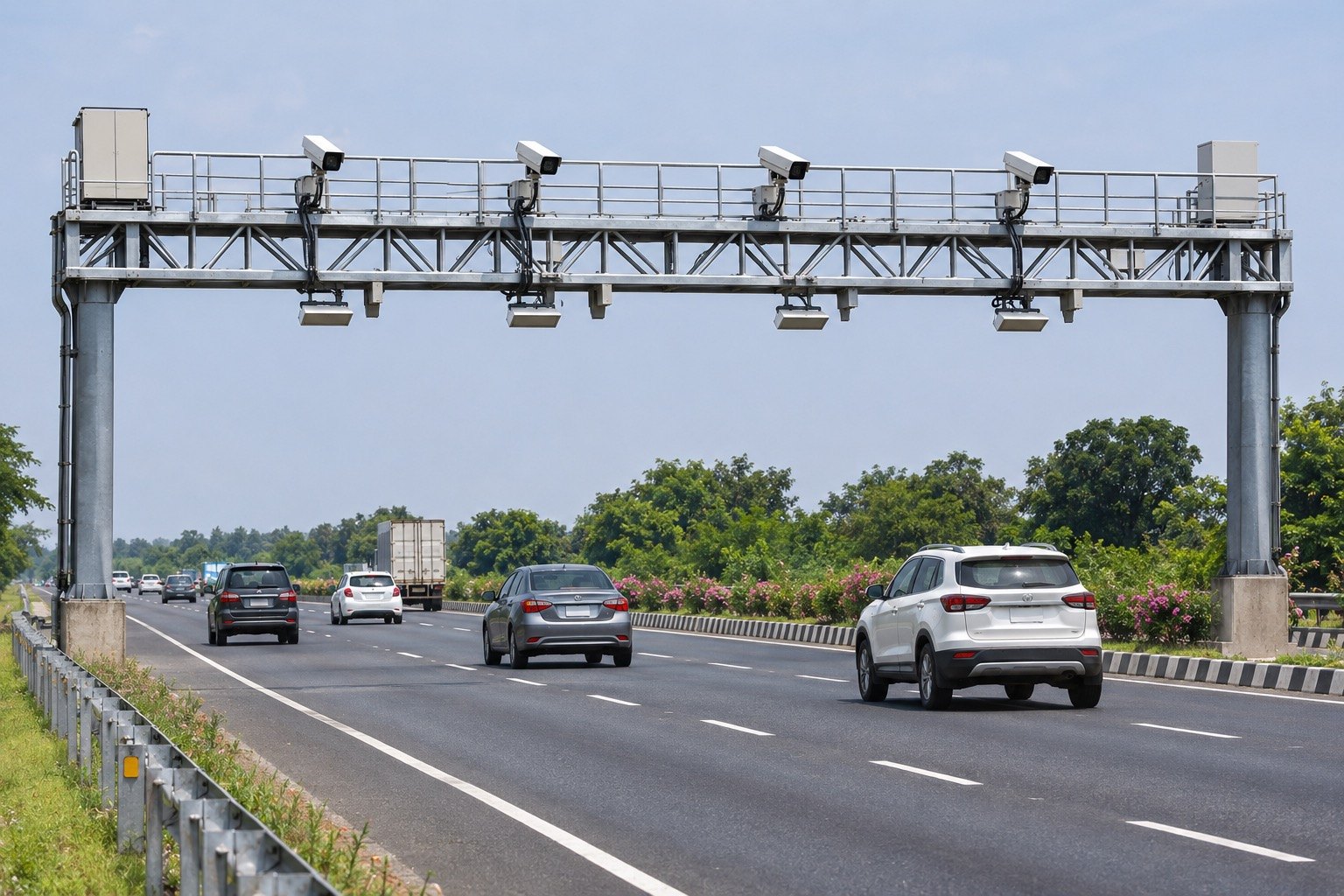
The Ministry of Road Transport and Highways (MoRTH) has decided to levy a penalty of five times the user fee on deliberate evaders under the Multi-Lane Free Flow (MLFF) tolling system. It targets vehicles whose registration plates are masked, tampered with or hidden, or that carry no FASTag. The fee is recovered too, the ministry said on 27 November 2026.
Syllabus: Prelims · Current Affairs & IR; GS3 · Infrastructure; GS2 · Governance & e-Governance
Why this matters for UPSC
GS3 infrastructure: electronic toll collection on National Highways. Prelims can ask how MLFF, FASTag and ANPR work; Mains, technology-led enforcement and fairness.
Why it matters
A driver who hides a number plate to slip through a toll with no booth now risks a bill many times larger than the toll itself. That matters to everyone else on the road, because a barrier-less system works only if every vehicle is billed; each unbilled car weakens the case for faster, queue-free highways. The intent condition is meant to separate deliberate evaders from motorists with a faulty tag or a short balance, who already receive an E-Notice. The larger issue is how the state enforces rules fairly once cameras and software replace the toll attendant.
Prelims pointers
- NHAI launched MLFF tolling at the Chorayasi Toll Plaza, Surat–Bharuch section of NH-48 in Gujarat, in May 2026; PIB called it India's first MLFF site.
- Under MLFF, too little FASTag balance or an invalid tag brings an E-Notice; the normal fee is due within 72 hours, then twice the normal rate.
- An unpaid E-Notice may lead to the FASTag being blacklisted and to curbs on other vehicle-related services through the VAHAN platform.
- Since 15 November 2025, a vehicle without a valid FASTag at a fee plaza pays twice the fee in cash, but 1.25 times through UPI.
- Three charges differ: double fee for an E-Notice left unpaid; double fee in cash at a plaza without FASTag; five times the fee for proven deliberate MLFF evasion.
- PIB lists MLFF's aims as less congestion, shorter travel time, better fuel efficiency, lower emissions and lower costs of setting up toll plazas.
Practise a UPSC-style question
With reference to Multi-Lane Free Flow (MLFF) tolling in India, consider the following statements:
1. Vehicles must slow to a halt at a lane barrier while their FASTag is read.
2. Vehicles are identified by FASTag readers and Automatic Number Plate Recognition cameras on overhead gantries.
3. NHAI launched the first MLFF toll site on the Surat–Bharuch section of NH-48 in Gujarat.
Which of the statements given above is/are correct?
- (a) 1 and 2 only
- (b) 2 and 3 only
- (c) 1 and 3 only
- (d) 1, 2 and 3
Show the answer
Answer: (b) 2 and 3 only
Answer: (b) 2 and 3 only. MLFF has no barrier, so statement 1 fails while 2 and 3 hold.
Statement 1: incorrect. MLFF is barrier-less tolling; vehicles pass the toll location without stopping while the fee is deducted.
Statement 2: correct. Gantry-mounted FASTag readers and ANPR cameras identify each vehicle and deduct the user fee automatically.
Statement 3: correct. NHAI began MLFF tolling at the Chorayasi Toll Plaza on the Surat–Bharuch section of NH-48 in Gujarat in May 2026, per PIB.
Eliminate: Statement 1 contradicts the very idea of free flow. Out: (a), (c), (d).
Trap: Sounds right. Statement 1 describes a conventional FASTag plaza, where a boom barrier lifts after the tag is read, and pins it on MLFF.
Remember: MLFF means no barrier and no stop: FASTag readers plus ANPR cameras on gantries.
Explainers on this topic
More from the 29 November 2026 edition
- Jute Commissioner caps raw jute stocks under 2016 Control Order Economy
- DRI seizes suspected king cobra venom and big-cat skins in Maharashtra Environment
- MoRTH proposes stricter tender conditions for EPC highway contracts Economy
- SCO's first Civilisational Dialogue Forum adopts the Indraprastha Communique World & IR
- Maharashtra withdraws Tiger Conservation Plans of four tiger reserves Environment
- WHO measles report: India to miss 2026 measles-rubella elimination target National
- Education Ministry accepts Sahasrabudhe committee plan to prevent campus suicides National
- TRAI rewrites Reference Interconnect Offer rules with new market-power test Economy
- MHA amends Citizenship Rules, 2009: citizenship certificates go digital Polity
- ITU Plenipotentiary Conference accepts India as host of PP-30 in 2030 World & IR