
SCO's first Civilisational Dialogue Forum adopts the Indraprastha Communique
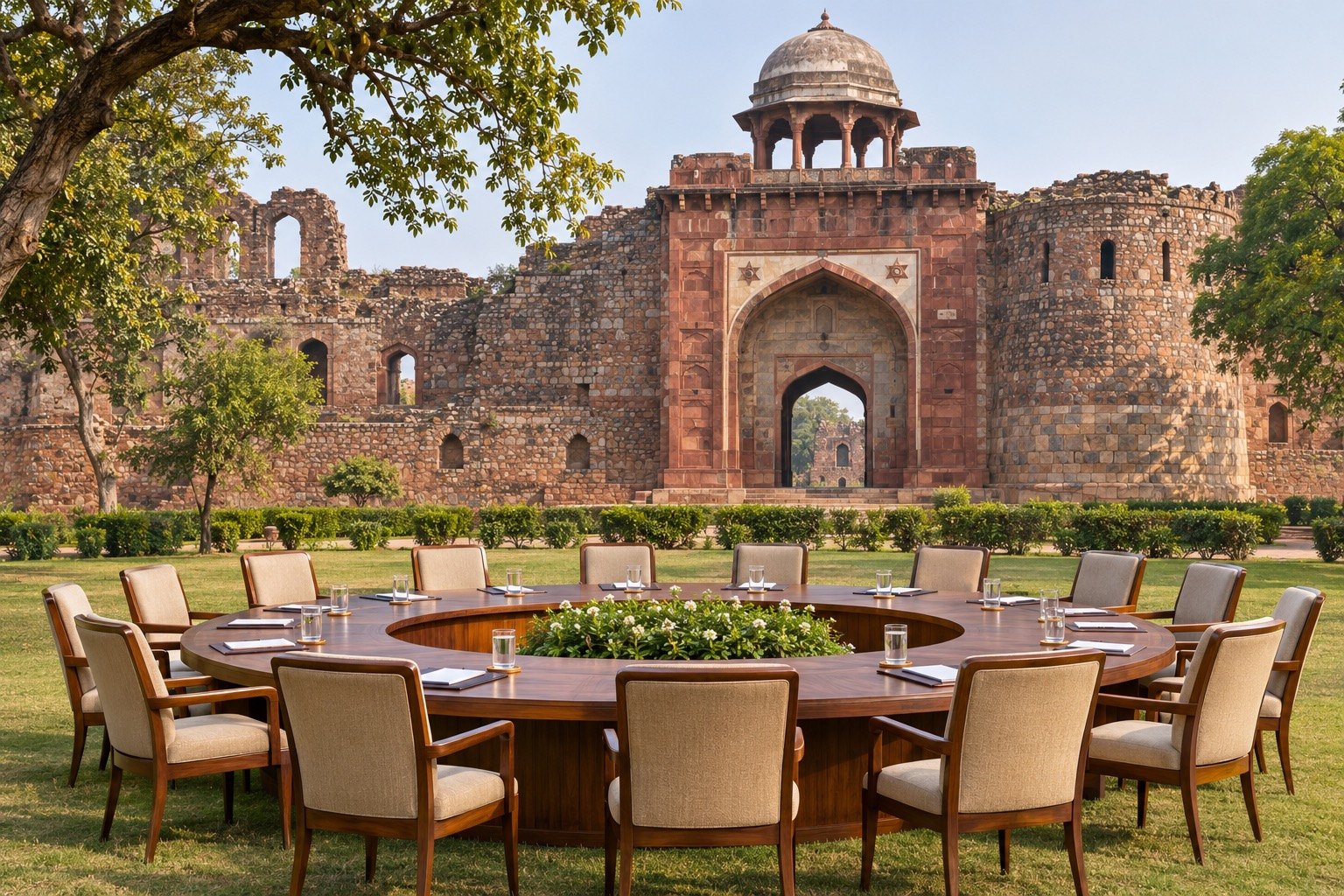
Member States and Dialogue Partners of the Shanghai Cooperation Organisation (SCO) adopted the Indraprastha Communique at the grouping's first Civilisational Dialogue Forum, held at Purana Qila, New Delhi, on 20-22 November 2026. It treats culture as a dimension of cooperation under the SCO Charter and makes twelve affirmations. India proposed that the Dialogue meet every two years.
Syllabus: GS1 · Art & Culture; Prelims · Current Affairs & IR; GS2 · Groupings & Agreements
Why this matters for UPSC
GS2 international relations: the SCO, its Charter, bodies and members, and India's role. Prelims can ask members and permanent bodies; Mains, culture as a track of regional cooperation.
Why it matters
A scholar in Delhi working on old scripts could one day read manuscripts kept in Central Asia without travelling, if the proposed digital repository is built. Joint nominations would let neighbours list a shared practice or site together, so one country does not claim what many created. Museums facing theft of artefacts gain partners to trace them. For a grouping best known for security and trade, these steps open a calmer channel where officials and scholars meet often. Such regular contact builds trust slowly, which helps when harder talks on borders or terrorism stall. The gain depends on follow-up, because the communique binds no member.
Prelims pointers
- The SCO was set up at Shanghai on 15 June 2001 by Kazakhstan, China, Kyrgyzstan, Russia, Tajikistan and Uzbekistan.
- The SCO Charter is registered with the UN Secretariat; the SCO's legal framework holds over 25 agreements and regulations.
- The SCO's official languages are Russian and Chinese; its Secretariat began work in January 2004.
- Afghanistan and Mongolia are SCO observer states, while Nepal, Sri Lanka, Maldives and Türkiye are dialogue partners, not observers.
- India, Pakistan, Iran and Belarus joined the 2007 SCO Treaty on Long-Term Good-Neighbourliness, Friendship and Cooperation.
- The SCO Secretariat states that the SCO is not a defence alliance.
Practise a UPSC-style question
With reference to the Shanghai Cooperation Organisation (SCO), consider the following statements:
1. Its official languages are Russian and English.
2. Its Charter, signed at St Petersburg, is described by the SCO Secretariat as the organisation's fundamental document.
3. Its two permanent bodies are a Secretariat based in Beijing and a Regional Anti-Terrorist Structure based in Tashkent.
Which of the statements given above is/are correct?
- (a) 1 and 2 only
- (b) 2 and 3 only
- (c) 1 and 3 only
- (d) 1, 2 and 3
Show the answer
Answer: (b) 2 and 3 only
Answer: (b) 2 and 3 only. The Charter and the two permanent bodies are right; the second official language is Chinese, not English.
Statement 1: incorrect. The SCO uses Russian and Chinese as its official languages.
Statement 2: correct. SCO leaders signed the Charter at St Petersburg in 2002; the Secretariat calls it the fundamental document of the organisation.
Statement 3: correct. Of the SCO's two permanent bodies, the Secretariat is in Beijing, while the Executive Committee of the Regional Anti-Terrorist Structure (RATS) sits in Tashkent.
Eliminate: Statement 1 is wrong, since the SCO works in Russian and Chinese. Out: (a), (c), (d).
Trap: Swapped attribution. English is the common working language of many groupings, so it is planted in place of Chinese for a body headquartered in Beijing.
Remember: SCO: Secretariat Beijing, RATS Tashkent, languages Russian and Chinese.
Explainers on this topic
More from the 29 November 2026 edition
- Jute Commissioner caps raw jute stocks under 2016 Control Order Economy
- DRI seizes suspected king cobra venom and big-cat skins in Maharashtra Environment
- MoRTH proposes stricter tender conditions for EPC highway contracts Economy
- Maharashtra withdraws Tiger Conservation Plans of four tiger reserves Environment
- WHO measles report: India to miss 2026 measles-rubella elimination target National
- Education Ministry accepts Sahasrabudhe committee plan to prevent campus suicides National
- TRAI rewrites Reference Interconnect Offer rules with new market-power test Economy
- Road ministry decides five-times-fee penalty for masked plates at MLFF tolls Economy
- MHA amends Citizenship Rules, 2009: citizenship certificates go digital Polity
- ITU Plenipotentiary Conference accepts India as host of PP-30 in 2030 World & IR