
WHO measles report: India to miss 2026 measles-rubella elimination target
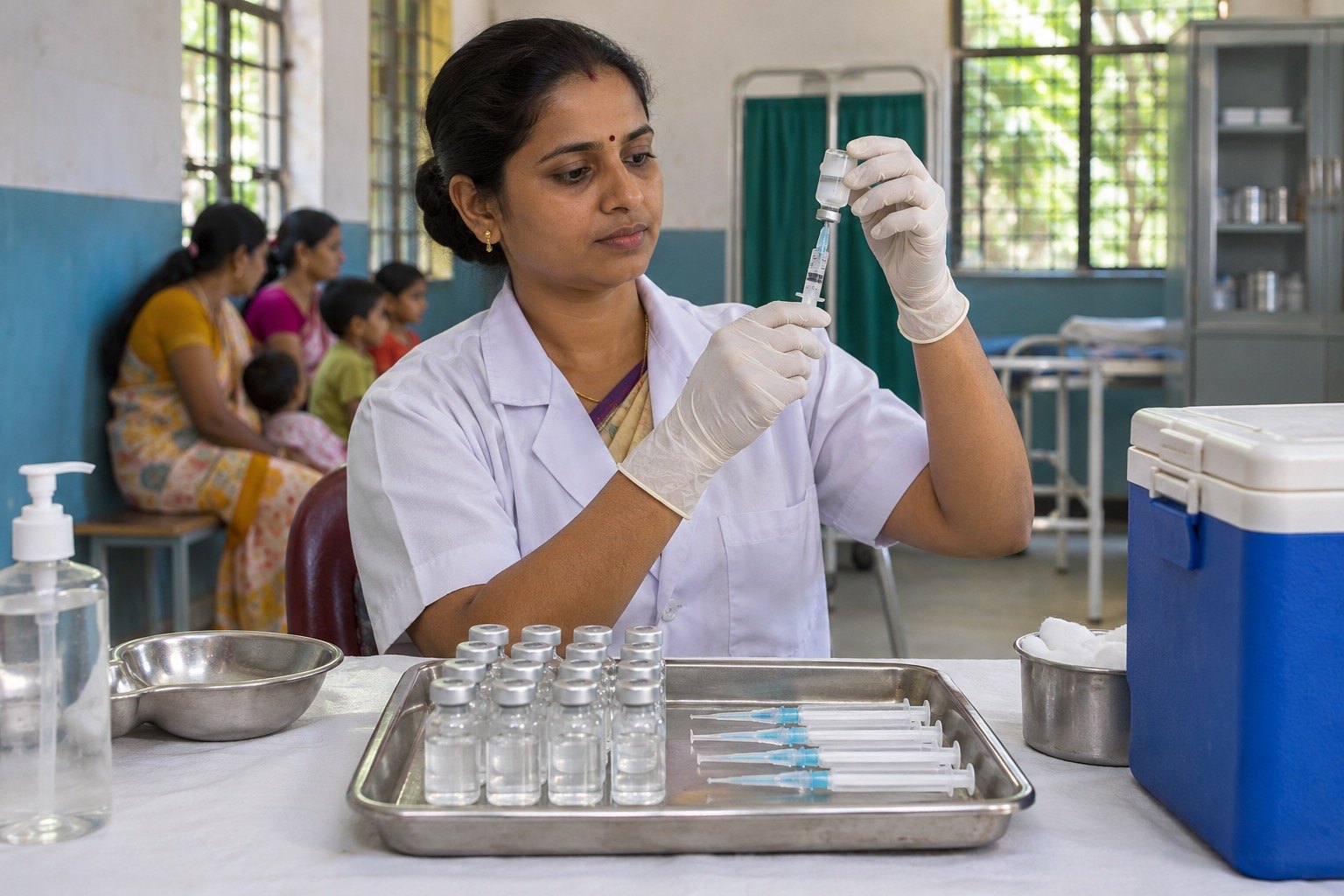
The World Health Organization (WHO) released its measles elimination report on 27 November 2026, putting 2025 measles deaths worldwide at 72,000, down 91% since 2000. WHO officials said India will miss the regional 2026 measles-rubella elimination target. India has left the list of ten countries with the most unvaccinated children, a first since 2001.
Syllabus: Prelims · Science & Technology; GS2 · Health, Education & Human Resources; GS2 · International Institutions
Why this matters for UPSC
GS2 health: the WHO measles elimination report and India's measles-rubella drive under the Universal Immunization Programme. Prelims can ask the MR doses or what measles elimination requires; Mains, why high coverage still leaves gaps.
Why it matters
A child in a migrant camp, a city slum or a remote hamlet can miss both vaccine doses even when the national record looks excellent. Measles spreads fast among such children, so one missed pocket can start an outbreak that reaches others. Measles also weakens the body's defences for months or years, which leaves a child open to pneumonia and diarrhoea after the rash is gone. Missing the 2026 goal does not undo India's gains. It means the programme must now hunt for the last unreached families, keep surveillance sharp in every district, and answer the rumours that make some parents wait. The larger issue is that a disease beaten back can return wherever effort and funding slacken.
Prelims pointers
- Under the Universal Immunization Programme, two doses of the measles-rubella vaccine are free for eligible children: the first at 9-12 months, the second at 16-24 months.
- Before a country can be declared measles-free, it must show three years without indigenous measles transmission.
- The WHO South-East Asia Regional Verification Commission reviews reports from each member's National Verification Committee on transmission, surveillance, immunity and outbreak readiness.
- The UIP protects against 12 vaccine-preventable diseases, among them polio, measles, rubella, diphtheria, tetanus, rotavirus diarrhoea and hepatitis B.
- India's measles-rubella elimination framework has five parts: immunisation, case-based surveillance, outbreak response, linkages, and demand generation against vaccine hesitancy.
- U-WIN is the digital platform used under the UIP to record vaccinations, issue certificates and book vaccination appointments.
Practise a UPSC-style question
With reference to measles-rubella elimination in India, consider the following statements:
1. The WHO South-East Asia Regional Verification Commission is an independent expert body that verifies progress towards elimination.
2. Under the Universal Immunization Programme, the two MR vaccine doses are given at 9-12 months and 16-24 months.
Which of the statements given above is/are correct?
- (a) 1 only
- (b) 2 only
- (c) Both 1 and 2
- (d) Neither 1 nor 2
Show the answer
Answer: (c) Both 1 and 2
Answer: (c) Both 1 and 2. The verifier is an independent regional commission and the UIP gives two MR doses.
Statement 1: correct. The commission is an independent expert panel that examines country evidence and verifies progress towards measles and rubella elimination.
Statement 2: correct. The UIP gives two free MR doses to eligible children, the first at 9-12 months and the second at 16-24 months.
Eliminate: statement 1 is true, since the commission is independent. Out: (b), (d).
Eliminate: statement 2 is true, since the doses fall at 9-12 and 16-24 months. Out: (a).
Trap: Swapped attribution. A student may think the Union Health Ministry verifies its own elimination, while an independent regional commission does that work.
Remember: MR doses at 9-12 and 16-24 months; an independent commission verifies elimination.
Explainers on this topic
More from the 29 November 2026 edition
- Jute Commissioner caps raw jute stocks under 2016 Control Order Economy
- DRI seizes suspected king cobra venom and big-cat skins in Maharashtra Environment
- MoRTH proposes stricter tender conditions for EPC highway contracts Economy
- SCO's first Civilisational Dialogue Forum adopts the Indraprastha Communique World & IR
- Maharashtra withdraws Tiger Conservation Plans of four tiger reserves Environment
- Education Ministry accepts Sahasrabudhe committee plan to prevent campus suicides National
- TRAI rewrites Reference Interconnect Offer rules with new market-power test Economy
- Road ministry decides five-times-fee penalty for masked plates at MLFF tolls Economy
- MHA amends Citizenship Rules, 2009: citizenship certificates go digital Polity
- ITU Plenipotentiary Conference accepts India as host of PP-30 in 2030 World & IR