
ZSI and CMFRI describe Indian Bramble Shark, Echinorhinus roinee, as new species
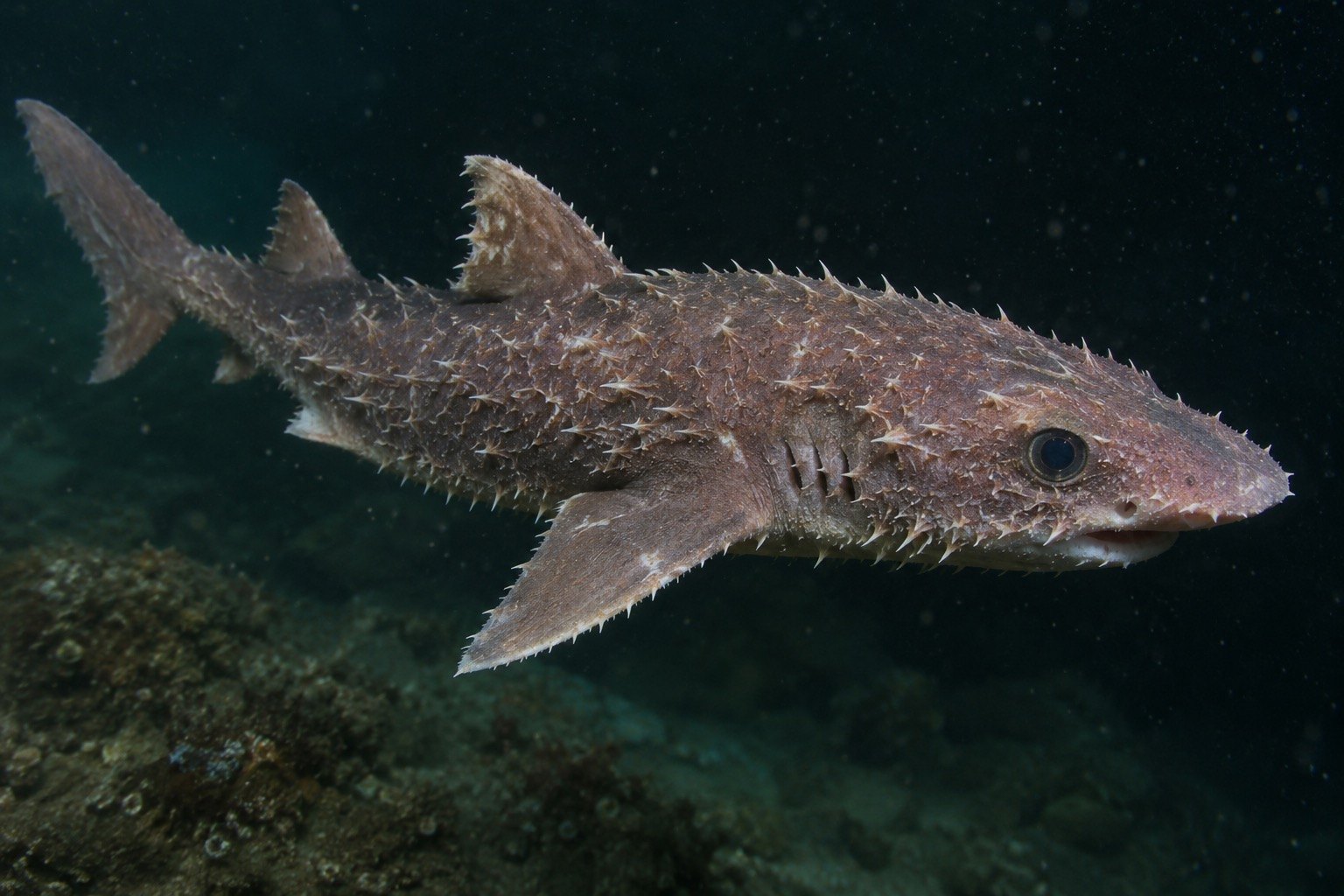
The Zoological Survey of India (ZSI) and ICAR-Central Marine Fisheries Research Institute (CMFRI) have described the Indian Bramble Shark, Echinorhinus roinee, as a distinct deep-sea species. The ZSI announced it on 12 November 2026. Bramble sharks from Indian waters had for decades been recorded as an Atlantic species. Specimens came from shrimp-trawler bycatch landed at Kollam, Kerala.
Syllabus: Prelims · Environment & Ecology; GS3 · Indian Achievements in S&T; GS3 · Environment & Conservation
Why this matters for UPSC
GS3 environment: biodiversity, taxonomy and deep-sea fisheries. Prelims can ask about Echinorhinus species, ZSI and CMFRI; Mains, bycatch and the Deep Ocean Mission.
Why it matters
A fisheries researcher in Kerala who logs every shark a trawler lands needs the right name for each one. If one species is booked under another, counts of how many are caught, and how fast, describe the wrong animal. That can hide fishing pressure on a deep-water shark found in a narrow depth band. A correct name lets scientists track this shark across harbours and, perhaps, neighbouring seas. It also shows that animals hauled up by accident in fishing nets can reveal species nobody had told apart. The larger issue is how little is known about life in India's deep waters.
Prelims pointers
- The Zoological Survey of India was established on 1 July 1916 and functions under the Ministry of Environment, Forest and Climate Change.
- The ZSI grew from the Indian Museum's Zoological Section in Calcutta, which dates from 1875.
- ICAR-CMFRI was established on 3 February 1947 under the agriculture ministry; it joined the ICAR family in 1967.
- The ZSI is a faunal survey body under MoEFCC; the CMFRI is a marine fisheries research institute within ICAR.
- CMFRI estimates marine catch and effort along India's coast by the Stratified Multistage Random Sampling Method and maintains the National Marine Fisheries Data Centre.
- Genus Echinorhinus: E. brucus is the Atlantic bramble shark, E. cookei the Pacific prickly shark, and E. roinee the Indian Bramble Shark.
Practise a UPSC-style question
Consider the following statements about the Zoological Survey of India (ZSI):
1. It functions under the Ministry of Environment, Forest and Climate Change.
2. It maintains the National Marine Fisheries Data Centre of India.
3. It grew out of a zoological section set up in 1875 within the Indian Museum, Calcutta.
Which of the statements given above is/are correct?
- (a) 1 and 2 only
- (b) 2 and 3 only
- (c) 1 and 3 only
- (d) 1, 2 and 3
Show the answer
Answer: (c) 1 and 3 only
Answer: (c) 1 and 3 only. The ZSI sits under MoEFCC and began in the Indian Museum; the data centre belongs to CMFRI.
Statement 1: correct. The ZSI, set up on 1 July 1916, is under the Ministry of Environment, Forest and Climate Change.
Statement 2: incorrect. The National Marine Fisheries Data Centre is maintained by ICAR-CMFRI, not the ZSI.
Statement 3: correct. The ZSI grew from the Indian Museum's Zoological Section in Calcutta, which dates from 1875.
Eliminate: statement 2 is wrong, since the data centre is a CMFRI facility. Out: (a), (b), (d).
Trap: Swapped attribution. A real fisheries data centre is pinned on the ZSI because both bodies worked on the new shark.
Remember: ZSI, MoEFCC, 1916; CMFRI, founded 1947, in ICAR since 1967.
More from the 13 November 2026 edition
- MoRTH publishes draft Rent-A-Cab Scheme, 2026 to replace the 1989 Scheme Polity
- WHO Global Tuberculosis Report 2026: first End TB milestone reached late World & IR
- ISRO ground-tests redesigned PSLV third stage after two mission anomalies Sci-Tech
- NITI Aayog and IIM Ahmedabad assess all 14 PLI schemes Economy
- PLI ACC scheme: 22 bids for 10 GWh of grid-storage cell capacity Economy
- DRI seizes 12.87 tonnes of red sanders at Chennai Port Environment
- Ladakh bars Leh, Kargil protests till municipal polls end, citing Model Code Polity
- 22 Indian beaches get Blue Flag for 2026-27, Maharashtra's first three Environment