
PLI ACC scheme: 22 bids for 10 GWh of grid-storage cell capacity
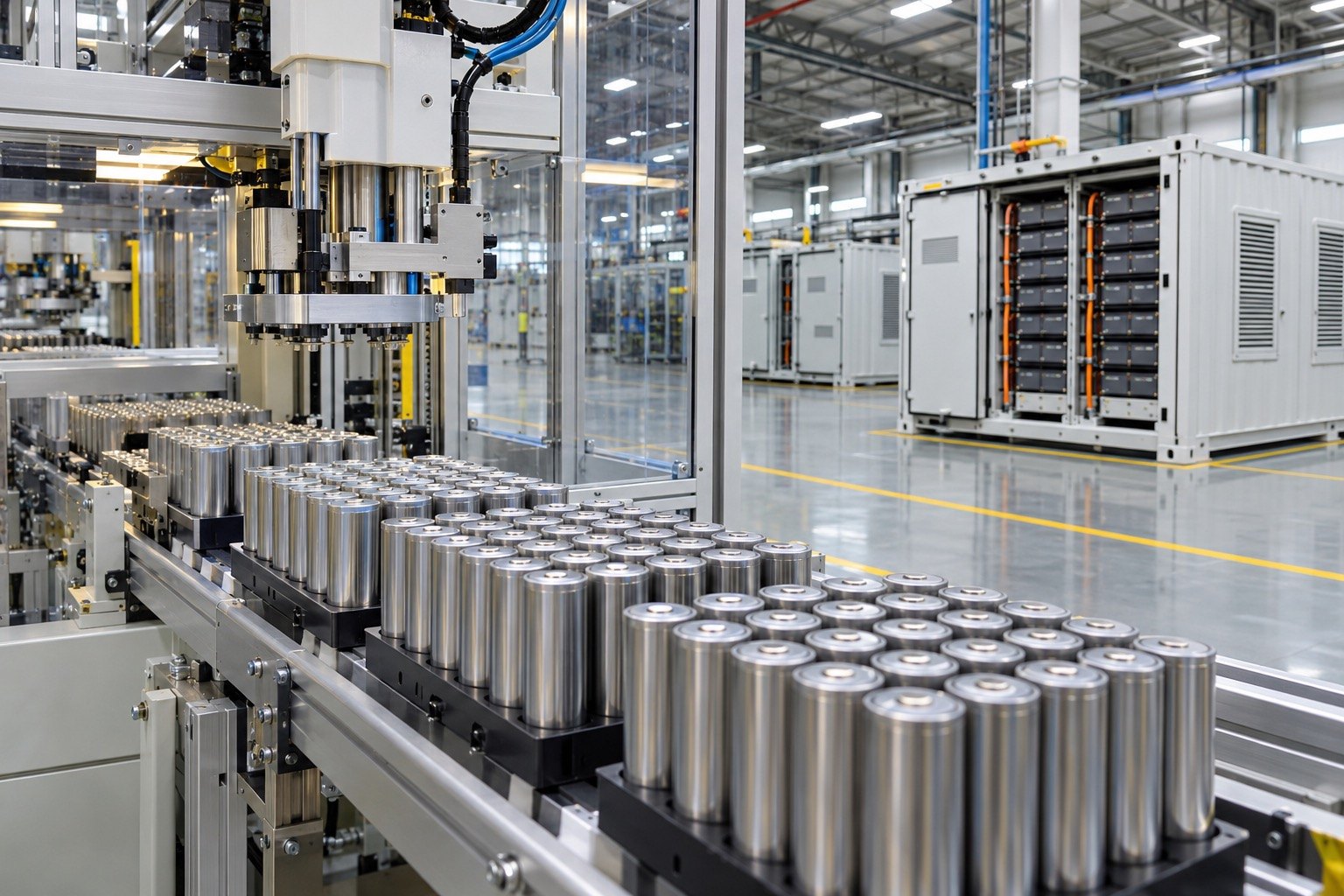
The Ministry of Heavy Industries has received 22 bids for 10 GWh of Advanced Chemistry Cell (ACC) manufacturing capacity reserved for grid-scale stationary storage. Technical bids were opened on 11 November 2026. The capacity is part of the 50 GWh target of the ₹18,100-crore PLI ACC scheme. Four firms already hold 40 GWh.
Syllabus: Prelims · Current Affairs & IR; GS3 · Liberalisation & Industry; GS3 · Infrastructure
Why this matters for UPSC
GS3 economy and energy infrastructure: industrial policy and battery storage. Prelims can ask the PLI ACC scheme's ministry, target and conditions; Mains, why domestic cell making lags.
Why it matters
A solar park produces power only while the sun shines, and wind farms rise and fall with the weather. To keep lights on in the evening, grid operators need large batteries that store daytime power and release it later. If those batteries are made from imported cells, the country's power security depends on foreign factories and their prices. Cells made at home keep that value, and the jobs, in India. The worry is pace: plants promised years ago have been slow to start, so storage buyers may keep importing cells while domestic factories catch up.
Prelims pointers
- The Union Cabinet approved the PLI ACC scheme in May 2021; besides 50 GWh of ACC, it covers 5 GWh of niche ACC to promote newer cell technologies.
- A winner must commission its plant within two years; the incentive is then paid over five years on sales of batteries made in India.
- The incentive grows with higher specific energy density, more charge cycles and greater local value addition.
- The scheme is technology agnostic: a beneficiary chooses its own cell technology and machinery, and no location for plants is prescribed.
- PLI ACC (₹18,100 crore) sits beside the PLI scheme for the automotive sector (₹25,938 crore) to support the move to electric vehicles.
- PLI ACC is a supply-side incentive to cell makers; the 2026 VGF scheme supports storage projects: 60 GWh pumped storage, 30 GWh BESS, 2 GWh other technologies.
Practise a UPSC-style question
With reference to the Production Linked Incentive (PLI) scheme 'National Programme on Advanced Chemistry Cell (ACC) Battery Storage', consider the following statements:
1. It is administered by the Ministry of Heavy Industries.
2. Its incentive is paid as an upfront capital subsidy on the cost of building the plant.
3. It targets 50 GWh of ACC manufacturing capacity besides 5 GWh of niche ACC.
Which of the statements given above is/are correct?
- (a) 1 and 2 only
- (b) 2 and 3 only
- (c) 1 and 3 only
- (d) 1, 2 and 3
Show the answer
Answer: (c) 1 and 3 only
Answer: (c) 1 and 3 only. The ministry and the targets are right; the incentive is tied to sales, not to plant cost.
Statement 1: correct. The Ministry of Heavy Industries runs the scheme and conducts its tenders.
Statement 2: incorrect. The plant must be commissioned within two years; the incentive then flows over five years on sales of batteries made in India.
Statement 3: correct. The Cabinet approved it in May 2021 for 50 GWh of ACC and 5 GWh of niche ACC, with ₹18,100 crore.
Eliminate: Statement 2 is wrong because a PLI pays on output sold. Out: (a), (b), (d).
Trap: Sounds right. Many industrial schemes give capital subsidies, so a plant-cost subsidy feels plausible, but a PLI rewards production and sales.
Remember: PLI ACC pays on cells sold, over five years, after the plant is built.
More from the 13 November 2026 edition
- MoRTH publishes draft Rent-A-Cab Scheme, 2026 to replace the 1989 Scheme Polity
- WHO Global Tuberculosis Report 2026: first End TB milestone reached late World & IR
- ISRO ground-tests redesigned PSLV third stage after two mission anomalies Sci-Tech
- ZSI and CMFRI describe Indian Bramble Shark, Echinorhinus roinee, as new species Environment
- NITI Aayog and IIM Ahmedabad assess all 14 PLI schemes Economy
- DRI seizes 12.87 tonnes of red sanders at Chennai Port Environment
- Ladakh bars Leh, Kargil protests till municipal polls end, citing Model Code Polity
- 22 Indian beaches get Blue Flag for 2026-27, Maharashtra's first three Environment