
DRI seizes 12.87 tonnes of red sanders at Chennai Port
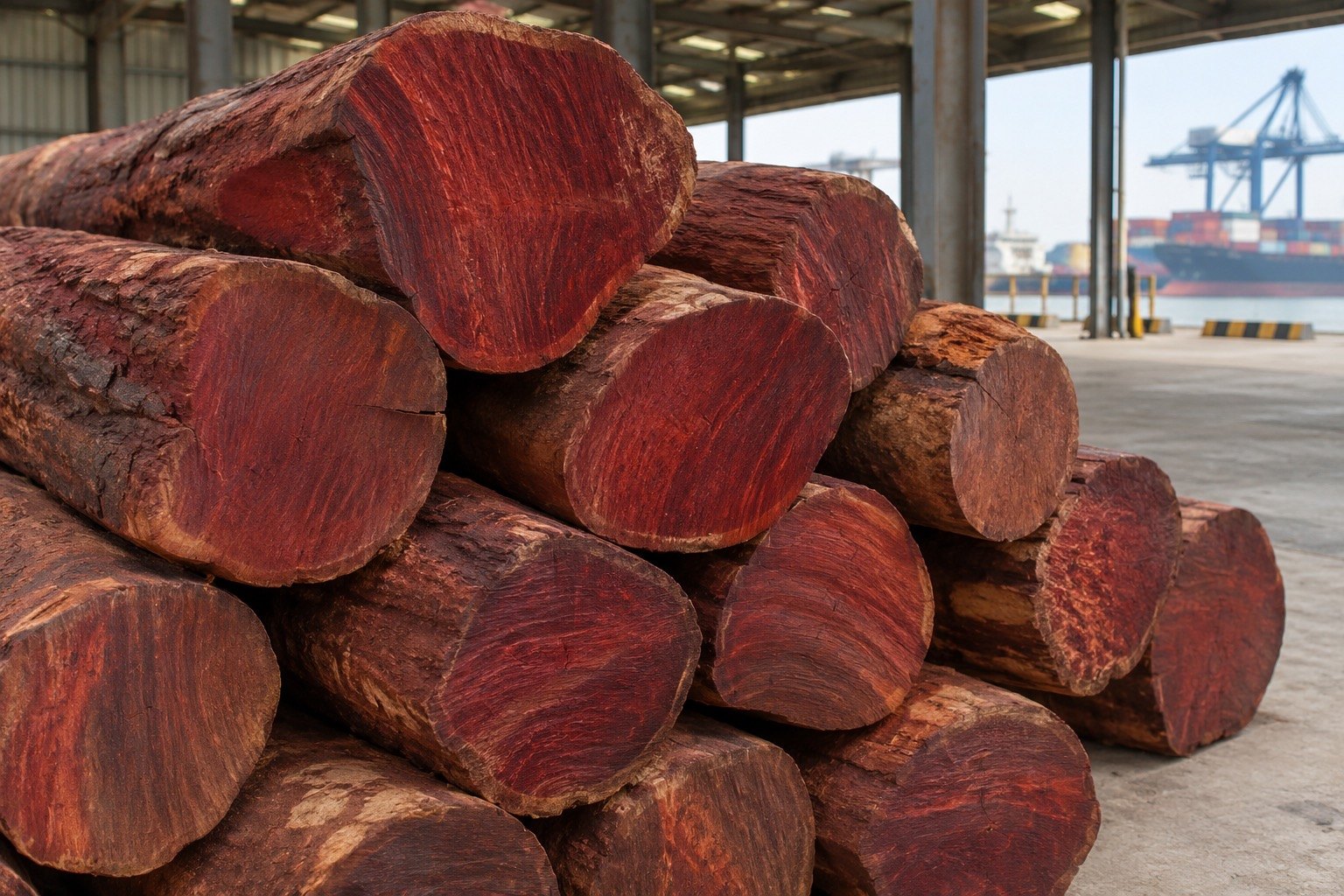
The Directorate of Revenue Intelligence (DRI) seized 12.87 tonnes of red sanders logs from an export container at Chennai Port between 9 and 11 November 2026. The container, bound for Malaysia, had been declared as carrying paper laminate rolls. Three persons were arrested under the Customs Act, 1962.
Syllabus: Prelims · Environment & Ecology; GS3 · Environment & Conservation; GS2 · Groupings & Agreements
Why this matters for UPSC
GS3 environment: wildlife trafficking and the legal protection of red sanders. Prelims can ask its CITES appendix, schedule and range; Mains, trade facilitation versus enforcement.
Why it matters
A farmer in Andhra Pradesh who grows red sanders needs foreign buyers to trust that exported wood is legal. Every log cut from the wild and smuggled out weakens that trust and thins the natural stands of a tree that grows in only a few districts. If treaty partners again doubt India's controls, trade curbs could follow, and they would hit lawful growers as well as smugglers. The case also shows how an arrangement built to speed up honest exports can be turned into a route for wildlife crime, so officials have to keep checks sharp without slowing genuine trade.
Prelims pointers
- Red sanders (Pterocarpus santalinus) is a high-value tree endemic to a few districts of Andhra Pradesh.
- Red sanders is in Appendix II of CITES, listed since 1994 per the Environment Ministry, and in Schedule IV of the Wild Life (Protection) Act, 1972.
- CITES appendices are lists under an international treaty that governs trade across borders; the Wild Life Act's schedules are Indian law's own lists, enforced inside India.
- India has been a Party to CITES since 1976.
- India allows no export of red sanders taken from the wild (a zero quota); a major part of legal exports comes from plantation-grown trees.
- India's CITES legislation has been in Category 1 of the CITES National Legislation Project since November 2023; it was in Category 2 before.
Practise a UPSC-style question
With reference to red sanders (Pterocarpus santalinus), consider the following statements:
1. It is listed in Appendix I of CITES.
2. It is endemic to a few districts of Andhra Pradesh.
3. It is listed in Schedule IV of the Wild Life (Protection) Act, 1972.
Which of the statements given above is/are correct?
- (a) 1 and 2 only
- (b) 2 and 3 only
- (c) 1 and 3 only
- (d) 1, 2 and 3
Show the answer
Answer: (b) 2 and 3 only
Answer: (b) 2 and 3 only. The tree is endemic to Andhra Pradesh and sits in Appendix II, not Appendix I.
Statement 1: incorrect. Red sanders is in Appendix II of CITES, not Appendix I; the Environment Ministry dates that listing to 1994.
Statement 2: correct. The Environment Ministry (2023) describes red sanders as endemic to a few districts of Andhra Pradesh.
Statement 3: correct. The species is in Schedule IV of the Wild Life (Protection) Act, 1972, as the DRI's release of November 2026 states.
Eliminate: statement 1 is wrong, so every code containing 1 goes. Out: (a), (c), (d).
Trap: Look-alike names. Appendix I and Appendix II are both CITES lists; a protected, smuggled species tempts a student to pick the stricter one.
Remember: Red sanders: Andhra Pradesh endemic, CITES Appendix II, WPA Schedule IV.
More from the 13 November 2026 edition
- MoRTH publishes draft Rent-A-Cab Scheme, 2026 to replace the 1989 Scheme Polity
- WHO Global Tuberculosis Report 2026: first End TB milestone reached late World & IR
- ISRO ground-tests redesigned PSLV third stage after two mission anomalies Sci-Tech
- ZSI and CMFRI describe Indian Bramble Shark, Echinorhinus roinee, as new species Environment
- NITI Aayog and IIM Ahmedabad assess all 14 PLI schemes Economy
- PLI ACC scheme: 22 bids for 10 GWh of grid-storage cell capacity Economy
- Ladakh bars Leh, Kargil protests till municipal polls end, citing Model Code Polity
- 22 Indian beaches get Blue Flag for 2026-27, Maharashtra's first three Environment