
22 Indian beaches get Blue Flag for 2026-27, Maharashtra's first three
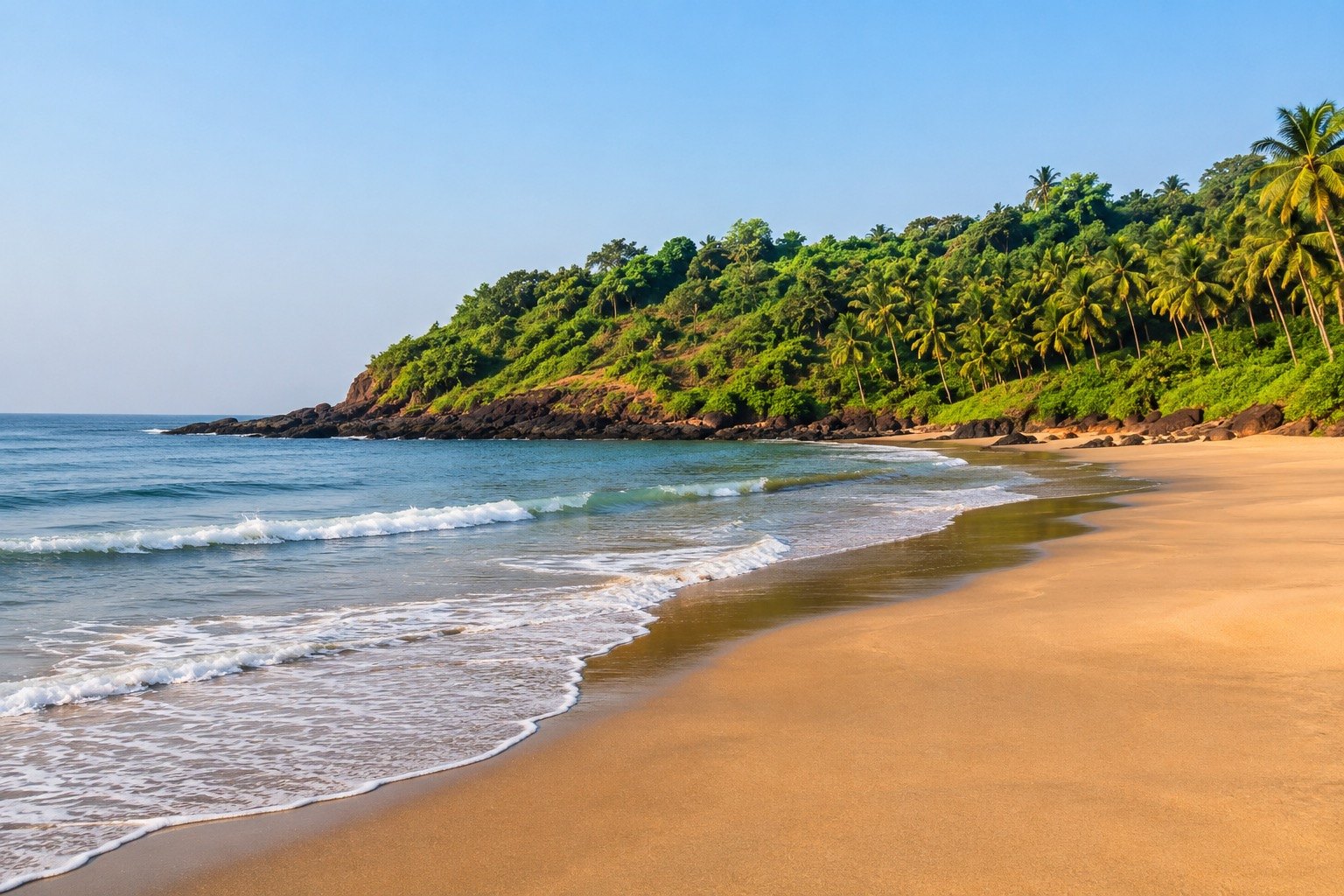
Three Maharashtra beaches have won the international Blue Flag eco-label for 2026-27, the State's first. They are Ladghar and Guhagar, both in Ratnagiri district, and Shrivardhan in Raigad. India has 22 Blue Flag beaches this season, 13 renewed and nine new, per the State's Environment and Climate Change Department. The season at the three Maharashtra beaches opens on 15 November.
Syllabus: Prelims · Current Affairs & IR; Prelims · Environment & Ecology; GS3 · Environment & Conservation
Why this matters for UPSC
GS3 environment: coastal conservation, eco-labels and Integrated Coastal Zone Management. Prelims can ask who awards the Blue Flag and what BEAMS is; Mains, coastal tourism versus ecology.
Why it matters
For a visitor at Ladghar, Guhagar or Shrivardhan, the label promises a beach whose bathing water is sampled and the results made public. It also means toilets, drinking water, waste sorting and access for people with disabilities. The flag is held one season at a time, so gram panchayats, beach management committees and district officials have to keep the work going to win it again. For the wider coast, each certified beach shows that cleanliness, safety and the care of dunes and coastal plants can be managed together, which is what integrated coastal zone management sets out to do.
Prelims pointers
- Blue Flag criteria differ by site category: beaches, marinas and tourism boats each have their own requirements.
- BEAMS was launched in 2020 as India's own eco-label, with a flag raised at the first eight beaches recommended for the Blue Flag.
- SICOM, under the Ministry of Environment, Forest and Climate Change, runs ICZM and BEAMS; the National Centre for Coastal Research is under the Ministry of Earth Sciences.
- The ICZM concept was introduced at the 1992 Earth Summit in Rio de Janeiro; most coastal countries now follow its principles.
- Coastal activity in India is regulated through the Coastal Regulation Zone (CRZ) Notification, 2019, backed by Coastal Zone Management Plans.
- International Coastal Clean-up Day began in 1986 with Ocean Conservancy and is now observed in more than 100 countries.
Practise a UPSC-style question
With reference to the Blue Flag certification, consider the following statements:
1. It is an eco-label awarded by the International Union for Conservation of Nature (IUCN).
2. Its criteria are set separately for beaches, marinas and tourism boats.
3. A certified site must keep meeting the criteria through its season and is monitored during it.
Which of the statements given above is/are correct?
- (a) 1 and 2 only
- (b) 2 and 3 only
- (c) 1 and 3 only
- (d) 1, 2 and 3
Show the answer
Answer: (b) 2 and 3 only
Answer: (b) 2 and 3 only. The label belongs to the Foundation for Environmental Education, and it covers three kinds of site.
Statement 1: incorrect. PIB (2026) names the Foundation for Environmental Education (FEE), Denmark, as the body that awards the Blue Flag, not the IUCN.
Statement 2: correct. FEE's own criteria page sets requirements for beaches, marinas and tourism boats, and they vary by category.
Statement 3: correct. FEE says awarded sites must stay compliant for the whole Blue Flag season and face monitoring and control.
Eliminate: statement 1 is the surest error, since FEE awards the label. Out: (a), (c), (d).
Trap: Swapped attribution. The IUCN is a familiar environmental name, so a student may pin the beach eco-label on it instead of FEE.
Remember: Blue Flag = FEE, Denmark; beaches, marinas and tourism boats.
More from the 13 November 2026 edition
- MoRTH publishes draft Rent-A-Cab Scheme, 2026 to replace the 1989 Scheme Polity
- WHO Global Tuberculosis Report 2026: first End TB milestone reached late World & IR
- ISRO ground-tests redesigned PSLV third stage after two mission anomalies Sci-Tech
- ZSI and CMFRI describe Indian Bramble Shark, Echinorhinus roinee, as new species Environment
- NITI Aayog and IIM Ahmedabad assess all 14 PLI schemes Economy
- PLI ACC scheme: 22 bids for 10 GWh of grid-storage cell capacity Economy
- DRI seizes 12.87 tonnes of red sanders at Chennai Port Environment
- Ladakh bars Leh, Kargil protests till municipal polls end, citing Model Code Polity