
ISRO ground-tests redesigned PSLV third stage after two mission anomalies
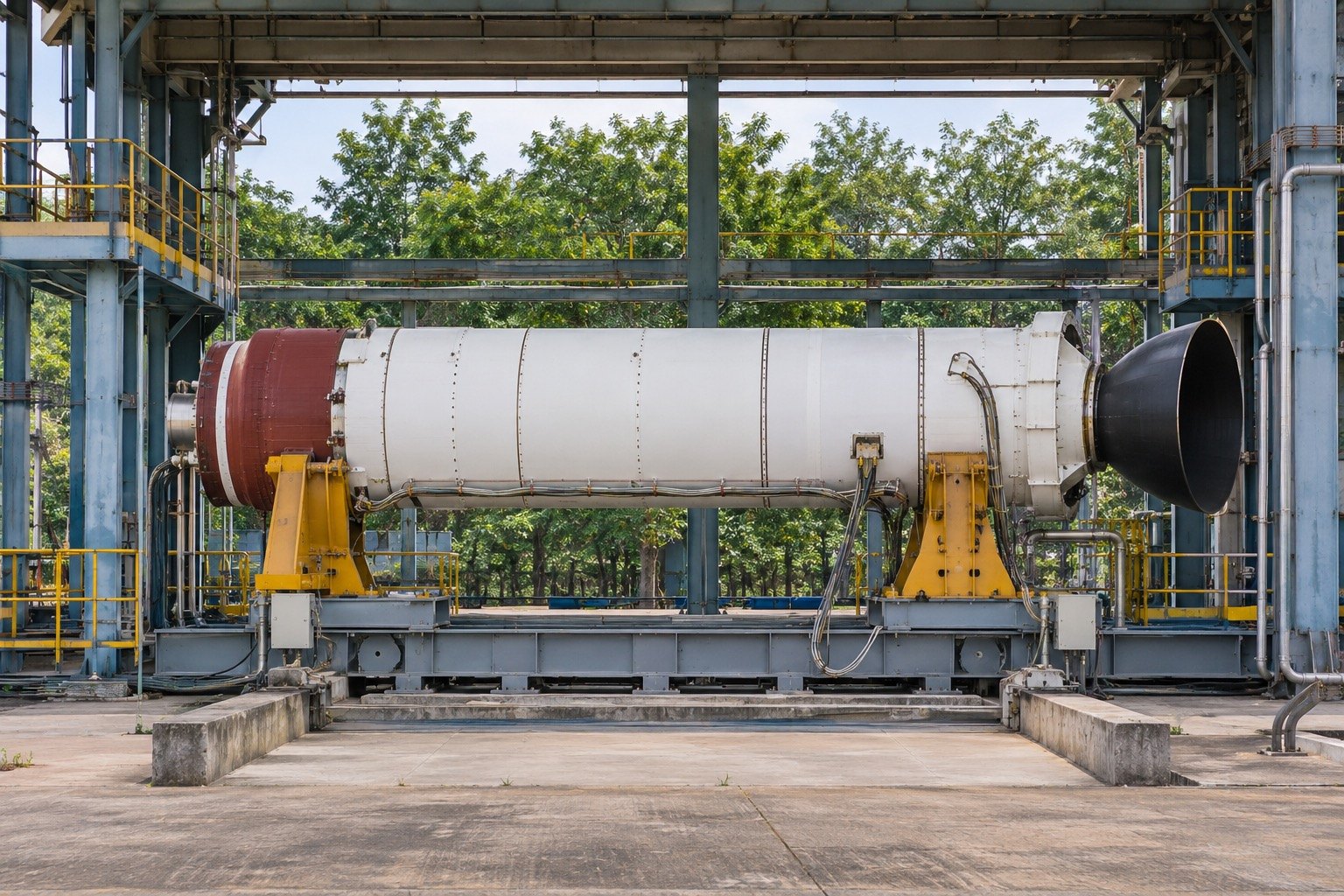
The Indian Space Research Organisation (ISRO) fired a redesigned third stage (PS3) of the Polar Satellite Launch Vehicle (PSLV) in a ground static test at Sriharikota on 12 November 2026. The solid motor stage was reworked after third-stage anomalies on the PSLV-C61 and PSLV-C62 missions. ISRO plans more tests once the data is analysed.
Syllabus: Prelims · Current Affairs & IR; GS3 · Indian Achievements in S&T; GS3 · IT, Space, Biotech & IPR
Why this matters for UPSC
GS3 science and technology: ISRO's launch vehicles and the PSLV. Prelims can ask the four stages and their propulsion; Mains, launch reliability and quality assurance.
Why it matters
For scientists, farmers' advisers and disaster managers who rely on Indian earth-observation satellites, a grounded launcher means data that arrives later. The PSLV is the vehicle ISRO calls its workhorse, so two third-stage anomalies in a row stall both government satellites and paying customers who booked rides through NSIL. A successful ground firing is the first proof that the weak stage has been fixed, but one test is not a flight: ISRO wants more data before it trusts the stage again. The episode also shows how a space programme recovers, by checking materials, assembly and inspection along with design, which is the same discipline any high-risk industry needs.
Prelims pointers
- PSLV alternates propulsion: PS1 and PS3 are solid motors, while PS2 and PS4 are liquid stages.
- PS1 uses the S139 solid motor holding 139 tonnes of HTPB; PS3 also burns an HTPB-based propellant and works after the atmospheric phase.
- Both liquid stages differ: PS2 has one Vikas engine, built by the Liquid Propulsion Systems Centre; PS4 has two engines and injects the payloads.
- Strap-on count by variant: PSLV-XL six, PSLV-QL four, PSLV-DL two; the core-alone PSLV-CA has none.
- ISRO rates the PSLV at up to 1,750 kg to a Sun-synchronous polar orbit at 600 km altitude.
- PSLV launched Chandrayaan-1 in 2008 and the Mars Orbiter Spacecraft in 2013, and put 104 satellites up in one 2017 mission.
Practise a UPSC-style question
With reference to the Polar Satellite Launch Vehicle (PSLV), consider the following statements:
1. Its second stage is powered by the cryogenic CE-7.5 engine.
2. Its first and third stages are solid motors that burn HTPB-based propellant.
3. Its fourth stage carries two Earth-storable liquid engines.
Which of the statements given above is/are correct?
- (a) 1 and 2 only
- (b) 2 and 3 only
- (c) 1 and 3 only
- (d) 1, 2 and 3
Show the answer
Answer: (b) 2 and 3 only
Answer: (b) 2 and 3 only. The PSLV has no cryogenic stage; its other two statements match ISRO's description.
Statement 1: incorrect. PS2 runs on the Vikas engine, an Earth-storable liquid engine from the Liquid Propulsion Systems Centre, not a cryogenic one.
Statement 2: correct. PS1 is the S139 motor with 139 tonnes of HTPB, and PS3 is a solid motor with HTPB-based propellant.
Statement 3: correct. PS4, the uppermost stage, has two Earth-storable liquid engines.
Eliminate: statement 1 is false, as PS2 uses the Vikas engine. Out: (a), (c), (d).
Trap: Look-alike names. The cryogenic engine name belongs to a different ISRO launcher, and placing it on the PSLV sounds plausible.
Remember: PSLV goes solid, liquid, solid, liquid; Vikas powers PS2.
More from the 13 November 2026 edition
- MoRTH publishes draft Rent-A-Cab Scheme, 2026 to replace the 1989 Scheme Polity
- WHO Global Tuberculosis Report 2026: first End TB milestone reached late World & IR
- ZSI and CMFRI describe Indian Bramble Shark, Echinorhinus roinee, as new species Environment
- NITI Aayog and IIM Ahmedabad assess all 14 PLI schemes Economy
- PLI ACC scheme: 22 bids for 10 GWh of grid-storage cell capacity Economy
- DRI seizes 12.87 tonnes of red sanders at Chennai Port Environment
- Ladakh bars Leh, Kargil protests till municipal polls end, citing Model Code Polity
- 22 Indian beaches get Blue Flag for 2026-27, Maharashtra's first three Environment