
Cabinet clears Rs 2,814-crore capex scheme for critical mineral processing
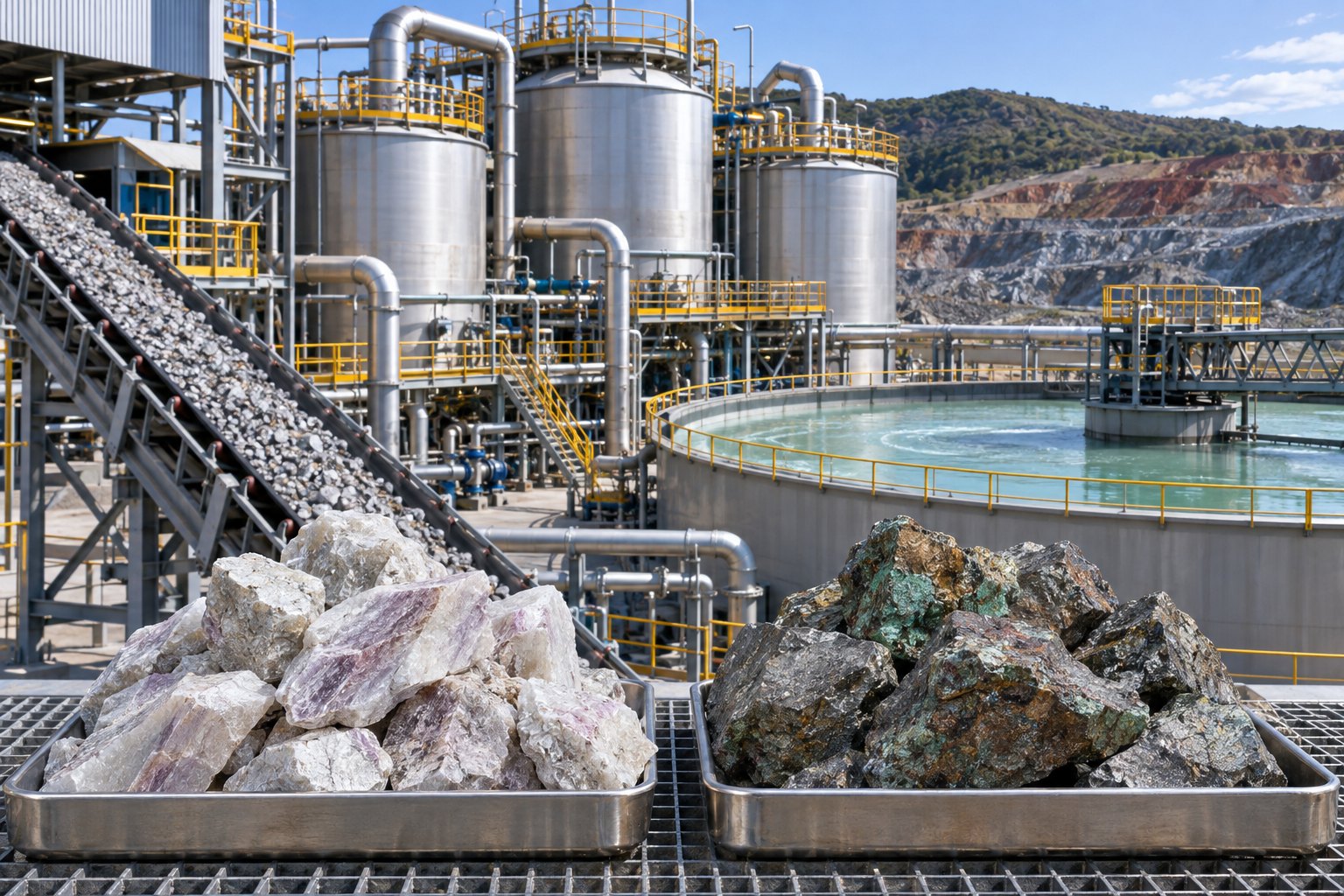
The Union Cabinet on 4 November 2026 approved a Rs 2,814-crore Capex Support Scheme to Promote Critical Mineral Processing, running from 2026-27 to 2030-31. It will pay 30% of eligible investment for four plants turning lithium and nickel into high-purity compounds. Support is capped at Rs 500 crore per lithium beneficiary and Rs 900 crore per nickel beneficiary.
Syllabus: GS3 · Indian Economy & Growth; Prelims · Current Affairs & IR; GS3 · Liberalisation & Industry
Why this matters for UPSC
GS3 economy: critical mineral processing and supply-chain security. Prelims can ask the NCMM's scope and KABIL; Mains, India's import dependence for battery minerals.
Why it matters
A battery maker in India today buys most of its refined lithium and nickel compounds from abroad. A shipping halt or an export curb elsewhere can then stall its line and push up the price of electric vehicles and grid batteries. Plants at home would keep more of that value in India and give factories a nearer supplier. Refining is the step where capital costs are heaviest and technology hardest to obtain, which is why private firms have held back; sharing part of the plant cost lowers that barrier. The larger issue is economic security: control over refining shapes who can build the clean-energy economy, and India's decarbonisation goals depend on steady supply.
Prelims pointers
- The NCMM's Rs 34,300 crore over seven years combines Rs 16,300 crore of government expenditure with Rs 18,000 crore expected from PSUs and others.
- The Critical Mineral Mission was announced in the Union Budget for 2024-25 and approved by the Union Cabinet in January 2025.
- KABIL, a joint venture of the Ministry of Mines, has acquired about 15,703 hectares in Argentina's Catamarca province for lithium exploration and mining.
- The Geological Survey of India carries out exploration projects for critical minerals, while blocks of strategic minerals have been auctioned by the Ministry of Mines.
- The Union Budget 2024-25 removed customs duties on most critical minerals to encourage processing within India.
- Lithium, nickel and cobalt are key components of lithium-ion batteries used in smartphones and electric vehicles.
- The S&T PRISM programme of the Ministry of Mines, launched in 2023, funds start-ups and MSMEs to carry research and development through to commercial use.
Practise a UPSC-style question
With reference to the National Critical Mineral Mission (NCMM), consider the following statements:
1. The mission was first announced in the Union Budget for 2023-24.
2. It covers recovery of critical minerals from end-of-life products and from overburden and tailings.
3. It proposes building a stockpile of critical minerals within the country.
Which of the statements given above is/are correct?
- (a) 1 and 2 only
- (b) 2 and 3 only
- (c) 1 and 3 only
- (d) 1, 2 and 3
Show the answer
Answer: (b) 2 and 3 only
Answer: (b) 2 and 3 only. The mission was announced in the 2024-25 Budget, not the 2023-24 one.
Statement 1: incorrect. The Finance Minister announced the Critical Mineral Mission in the Union Budget for 2024-25, on 23 July 2024; the Cabinet approved it in January 2025.
Statement 2: correct. The NCMM spans the whole value chain, including recovery from end-of-life products, and promotes recovery from overburden and tailings.
Statement 3: correct. The mission proposes developing a domestic stockpile of critical minerals.
Eliminate: statement 1 is off by a year, so every option holding 1 goes. Out: (a), (c), (d).
Trap: Near-miss figure. The year 2023-24 sits one Budget before the real announcement, and the 2023 amendment of the mining law makes it feel right.
Remember: NCMM: announced in Budget 2024-25, approved January 2025, exploration to recycling.
Explainers on this topic
More from the 5 November 2026 edition
- Supreme Court calls additional sales tax reference academic; Kodar ruling stands Polity
- Finance Ministry extends Swachh Bharat Mission (Grameen) Phase-II to March 2028 National
- Cabinet extends Fast Track Special Courts scheme till 2031 National
- Cabinet approves VISTAR scheme to overhaul India's official statistics National
- Cabinet approves pathway for all Agniveers to become regular soldiers Defence
- Cabinet approves Rs 14,500 crore VGF scheme for 92 GWh energy storage Economy
- Two-child election norm has lost relevance, Supreme Court holds Polity
- RBI eases FEMA reporting for service exports and imports by individuals Economy
- IRDAI sets four-layer motor insurance cover for private cars, two-wheelers Economy
- Supreme Court: foreign divorce on irretrievable breakdown not valid in India Polity
- Election Commission: SIR-dropped voters filing Form 6 face no Section 31 action Polity
- IndiaAI Mission releases indigenous foundation models EKA-1 and Dhir Sci-Tech