
Finance Ministry extends Swachh Bharat Mission (Grameen) Phase-II to March 2028
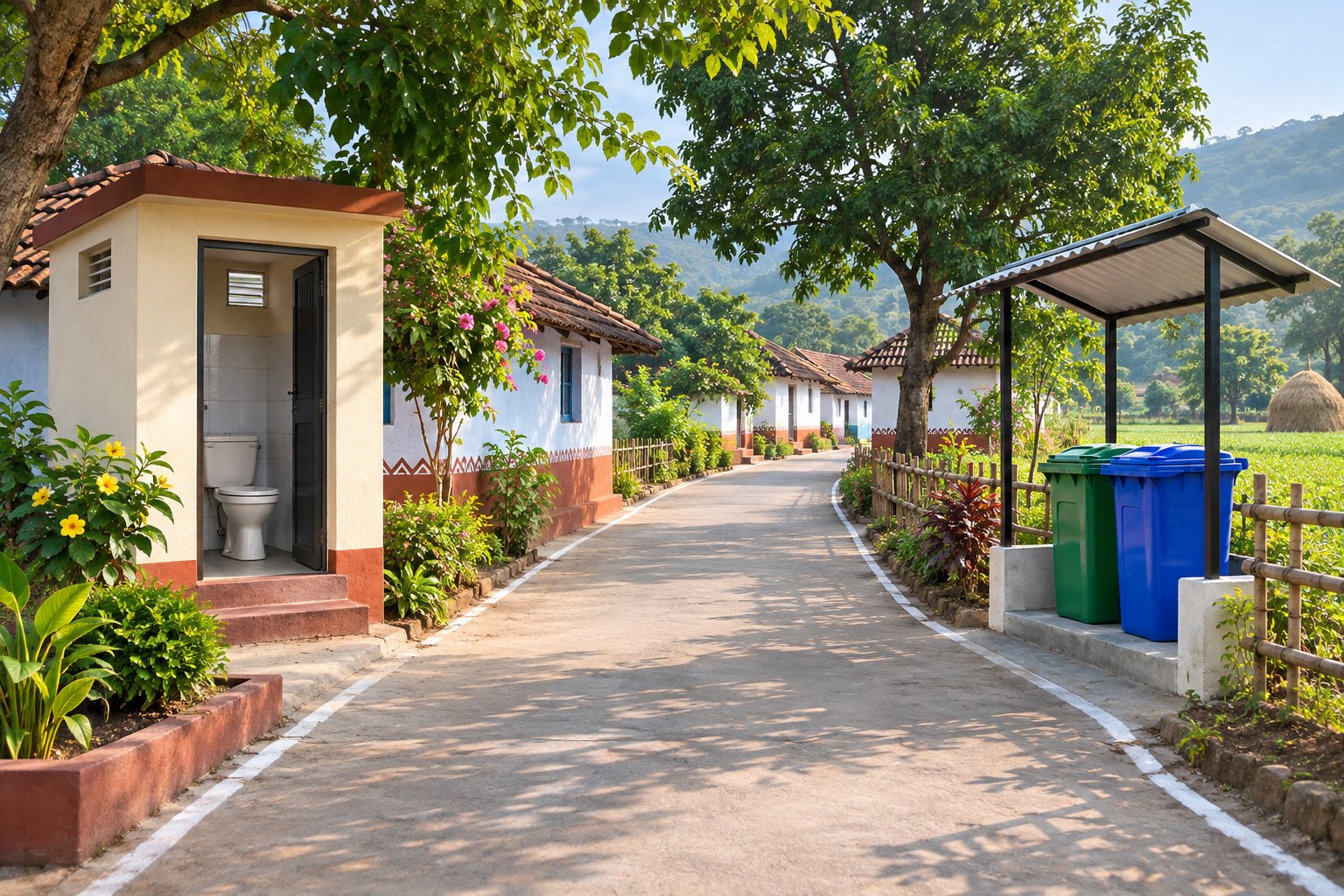
The Finance Ministry on 3 November 2026 extended Swachh Bharat Mission (Grameen) Phase-II to 31 March 2028, at the Department of Drinking Water and Sanitation's request. All remaining villages must become ODF Plus by then, within the existing outlay, and no further extension will be considered. The scheme's dashboard lists 5.70 lakh of 5.86 lakh villages as ODF Plus.
Syllabus: Prelims · Economy & Social Development; GS2 · Government Policies; GS2 · Welfare of Vulnerable Sections
Why this matters for UPSC
GS2 welfare schemes and GS3 sanitation: Swachh Bharat Mission (Grameen) and ODF Plus. Prelims can ask Phase-II's funding and components; Mains, sustaining sanitation gains.
Why it matters
A woman in a village that is ODF but not yet ODF Plus may have a toilet at home, yet the water from her kitchen and bathing still runs into the lane and stands there. Plastic piles up at the village edge, and sludge from a full septic tank has nowhere safe to go. Such waste can foul wells and ponds and spread disease even after open defecation ends. The extension gives the remaining villages one more year of central help for soak pits, compost pits, plastic units and desludging. Because the order shuts the door on any later extension, lagging States and gram panchayats now face a firm finish line. The larger question is whether sanitation gains, once declared, can be kept up.
Prelims pointers
- Swachh Bharat Mission (Grameen) was launched on 2 October 2014 and is implemented by the DDWS under the Ministry of Jal Shakti.
- Phase-II costs are shared 90:10 with North-Eastern and Himalayan States and Jammu and Kashmir, 60:40 with other States, and 100:0 with other Union Territories.
- ODF Plus tiers: Aspiring villages have solid or liquid waste arrangements; Rising villages have both; Model villages have both plus visual cleanliness and ODF Plus messages.
- Phase-II raised assistance to Gram Panchayats for a Community Managed Sanitary Complex from Rs 2 lakh to Rs 3 lakh per complex.
- Phase-II kept the incentive of Rs 12,000 for an Individual Household Toilet for newly eligible households and moved SLWM funding to a per capita basis.
- Twin pit toilets are SBM(G)'s recommended mode for in-situ treatment of faecal sludge; septic tank sludge is taken to treatment plants.
- SBM(G) greywater work follows three Rs, Reduce, Reuse and Recharge, mainly through on-site soak pits, leach pits and kitchen gardens.
Practise a UPSC-style question
With reference to Swachh Bharat Mission (Grameen), consider the following statements:
1. Under its Phase-II, the Centre and the North-Eastern and Himalayan States share costs in the ratio 90:10.
2. The mission is implemented by the Ministry of Housing and Urban Affairs.
Which of the statements given above is/are correct?
- (a) 1 only
- (b) 2 only
- (c) Both 1 and 2
- (d) Neither 1 nor 2
Show the answer
Answer: (a) 1 only
Answer: (a) 1 only. The cost ratio is right; the implementing ministry is wrong.
Statement 1: correct. PIB (2020) gives Phase-II cost sharing as 90:10 for North-Eastern and Himalayan States and Jammu and Kashmir.
Statement 2: incorrect. The Department of Drinking Water and Sanitation under the Ministry of Jal Shakti implements Swachh Bharat Mission (Grameen).
Eliminate: statement 2 is wrong and statement 1 is right, so only (a) stands. Out: (b), (c), (d).
Trap: Swapped attribution. The rural mission is pinned on an urban ministry, a swap that sounds plausible because the mission has an urban counterpart.
Remember: SBM (Grameen) is run by the DDWS, Ministry of Jal Shakti.
More from the 5 November 2026 edition
- Supreme Court calls additional sales tax reference academic; Kodar ruling stands Polity
- Cabinet extends Fast Track Special Courts scheme till 2031 National
- Cabinet approves VISTAR scheme to overhaul India's official statistics National
- Cabinet approves pathway for all Agniveers to become regular soldiers Defence
- Cabinet approves Rs 14,500 crore VGF scheme for 92 GWh energy storage Economy
- Cabinet clears Rs 2,814-crore capex scheme for critical mineral processing Economy
- Two-child election norm has lost relevance, Supreme Court holds Polity
- RBI eases FEMA reporting for service exports and imports by individuals Economy
- IRDAI sets four-layer motor insurance cover for private cars, two-wheelers Economy
- Supreme Court: foreign divorce on irretrievable breakdown not valid in India Polity
- Election Commission: SIR-dropped voters filing Form 6 face no Section 31 action Polity
- IndiaAI Mission releases indigenous foundation models EKA-1 and Dhir Sci-Tech