
Supreme Court asks NCLT, NCLAT heads for four-week infrastructure and staff plan
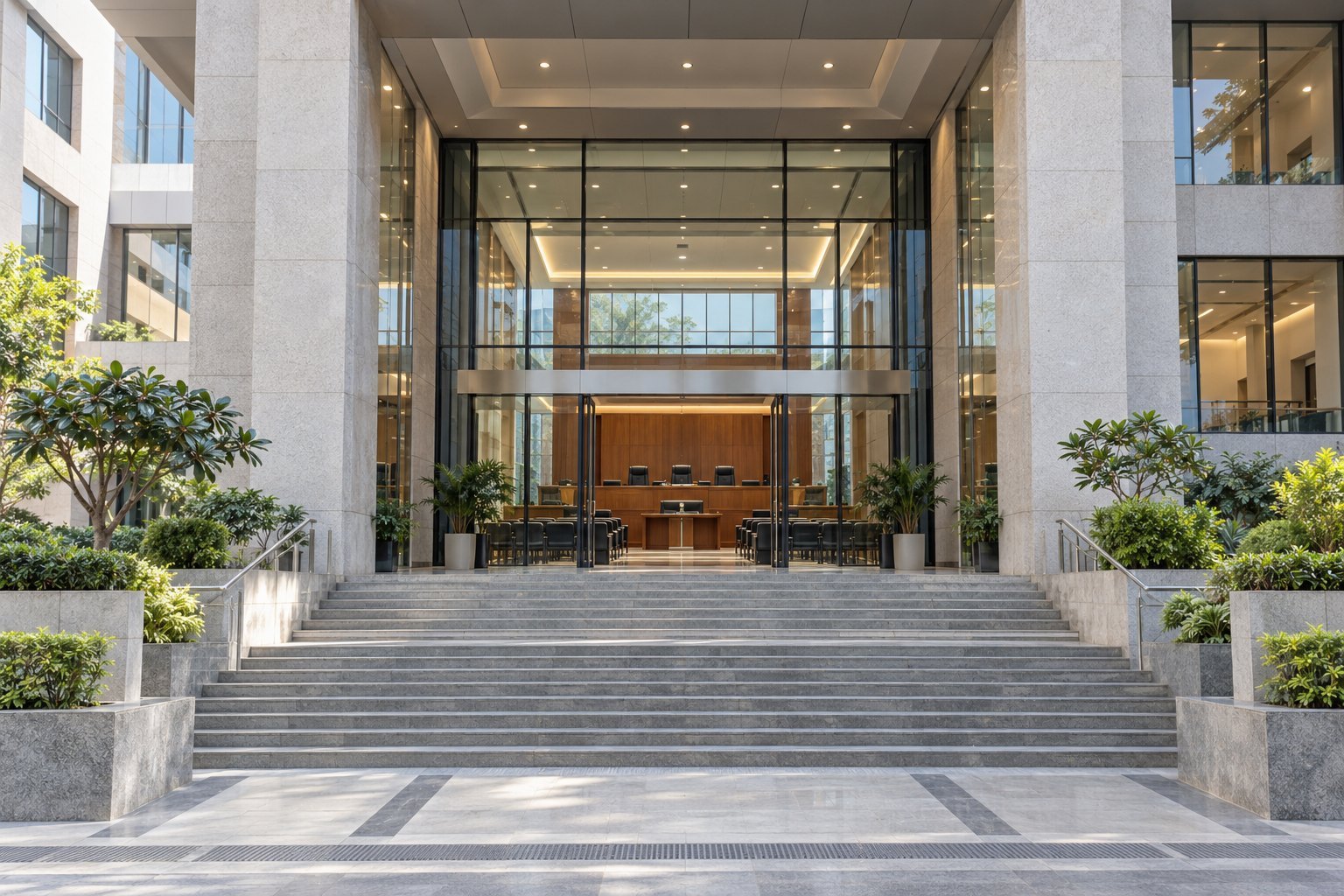
The Supreme Court on 29 October 2026 directed the heads of the National Company Law Tribunal (NCLT) and the National Company Law Appellate Tribunal (NCLAT) to submit proposals within four weeks. These are to cover infrastructure, land, buildings and staff. The Court also asked the Centre to hold a meeting with stakeholders.
Syllabus: GS3 · Indian Economy & Growth; GS2 · Separation of Powers; GS2 · Statutory & Regulatory Bodies
Why this matters for UPSC
GS2: statutory and quasi-judicial bodies, here the NCLT and NCLAT; GS3: insolvency under the IBC. Prelims can ask who hears appeals and on what; Mains, how tribunal capacity shapes insolvency outcomes.
Why it matters
A small supplier trying to recover dues from a bankrupt buyer has to wait for the NCLT to hear the case. When a bench runs short of members or a courtroom closes, hearings slip, and a failing firm's assets lose value while they sit idle. Lenders then recover less, buyers for the business walk away, and workers wait longer for the wages they are owed. The insolvency law was built on quick, time-bound resolution, so a tribunal without enough people or space weakens its central promise. The case also tests a wider question: whether bodies that take work away from courts are given the means to do it.
Prelims pointers
- The Central Government constitutes the NCLT by notification under the Companies Act, 2013; it has a President and Judicial and Technical Members.
- An NCLT order can be appealed to the NCLAT, except an order made with the consent of the parties.
- An appeal from an NCLAT order lies to the Supreme Court only on a question of law arising from that order.
- The Companies Act, 2013 asks both tribunals to try to dispose of each case within three months of filing.
- Under the Insolvency and Bankruptcy Code, 2016, the competent NCLT is the one with territorial jurisdiction over the corporate person's registered office.
- The NCLT decides corporate insolvency cases; the Insolvency and Bankruptcy Board of India (IBBI), set up by the same Code, is the regulator, not an adjudicator.
- The NCLT sits at a Principal Bench in New Delhi and fifteen regional benches, including Guwahati, Cuttack, Kochi, Amaravati and Indore.
Practise a UPSC-style question
With reference to the National Company Law Tribunal (NCLT), consider the following statements:
1. It exercises powers conferred on it by the Companies Act, 2013 and by any other law in force.
2. An appeal against its order lies directly to the Supreme Court of India.
3. No appeal lies to the appellate tribunal against its order made with the consent of parties.
Which of the statements given above is/are correct?
- (a) 1 and 2 only
- (b) 2 and 3 only
- (c) 1 and 3 only
- (d) 1, 2 and 3
Show the answer
Answer: (c) 1 and 3 only
Answer: (c) 1 and 3 only. Appeals from the NCLT go first to the NCLAT, not to the Supreme Court.
Statement 1: correct. The Companies Act, 2013 sets up the NCLT to exercise powers under that Act or any other law in force, such as the insolvency law.
Statement 2: incorrect. The Companies Act, 2013 sends appeals against NCLT orders to the National Company Law Appellate Tribunal (NCLAT).
Statement 3: correct. The Act bars an appeal to the NCLAT from an NCLT order made with the consent of parties.
Eliminate: statement 2 skips the appellate tier, so it is wrong. Out: (a), (b), (d).
Trap: Swapped attribution. The appeal is pinned on the Supreme Court instead of the NCLAT, the body the Act actually names.
Remember: NCLT to NCLAT to Supreme Court; consent orders cannot be appealed.
More from the 30 October 2026 edition
- US Freedom of Navigation report: three operations against India's maritime claims World & IR
- Narmada Control Authority's Review Committee adopts Sardar Sarovar dues settlement Polity
- UNODC survey: Afghan opium cultivation quadruples in 2026 despite Taliban ban World & IR
- Madhya Pradesh translocates over 1,200 protected blackbucks and nilgai from Shajapur farmland Environment
- DRI seizes 45 live reptiles smuggled from Bangkok at Trichy airport Environment
- PLI scheme for textiles reopens Round 4 with lower turnover bar Economy
- Japan and Bangladesh make Matarbari port the hub of upgraded BIG-B World & IR
- Indian Patent Office rejects BPaL TB regimen patent under Patents Act Sci-Tech