
UNODC survey: Afghan opium cultivation quadruples in 2026 despite Taliban ban
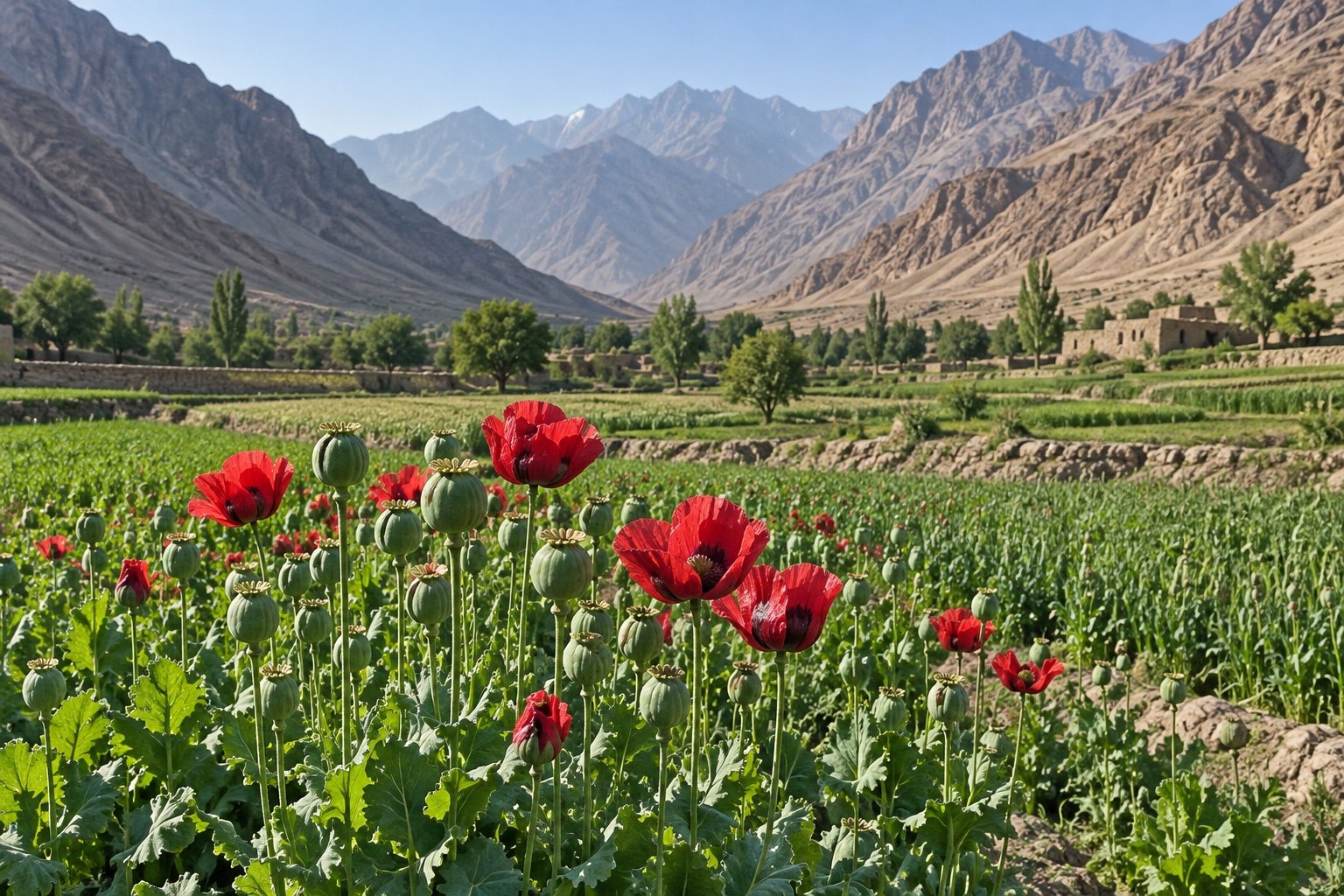
The United Nations Office on Drugs and Crime (UNODC) reported on 29 October 2026 that opium poppy in Afghanistan covered more than 43,000 hectares in 2026, up from about 10,000 hectares in 2025. Estimated opium output rose from about 300 tonnes to just under 1,500 tonnes. The rise came despite the Taliban's 2022 ban on the crop.
Syllabus: Prelims · Current Affairs & IR; GS3 · External Threats to Security; GS3 · Border Security & Organised Crime
Why this matters for UPSC
GS3 internal security and GS2 international bodies: UNODC and the Golden Crescent opium trade. Prelims can ask UNODC's mandate and the opium belts; Mains, bans versus alternative livelihoods.
Why it matters
A farmer in Badakhshan who earns far more from a field of poppy than from wheat will keep sowing it, even under threat of eradication. That choice shows why a ban alone rarely lasts: when poor households have no other crop, roads, storage or market, the drug crop returns. The revival feeds traffickers who move opium across the region and on to heroin users abroad. For India, which lies between the two great opium belts, a larger Afghan harvest means more pressure on border forces and anti-narcotics agencies. The larger issue is whether supply curbs can work without development aid and demand reduction.
Prelims pointers
- The United Nations Office on Drugs and Crime, headquartered in Vienna, was set up in 1997 and publishes the World Drug Report.
- UNODC is the guardian of the UN Convention against Transnational Organized Crime (adopted 2000, signed at Palermo) and the UN Convention against Corruption (adopted 2003).
- The three UN drug control treaties are the Single Convention on Narcotic Drugs, 1961, the Convention on Psychotropic Substances, 1971, and the 1988 Convention against Illicit Traffic.
- The Golden Crescent is Iran, Afghanistan and Pakistan, west of India; the Golden Triangle is the South-East Asian opium belt east of India, where Myanmar is the main grower.
- The Narcotic Drugs and Psychotropic Substances (NDPS) Act, 1985 is India's main drug law; the Narcotics Control Bureau (NCB) works under the Ministry of Home Affairs.
- The National Investigation Agency (NIA) was empowered under the NDPS Act in 2020 to probe narco-terrorism cases.
Practise a UPSC-style question
With reference to the United Nations Office on Drugs and Crime (UNODC), consider the following statements:
1. UNODC has its headquarters in Geneva, Switzerland.
2. UNODC is the guardian of the UN conventions against transnational organized crime and against corruption.
Which of the statements given above is/are correct?
- (a) 1 only
- (b) 2 only
- (c) Both 1 and 2
- (d) Neither 1 nor 2
Show the answer
Answer: (b) 2 only
Answer: (b) 2 only. UNODC sits in Vienna, and it guards the crime and corruption conventions.
Statement 1: incorrect. UNODC, started in 1997, has its headquarters in Vienna, Austria, not Geneva.
Statement 2: correct. UNODC is the guardian of the UN Convention against Transnational Organized Crime (2000) and the UN Convention against Corruption (2003).
Eliminate: statement 1 names the wrong city, and statement 2 is correct. Out: (a), (c), (d).
Trap: Look-alike names. Many UN bodies sit in Geneva, so the city swap reads as natural; UNODC belongs to the Vienna cluster of UN offices.
Remember: UNODC, Vienna, 1997; guardian of UNTOC and UNCAC.
More from the 30 October 2026 edition
- US Freedom of Navigation report: three operations against India's maritime claims World & IR
- Narmada Control Authority's Review Committee adopts Sardar Sarovar dues settlement Polity
- Supreme Court asks NCLT, NCLAT heads for four-week infrastructure and staff plan Polity
- Madhya Pradesh translocates over 1,200 protected blackbucks and nilgai from Shajapur farmland Environment
- DRI seizes 45 live reptiles smuggled from Bangkok at Trichy airport Environment
- PLI scheme for textiles reopens Round 4 with lower turnover bar Economy
- Japan and Bangladesh make Matarbari port the hub of upgraded BIG-B World & IR
- Indian Patent Office rejects BPaL TB regimen patent under Patents Act Sci-Tech