
US Freedom of Navigation report: three operations against India's maritime claims
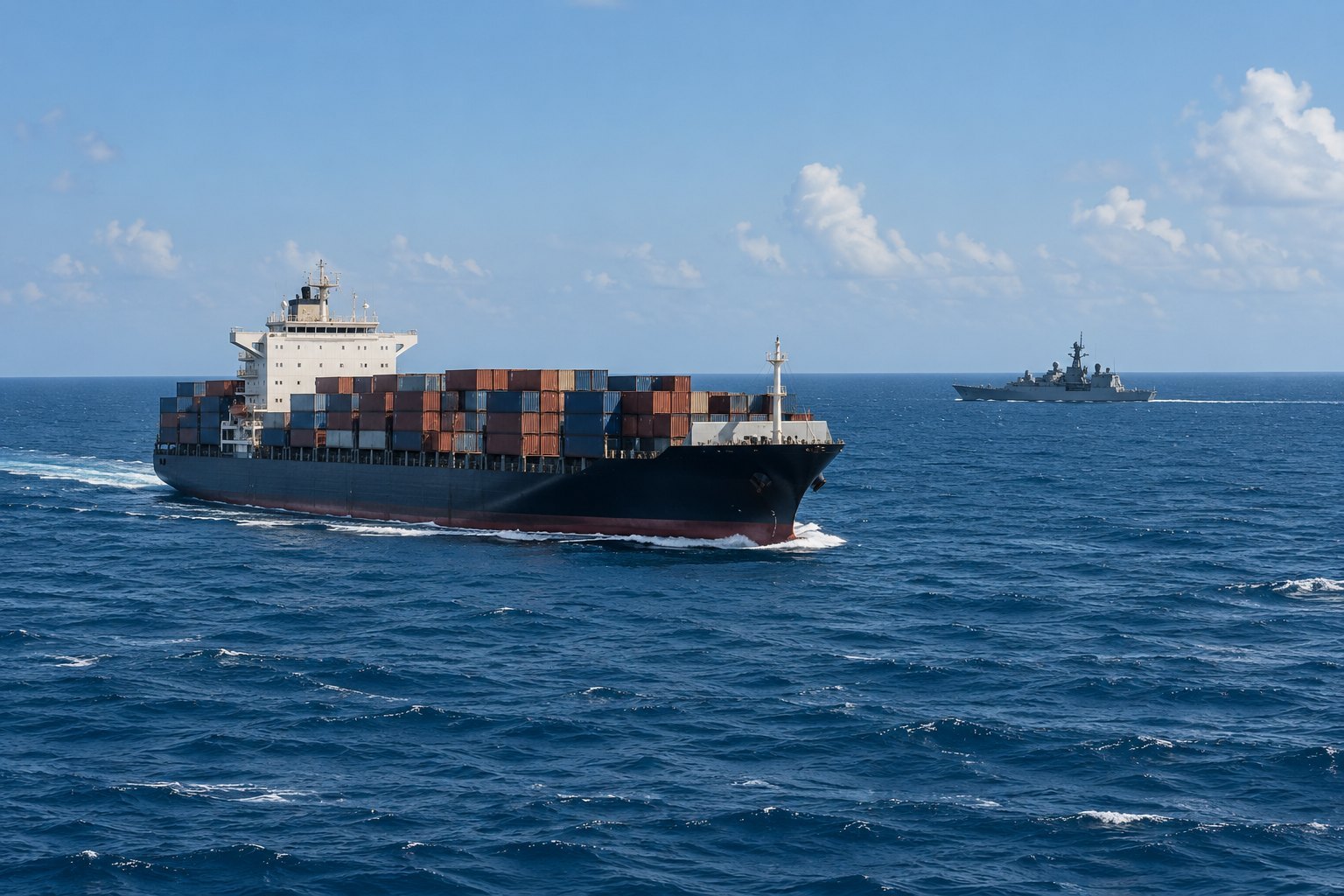
A US report lists three Freedom of Navigation Operations (FONOPs) against Indian maritime claims in fiscal year 2025. That is India's highest yearly count in public records since 1991. They contested Lakshadweep's straight baselines, India's consent rule for foreign military drills in its exclusive economic zone, and hazardous-cargo notice.
Syllabus: Prelims · Current Affairs & IR; GS2 · Foreign Policies & the Diaspora; GS3 · Border Security & Organised Crime
Why this matters for UPSC
GS2 international relations and GS3 security: UNCLOS maritime zones and India-US ties. Prelims can ask EEZ rights and innocent passage; Mains, coastal rights versus navigation freedom.
Why it matters
For an Indian naval planner, the report is a reminder that a close naval partner does not accept parts of India's sea law. A challenge to the Lakshadweep baselines is more than a quarrel over rules: the US ships may enter waters India counts as its own sovereign territory. The US runs these operations so that a coastal State's rules never settle into accepted State practice, so how India answers each one shapes the standing of its claims. The operations also come as the Indian Navy flies US-made patrol aircraft and helicopters and shares logistics and secure communications with the US Navy. New Delhi has to defend its legal position without unsettling a partnership it values.
Prelims pointers
- The 1976 Act gives all foreign ships other than warships innocent passage, but foreign warships need prior notice to the Centre, and submarines must surface and show their flag.
- The Centre may alter the limits of the territorial sea, contiguous zone or EEZ by notification only after both Houses of Parliament approve it by resolution.
- Under Article 19 of UNCLOS, weapons practice, launching aircraft, gathering defence information, fishing or survey work in the territorial sea makes a ship's passage not innocent.
- Under Article 58 of UNCLOS, all States may also lay submarine cables and pipelines in another State's EEZ, besides navigating and overflying it.
- Look-alike: the territorial sea carries sovereignty over the water, seabed and airspace, subject to innocent passage; the EEZ carries only sovereign rights over resources.
Practise a UPSC-style question
With reference to the exclusive economic zone under the United Nations Convention on the Law of the Sea (UNCLOS), consider the following statements:
1. The coastal State has sovereignty over the airspace above its exclusive economic zone.
2. The coastal State has sovereign rights to explore, exploit and manage the zone's natural resources, living and non-living.
Which of the statements given above is/are correct?
- (a) 1 only
- (b) 2 only
- (c) Both 1 and 2
- (d) Neither 1 nor 2
Show the answer
Answer: (b) 2 only
Answer: (b) 2 only. The EEZ gives resource rights, not sovereignty over the airspace.
Statement 1: incorrect. Under Article 58 of UNCLOS, all States enjoy freedom of overflight in an EEZ; sovereignty over airspace applies to the territorial sea.
Statement 2: correct. Article 56 of UNCLOS gives the coastal State sovereign rights for exploring, exploiting, conserving and managing natural resources in its EEZ.
Eliminate: statement 1 gives the EEZ a power that belongs to the territorial sea. Out: (a), (c).
Eliminate: statement 2 matches Article 56. Out: (d).
Trap: Wrong scope. Sovereignty, which a State holds in its territorial sea, is stretched to the EEZ, where it holds only sovereign rights over resources.
Remember: territorial sea, sovereignty; EEZ, sovereign rights over resources, with navigation and overflight free for all.
More from the 30 October 2026 edition
- Narmada Control Authority's Review Committee adopts Sardar Sarovar dues settlement Polity
- Supreme Court asks NCLT, NCLAT heads for four-week infrastructure and staff plan Polity
- UNODC survey: Afghan opium cultivation quadruples in 2026 despite Taliban ban World & IR
- Madhya Pradesh translocates over 1,200 protected blackbucks and nilgai from Shajapur farmland Environment
- DRI seizes 45 live reptiles smuggled from Bangkok at Trichy airport Environment
- PLI scheme for textiles reopens Round 4 with lower turnover bar Economy
- Japan and Bangladesh make Matarbari port the hub of upgraded BIG-B World & IR
- Indian Patent Office rejects BPaL TB regimen patent under Patents Act Sci-Tech