
Narmada Control Authority's Review Committee adopts Sardar Sarovar dues settlement
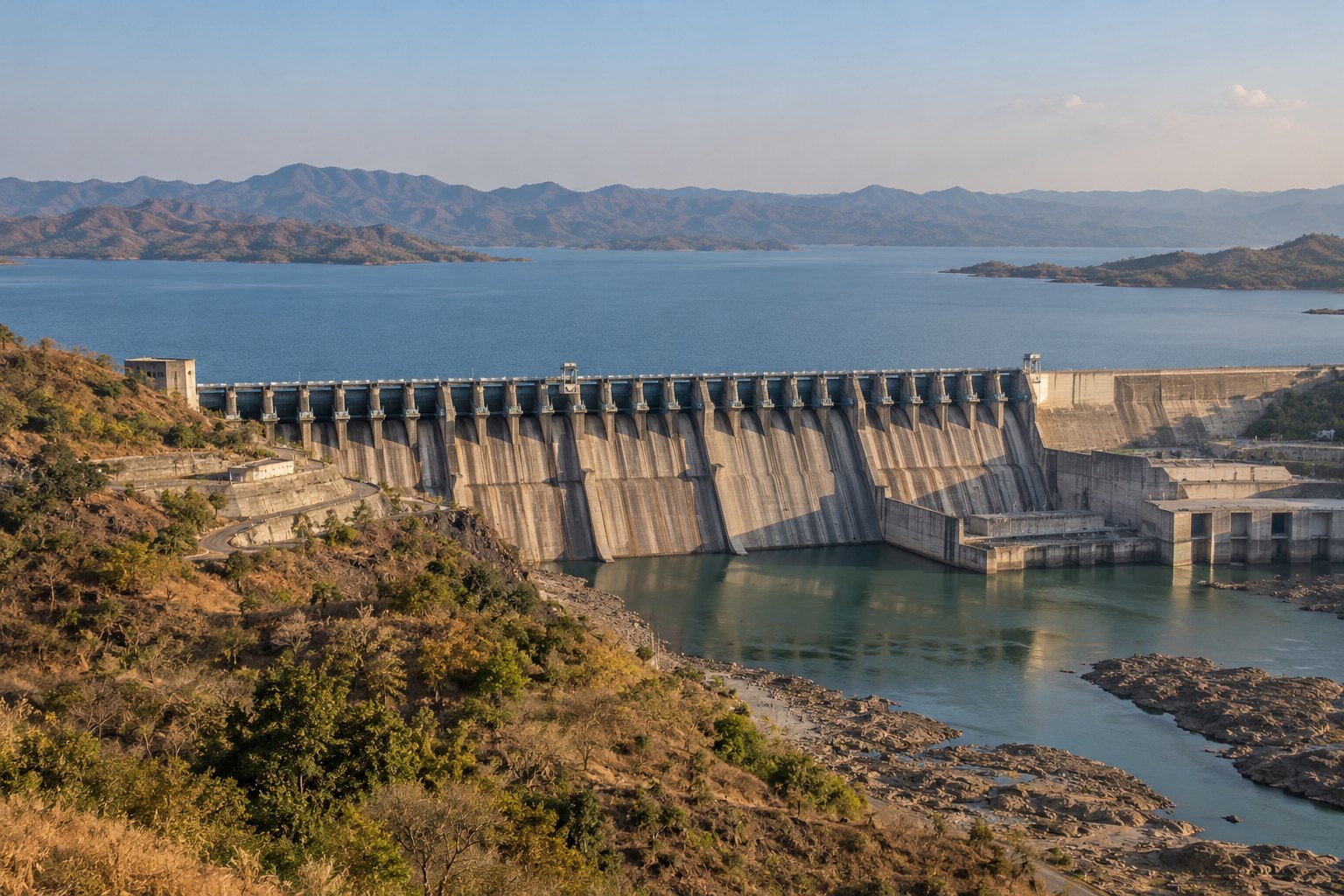
Gujarat, Madhya Pradesh, Maharashtra and Rajasthan will settle their pending Sardar Sarovar dues in one go. The Review Committee for Narmada Control Authority (RCNCA) adopted their 7 July 2026 agreement as a one-time settlement at its 15th meeting on 27 October 2026. It also adopted the Attorney General's opinion and approved the modalities for paying the outstanding dues within 2026-27.
Syllabus: GS2 · Federalism & Local Government; GS2 · Separation of Powers; GS3 · Agriculture & Irrigation
Why this matters for UPSC
GS2 federalism: inter-State water disputes, Article 262 and the 1956 Act. Prelims can ask about the NWDT award and the NCA; Mains, how tribunals and joint bodies settle river disputes.
Why it matters
A farmer in Rajasthan whose fields now get Narmada water depends on four States that share both the river and the bill for the dam. Their quarrel over what each owed for building it stayed unresolved for a long time, and a one-time settlement closes that account instead of leaving it open to fresh claims. It matters beyond this river too. The award's water shares are open to review after 45 years, and such a review goes more smoothly when the States already trust the joint body that keeps the books. The settlement shows a standing body, not a courtroom, ending a money dispute between States.
Prelims pointers
- Article 262 sits in Part XI of the Constitution, on relations between the Union and the States; Article 263, beside it, lets the President establish an Inter-State Council.
- The 1956 Act bars the Supreme Court and other courts from any water dispute that may be referred to a tribunal under it.
- The NWDT award gives Madhya Pradesh 18.25 MAF, Gujarat 9.00 MAF, Rajasthan 0.50 MAF and Maharashtra 0.25 MAF of Narmada water.
- The NCA, set up in 1980 to carry out the award, differs from the NWDT of 1969, which adjudicated the dispute itself.
- The NCA is chaired by the Secretary of the Union water resources ministry; the Chief Secretaries of the four party States are among its members.
Practise a UPSC-style question
With reference to inter-State river water disputes in India, consider the following statements:
1. Article 262 allows Parliament to provide by law that the Supreme Court shall not hear such disputes.
2. A published tribunal decision under the Inter-State River Water Disputes Act, 1956 has the force of a High Court decree.
3. The Act allows the Centre to frame a scheme setting up an authority to implement a tribunal's decision.
Which of the statements given above is/are correct?
- (a) 1 and 2 only
- (b) 2 and 3 only
- (c) 1 and 3 only
- (d) 1, 2 and 3
Show the answer
Answer: (c) 1 and 3 only
Answer: (c) 1 and 3 only. The decree force is that of the Supreme Court, not a High Court.
Statement 1: correct. Article 262 lets Parliament by law bar the Supreme Court and any other court from inter-State river water disputes.
Statement 2: incorrect. Since a 2002 amendment, a tribunal decision published by the Centre has the same force as an order or decree of the Supreme Court.
Statement 3: correct. The Act lets the Centre frame a scheme, including an authority, to give effect to a tribunal's decision; the Narmada Control Authority came this way.
Eliminate: statement 2 names the wrong court. Out: (a), (b), (d).
Trap: Swapped attribution. The decree force is pinned on a High Court instead of the Supreme Court, which sounds plausible for a State dispute.
Remember: Article 262 bars courts; a published award equals a Supreme Court decree.
More from the 30 October 2026 edition
- US Freedom of Navigation report: three operations against India's maritime claims World & IR
- Supreme Court asks NCLT, NCLAT heads for four-week infrastructure and staff plan Polity
- UNODC survey: Afghan opium cultivation quadruples in 2026 despite Taliban ban World & IR
- Madhya Pradesh translocates over 1,200 protected blackbucks and nilgai from Shajapur farmland Environment
- DRI seizes 45 live reptiles smuggled from Bangkok at Trichy airport Environment
- PLI scheme for textiles reopens Round 4 with lower turnover bar Economy
- Japan and Bangladesh make Matarbari port the hub of upgraded BIG-B World & IR
- Indian Patent Office rejects BPaL TB regimen patent under Patents Act Sci-Tech