
Telangana and Maharashtra agree to joint committee on Tummidihatti barrage
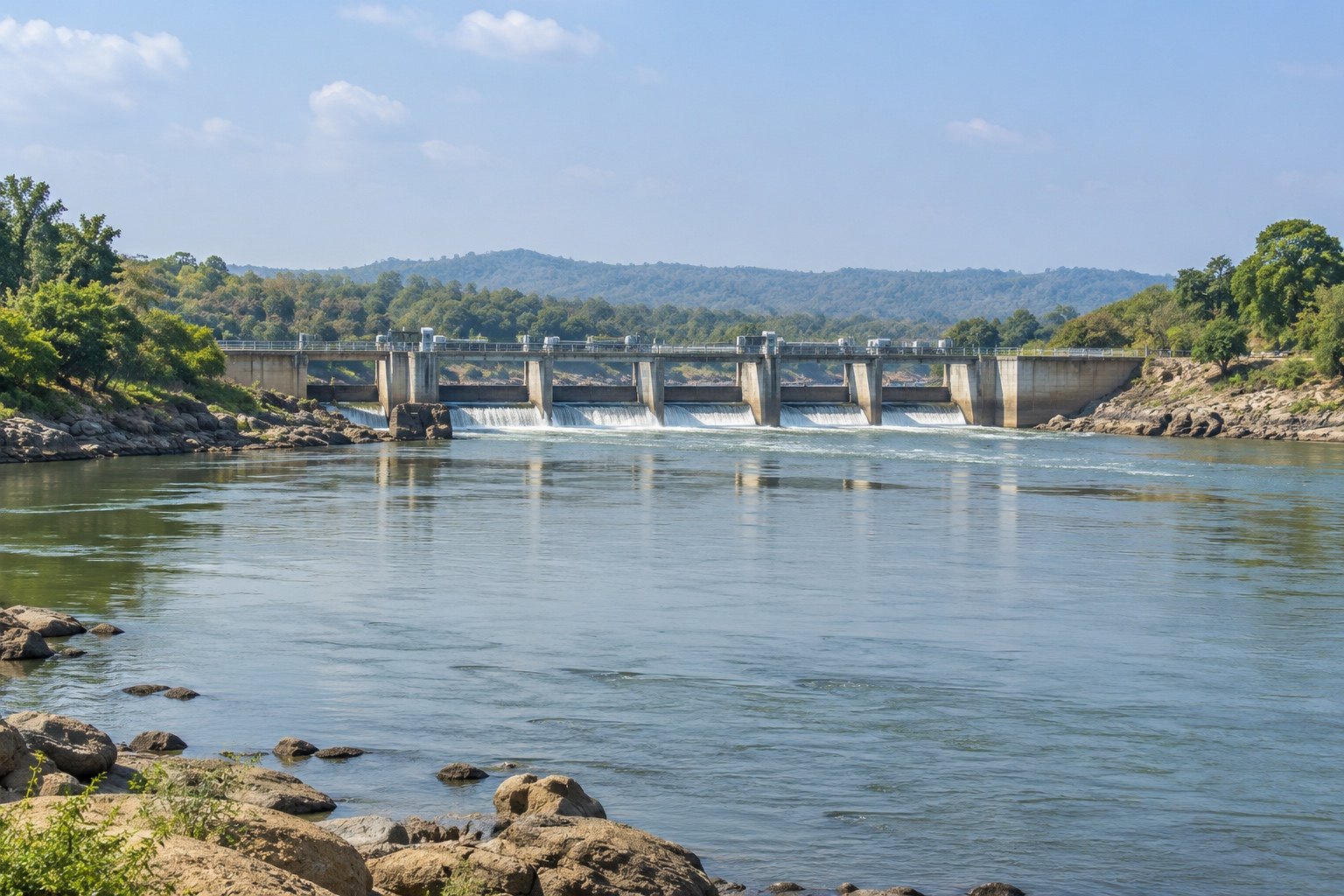
Telangana and Maharashtra agreed on 26 October 2026 in Mumbai to set up a joint committee of officials on raising the proposed Tummidihatti barrage on the Pranahita, a tributary of the Godavari. Telangana wants the barrage built to 150-152 metres against the 148 metres fixed in 2016. Maharashtra will separately study the submergence on its side.
Syllabus: GS2 · Federalism & Local Government; GS2 · Separation of Powers; Prelims · Geography
Why this matters for UPSC
GS2, inter-State relations and dispute redressal: Prelims can ask about Article 262, the Inter-State River Water Disputes Act, 1956 and the Pranahita in the Godavari basin; Mains, whether negotiation or tribunals settle river disputes better.
Why it matters
For a tribal farmer in the old Adilabad district of Telangana, a taller barrage means water could reach the fields by gravity instead of through costly pumps that the State must keep running. For a farmer across the river in Maharashtra, the same few metres decide whether a field stays dry or goes under water. Every dam on a shared river spreads its benefits on one side and its losses on the other. When the two governments cannot agree, a project can stay on paper for years while both sets of farmers wait. A joint study with agreed facts and fair compensation is the cheaper path, because a tribunal often takes far longer to decide.
Prelims pointers
- Article 262: Parliament may by law provide for adjudicating disputes over the use, distribution or control of inter-State river waters, and may exclude all courts.
- Section 3 of the 1956 Act: a State's request may rest on another State's executive action, its failure to use its powers, or its failure to honour a water agreement.
- Section 4 of the 1956 Act: if talks cannot settle a dispute, the Centre forms a tribunal within a year; the Chief Justice of India nominates its three judges.
- Section 4(3) of the 1956 Act: the Centre may, in consultation with a tribunal, appoint two or more assessors to advise it in the proceedings.
- Article 263: the President may by order set up an Inter-State Council to inquire into and advise upon disputes between States.
- Godavari award (July 1980): Maharashtra may use Godavari flows up to Paithan; changes need agreement of the party States or a law of Parliament.
- Godavari award: Inchampalli is a joint project of Madhya Pradesh, Maharashtra and Andhra Pradesh under a Tripartite Inter-State Control Board.
- Godavari award: the Polavaram agreement diverts 80 TMC of Godavari water to the Krishna upstream of the Vijayawada anicut.
Practise a UPSC-style question
With reference to the Inter-State River Water Disputes Act, 1956, consider the following statements:
1. A State may seek a reference when another State's proposed executive action threatens its interests in an inter-State river.
2. The members of a Water Disputes Tribunal are nominated by the President of India.
3. The Centre must constitute a tribunal within three years of receiving a State's request.
Which of the statements given above is/are correct?
- (a) 1 only
- (b) 2 only
- (c) 3 only
- (d) 1, 2 and 3
Show the answer
Answer: (a) 1 only
Answer: (a) 1 only. Only the ground for a State's request is stated correctly.
Statement 1: correct. Section 3 covers executive action or legislation taken, passed or proposed by another State that prejudices a State's interests in the river's waters.
Statement 2: incorrect. Section 4(2): the Chief Justice of India nominates the Chairman and two members from Supreme Court or High Court judges.
Statement 3: incorrect. Section 4(1), as amended in 2002, sets a limit of one year from the request.
Eliminate: statement 2 is wrong because the Chief Justice of India, not the President, nominates. Out: (b), (d).
Eliminate: statement 3 is wrong because the limit is one year. Out: (c).
Trap: Swapped attribution. The nominating authority is moved from the Chief Justice of India to the President, a familiar appointing name that sounds right.
Remember: State requests (s.3); Centre forms the tribunal within a year if talks fail; CJI nominates the judges (s.4).
Explainers on this topic
More from the 28 October 2026 edition
- UNFCCC NDC Synthesis Report: new pledges cut emissions only 6% by 2035 Environment
- Project Cheetah cub found injured outside Kuno dies of pellet injuries Environment
- National Highways Fee Rules amended to add annual Local Pass for residents Economy
- NHRC women's safety advisory seeks action reports within two months Polity
- Maharashtra wildlife board approves Kolamarka, Tansa sanctuaries and 14 conservation reserves Environment
- ECI suspends six Agra officials over lapses in Council teachers' poll Polity
- Violent Arunachal shutdown cancels hearing on Subansiri Upper hydro project Environment
- SC directs States, UTs to fund bar rooms, washrooms for women advocates Polity