
SC directs States, UTs to fund bar rooms, washrooms for women advocates
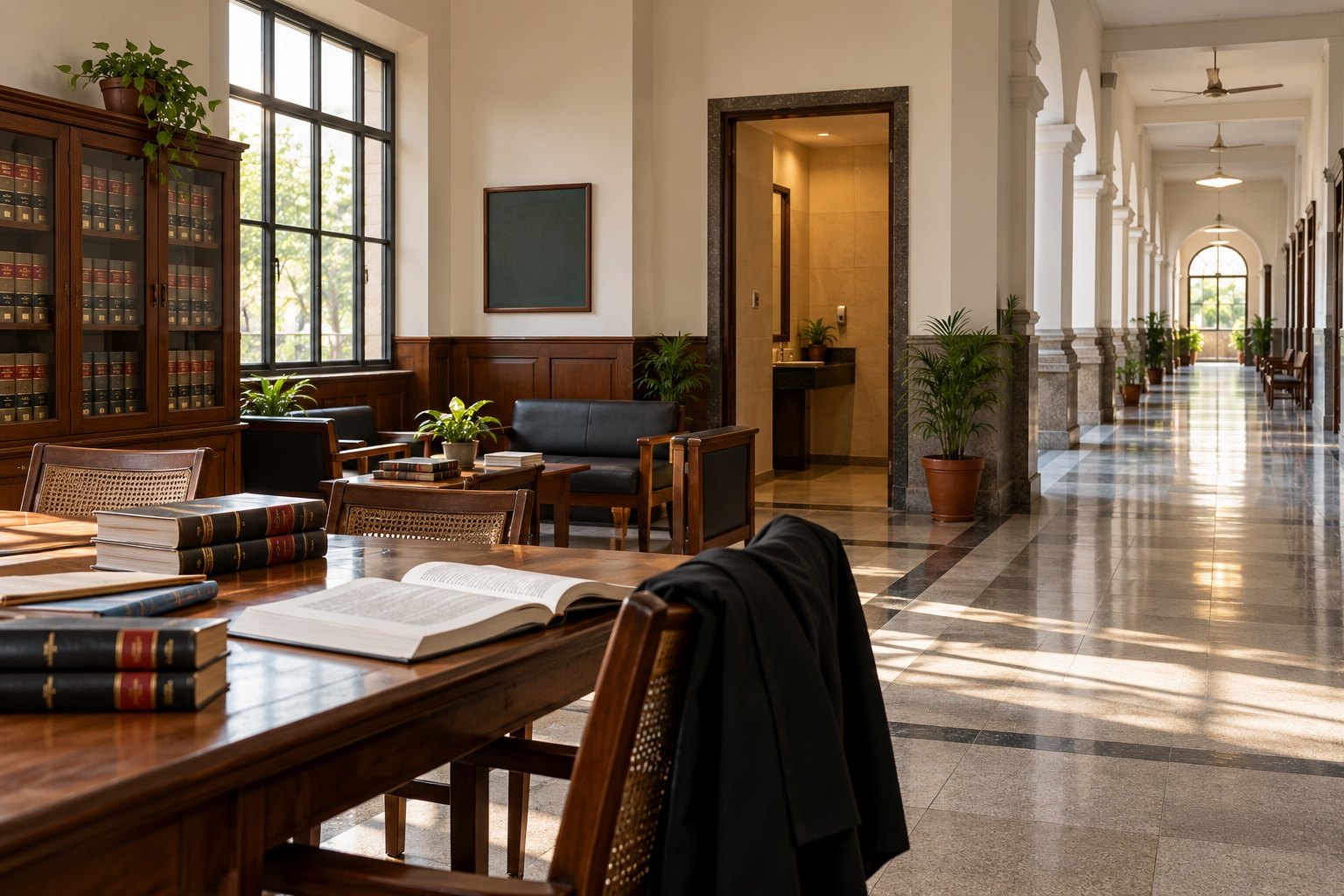
The Supreme Court on 26 October 2026 directed all States and Union Territories to allocate funds for bar rooms, washrooms and other basic amenities for women advocates in district and taluk courts. Wherever women practise, whatever their number, they must get an exclusive bar room. Extra land or money must be found if needed. The matter returns on 2 December.
Syllabus: GS2 · Constitution; Prelims · Polity & Governance; GS2 · Executive & Judiciary
Why this matters for UPSC
GS2 Polity: Articles 14, 15(3), 21 and 32 and the Centrally Sponsored Scheme for judicial infrastructure. Prelims can ask the scheme's funding pattern and the courts' place in the Concurrent List; Mains, women's equal access to the legal profession.
Why it matters
Picture a young woman advocate at a taluk court who has no room to sit between hearings, keep her files or change her robes, and no clean washroom within reach. She spends the working day in the court complex, so such a gap can decide whether she keeps practising there at all, and the Bar risks losing her. The direction turns a basic facility into a duty that States cannot defer on the plea of money or land. Because the Bar also supplies future judges and senior counsel, keeping women in district practice today shapes who argues and decides cases tomorrow. The larger issue is whether public institutions treat equal access for women as part of their design or as an afterthought.
Prelims pointers
- Article 15(3): nothing in Article 15 stops the State from making special provision for women and children.
- Article 14: the State shall not deny to any person equality before the law or the equal protection of the laws.
- Article 32(2): the Supreme Court may issue directions, orders or writs, including habeas corpus, mandamus, prohibition, quo warranto and certiorari.
- Entry 11A, Concurrent List: administration of justice and the constitution and organisation of all courts except the Supreme Court and High Courts; added by the Forty-second Amendment, 1976.
- Article 235: control over district courts and courts subordinate to them is vested in the High Court.
- Article 39A, a Directive Principle: the State shall secure equal justice and provide free legal aid so economic or other disabilities deny no citizen justice.
- Scheme monitoring: a High Court Level Monitoring Committee, a Central Level Monitoring Committee in the Department of Justice, and the Nyaya Vikas portal launched in 2018.
Practise a UPSC-style question
With reference to the Centrally Sponsored Scheme for Development of Infrastructure Facilities for the Judiciary, consider the following statements:
1. The scheme was first launched in 2014-15 to build court halls in district courts.
2. Union Territories receive full central funding under the scheme.
3. Lawyers' halls and toilet complexes in district and subordinate courts are covered under the scheme.
Which of the statements given above is/are correct?
- (a) 1 and 2 only
- (b) 2 and 3 only
- (c) 1 and 3 only
- (d) 1, 2 and 3
Show the answer
Answer: (b) 2 and 3 only
Answer: (b) 2 and 3 only. The scheme dates from 1993-94, and it funds UTs fully and now covers lawyers' halls and toilets.
Statement 1: incorrect. The scheme has been implemented since 1993-94; 2014-15 is only the year from which the Ministry counts a share of later releases.
Statement 2: correct. The fund-sharing pattern gives 100% central funding to the Union Territories, per the Ministry of Law and Justice.
Statement 3: correct. Revised guidelines of 19 August 2021 added lawyers' halls, toilet complexes and digital computer rooms to court halls and residences.
Eliminate: statement 1 is wrong because the scheme began in 1993-94. Out: (a), (c), (d).
Trap: Near-miss figure. The year 2014-15 appears in the Ministry's release figures, so it feels familiar as a starting point.
Remember: Judicial infrastructure CSS: since 1993-94; 60:40, 90:10 for NE and Himalayan States, 100% for UTs.
More from the 28 October 2026 edition
- UNFCCC NDC Synthesis Report: new pledges cut emissions only 6% by 2035 Environment
- Project Cheetah cub found injured outside Kuno dies of pellet injuries Environment
- National Highways Fee Rules amended to add annual Local Pass for residents Economy
- NHRC women's safety advisory seeks action reports within two months Polity
- Maharashtra wildlife board approves Kolamarka, Tansa sanctuaries and 14 conservation reserves Environment
- Telangana and Maharashtra agree to joint committee on Tummidihatti barrage Polity
- ECI suspends six Agra officials over lapses in Council teachers' poll Polity
- Violent Arunachal shutdown cancels hearing on Subansiri Upper hydro project Environment