
Japan launches MMX probe to bring back a sample from Phobos
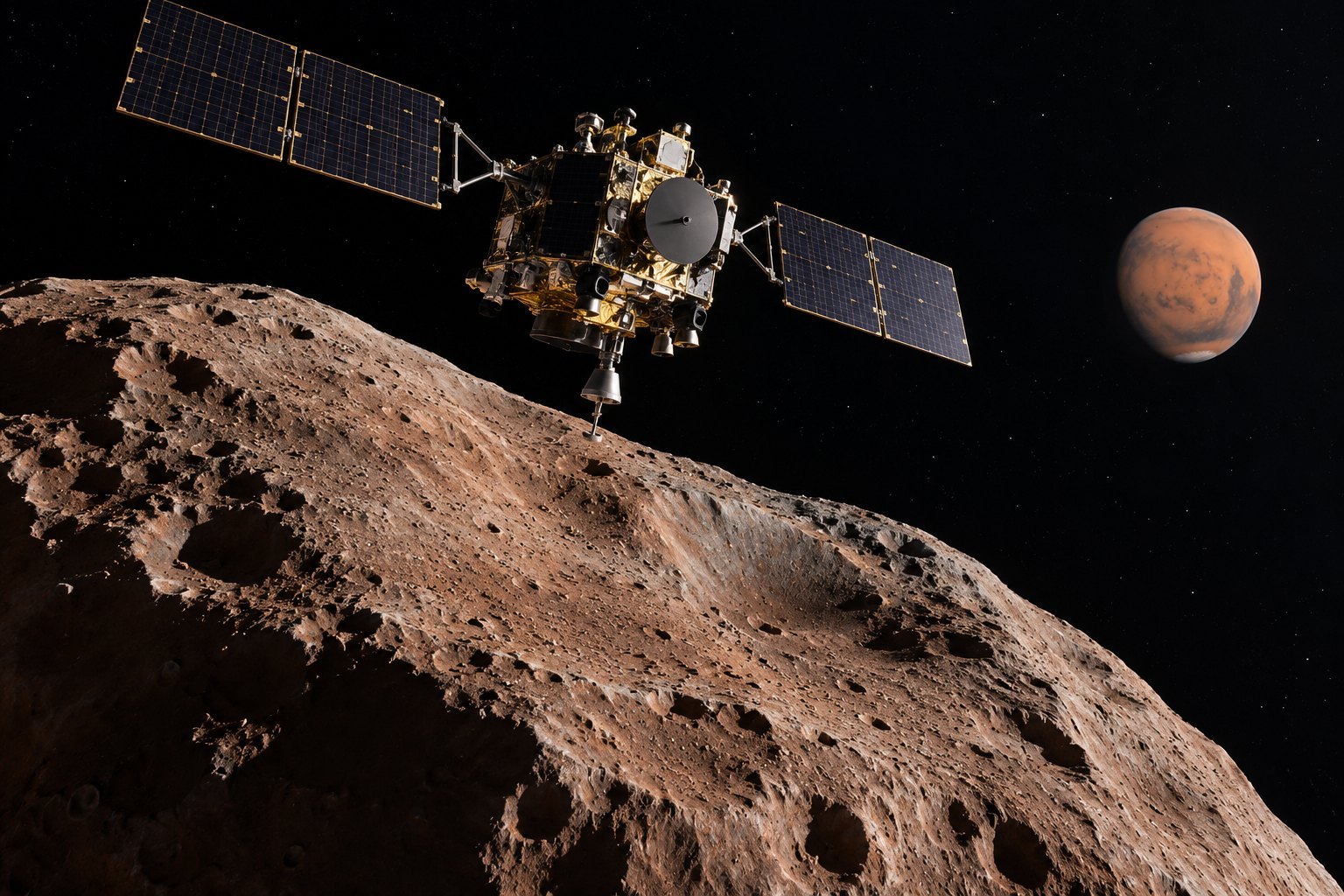
The Japan Aerospace Exploration Agency (JAXA) launched the Martian Moons eXploration (MMX) probe on an H3 rocket from Tanegashima Space Center on 20 October 2026. MMX is to orbit Phobos, the larger moon of Mars, land on it twice and return at least 10 grams of its surface material to Earth in 2031.
Syllabus: Prelims · Science & Technology; GS3 · Science & Technology; GS3 · IT, Space, Biotech & IPR
Why this matters for UPSC
GS3 science and technology (space): Prelims can ask about Mars's moons Phobos and Deimos, sample-return missions such as Hayabusa2 and MMX, and the Mars Orbiter Mission; Mains, about deep-space exploration and international cooperation in space.
Why it matters
Scientists still do not know how Mars got its two small moons. A piece of Phobos in a laboratory can show whether it is a captured asteroid or a chip of Mars itself, and that answer could help show how water and other ingredients for life reached rocky planets like Earth. The mission also tests what a crewed journey to Mars would need: reaching a moon, landing in almost no gravity and flying home. Space agencies of Japan, the United States, France, Germany and Europe share the cost and the sample, which shows how costly deep-space science is now done together. For India, which reached Mars orbit with its own orbiter, it marks the next step: going and coming back.
Prelims pointers
- Phobos is the larger of Mars's two moons, about 27 by 22 by 18 km; it orbits Mars three times a day (NASA).
- Deimos is the smaller and outer Martian moon and takes about 30 hours to circle Mars once (NASA).
- Asaph Hall discovered both Martian moons in 1877; they are named after the sons of the Greek war god Ares, Phobos meaning fear and Deimos terror.
- Phobos is drawing closer to Mars by about 1.8 metres every hundred years and may crash into it or break into a ring in about 50 million years (NASA).
- Stickney is the largest crater on Phobos; both moons appear to be made of C-type rock like carbonaceous chondrite asteroids (NASA).
- The H3's first stage uses two LE-9 engines that burn liquid hydrogen with liquid oxygen.
- With the Mars Orbiter Mission, ISRO became the fourth space agency to place a spacecraft in Mars orbit; designed for six months, it completed seven years there in September 2021.
Practise a UPSC-style question
With reference to the moons of Mars, consider the following statements:
1. Phobos is the larger of the two moons and orbits Mars three times a day.
2. Both moons of Mars were discovered by the astronomer Asaph Hall in 1977.
3. Deimos, the smaller moon, takes about 30 hours to complete one orbit of Mars.
Which of the statements given above is/are correct?
- (a) 1 and 2 only
- (b) 2 and 3 only
- (c) 1 and 3 only
- (d) 1, 2 and 3
Show the answer
Answer: (c) 1 and 3 only
Answer: (c) 1 and 3 only. Statements 1 and 3 give the moons' sizes and orbits correctly; statement 2 gives the wrong year of discovery.
Statement 1: correct. NASA describes Phobos as the larger Martian moon, about 27 by 22 by 18 km, circling Mars three times a day.
Statement 2: incorrect. Asaph Hall discovered both Phobos and Deimos in August 1877, a century before the year given, per NASA.
Statement 3: correct. Deimos is the smaller, outer moon and orbits Mars about every 30 hours, per NASA.
Eliminate: Statement 2 is the surest: Hall worked in the nineteenth century, so 1977 cannot be right. Out: (a), (b), (d).
Trap: Near-miss figure. The discoverer is right but the year is moved by exactly a century, 1977 for 1877, so a student who knows only the name is caught.
Remember: Phobos is larger and inner (three orbits a day); Deimos is smaller and outer (30 hours); Asaph Hall, 1877.
More from the 21 October 2026 edition
- India, US review ties in Mumbai, hold trilateral with UAE World & IR
- ECI lets EROs decide SIR discrepancy notices; hearings made exceptional Polity
- Tamil Nadu funds 25 extra work days beyond VB-G RAM G's 125 National
- Chhattisgarh's Sirpur enters India's UNESCO World Heritage Tentative List National
- SC directs Northeast panel to recommend law changes against racial harassment Polity
- No tax deducted on interest from NDB's Maharajah rupee bonds Economy
- India at UN renews offer of a multilateral No First Use pact World & IR
- Delhi HC: RTI security exemptions shield PM's IAF flight records Polity
- Supreme Court directs Centre to publicise Section 164A interim relief scheme Polity
- Dissent against a court verdict is not enmity: Karnataka High Court Polity
- SCO Council of Heads of Government adopts 2027 budget in Dushanbe World & IR
- UN dues: India tells Fifth Committee the Charter requires full, timely payment World & IR