
Tamil Nadu funds 25 extra work days beyond VB-G RAM G's 125
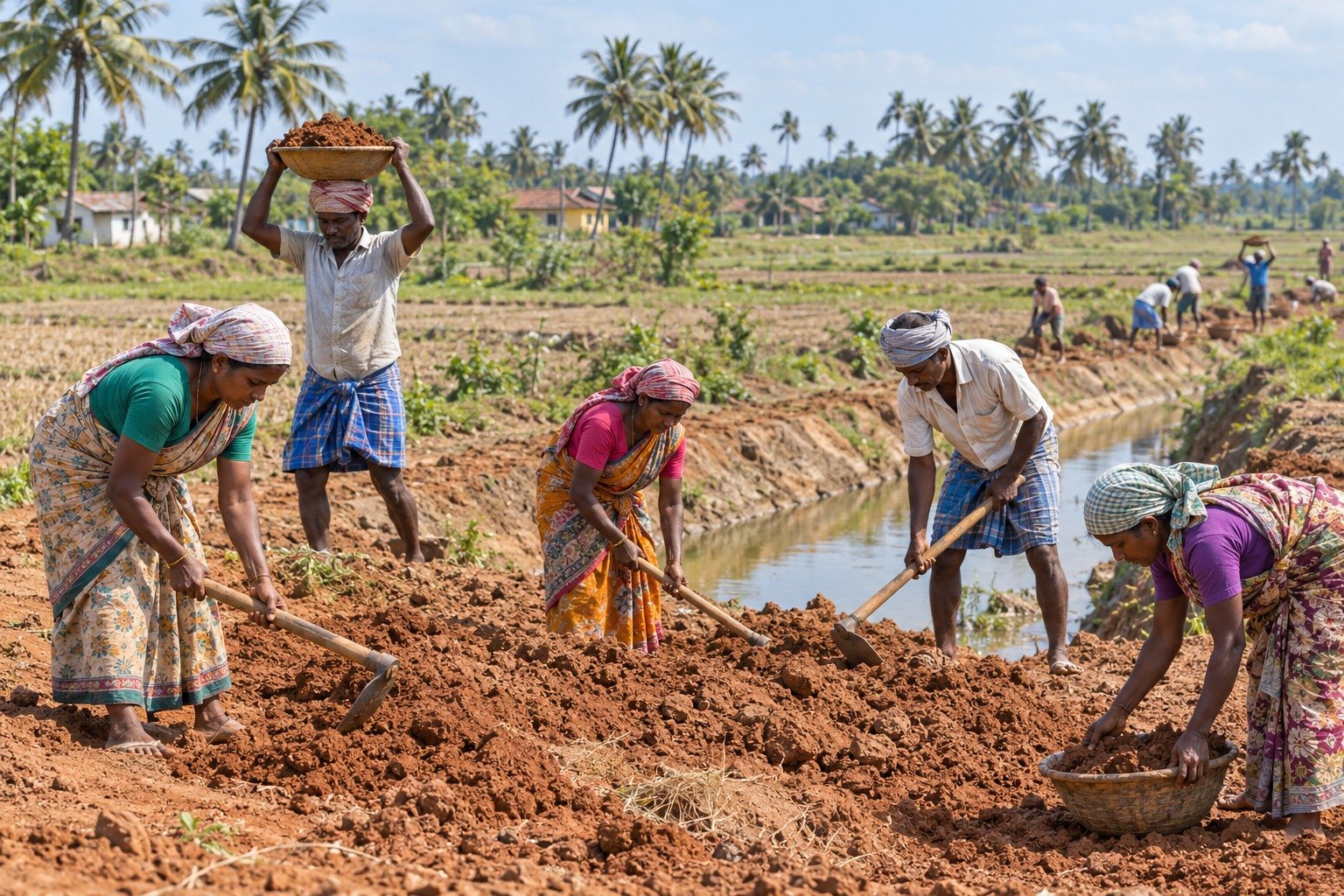
Tamil Nadu has sanctioned Rs 100 crore for 'Vetri 150', a State-funded scheme giving 25 more days of wage work to vulnerable rural households that complete the 125 days guaranteed under the Centre's VB-G RAM G Act, 2025. The extra days, taking them to 150 in 2026-27, go first to women-headed, Scheduled Caste, Scheduled Tribe and forest-rights households.
Syllabus: GS3 · Indian Economy & Growth; GS2 · Federalism & Local Government; Prelims · Economy & Social Development
Why this matters for UPSC
GS2 covers welfare schemes for vulnerable sections and Centre-State relations. Prelims can ask what the VB-G RAM G Act, 2025 guarantees and how its costs are shared; Mains, about States topping up central guarantees and targeting versus universal entitlement.
Why it matters
A woman heading a poor household in a Tamil Nadu village who has already used up her guaranteed work this year can now earn wages for nearly another month, in a season when farm work may be scarce. For a family caring for a disabled member, or a forest-dwelling tribal family, that is extra cash for food, school costs or repaying a loan. Because the State pays from its own purse, the benefit lasts only as long as its finances allow, and only the listed groups are served first. The larger question is whether a job guarantee should be aimed at the most vulnerable or left open to every rural family that asks for work.
Prelims pointers
- VB-G RAM G Act, 2025: States must notify in advance a no-work period aggregating 60 days a year, covering peak sowing and harvesting seasons.
- Fund sharing under the Act: 60:40 for most States; 90:10 for North Eastern and Himalayan States; the Centre bears the full cost in Union territories without legislature.
- If work is not given within 15 days of an application, a daily unemployment allowance is payable, and the liability rests on the State Government.
- Wages under the Act are paid weekly, or in any case within a fortnight of the work being done.
- Gram Panchayats implement at least half of the works by cost; Gram Sabhas conduct social audits at least once every six months.
- The Act raised the administrative expenditure ceiling from 6% to 9% and plans works through Viksit Gram Panchayat Plans linked to PM Gati Shakti.
- The Maharashtra Employment Guarantee Act of 1977 first introduced a statutory right to work in India, a model for MGNREGA.
- The Ministry of Tribal Affairs administers the Forest Rights Act, 2006, which makes the Gram Sabha a highly empowered body for forest dwellers.
Practise a UPSC-style question
With reference to the Viksit Bharat - Guarantee for Rozgar and Ajeevika Mission (Gramin) Act, 2025, consider the following statements:
1. States must notify in advance a no-work period aggregating 90 days a year covering peak sowing and harvesting.
2. It guarantees at least 125 days of wage employment a year to rural households whose adult members volunteer for unskilled manual work.
3. If work is not given within 15 days of an application, a daily unemployment allowance is payable, with the liability on the State.
Which of the statements given above is/are correct?
- (a) 1 and 2 only
- (b) 2 and 3 only
- (c) 1 and 3 only
- (d) 1, 2 and 3
Show the answer
Answer: (b) 2 and 3 only
Answer: (b) 2 and 3 only. The guarantee and the allowance are right; the farm-season pause is 60 days, not 90.
Statement 1: incorrect. States notify in advance a pause aggregating 60 days in a financial year for peak sowing and harvesting under the VB-G RAM G Act, 2025.
Statement 2: correct. The Act guarantees not less than 125 days a year to rural households whose adult members volunteer for unskilled manual work.
Statement 3: correct. A daily unemployment allowance is due if work is not given within 15 days of the application, and the State Government bears it.
Eliminate: statement 1 is wrong because the pause is 60 days. Out: (a), (c), (d).
Trap: Near-miss figure. The 90-day pause sounds plausible beside the 125-day guarantee, but the Act fixes the no-work period at 60 days.
Remember: VB-G RAM G: 125 days of work, 60-day farm-season pause, allowance after 15 days.
Explainers on this topic
More from the 21 October 2026 edition
- India, US review ties in Mumbai, hold trilateral with UAE World & IR
- ECI lets EROs decide SIR discrepancy notices; hearings made exceptional Polity
- Japan launches MMX probe to bring back a sample from Phobos Sci-Tech
- Chhattisgarh's Sirpur enters India's UNESCO World Heritage Tentative List National
- SC directs Northeast panel to recommend law changes against racial harassment Polity
- No tax deducted on interest from NDB's Maharajah rupee bonds Economy
- India at UN renews offer of a multilateral No First Use pact World & IR
- Delhi HC: RTI security exemptions shield PM's IAF flight records Polity
- Supreme Court directs Centre to publicise Section 164A interim relief scheme Polity
- Dissent against a court verdict is not enmity: Karnataka High Court Polity
- SCO Council of Heads of Government adopts 2027 budget in Dushanbe World & IR
- UN dues: India tells Fifth Committee the Charter requires full, timely payment World & IR