
Police accountability: Supreme Court panel opens portal on Jantar Mantar violence
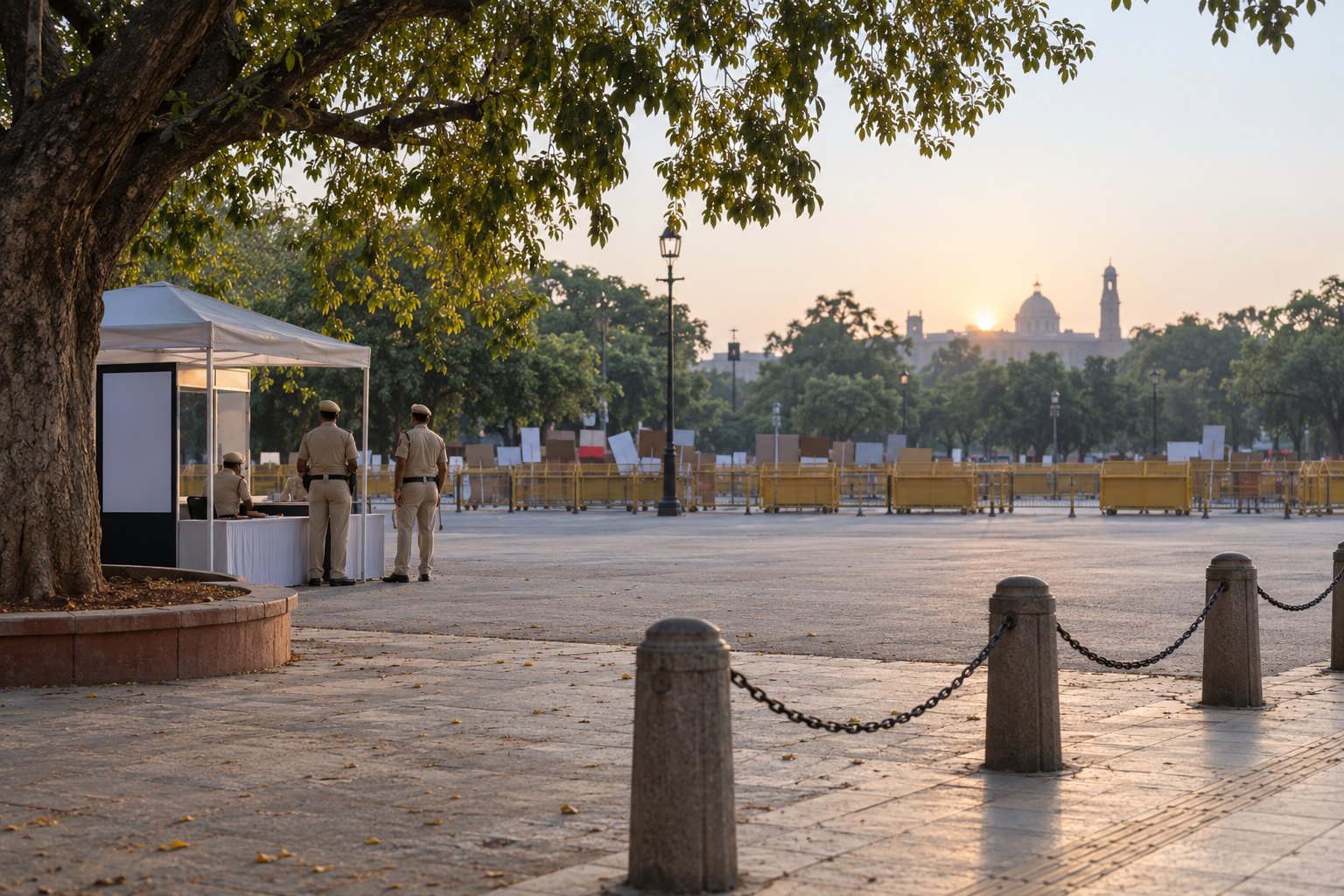
The Supreme Court's High Powered Enquiry Committee on the July 2026 violence at Jantar Mantar and places outside Delhi has opened a complaints portal, hpec.nic.in, the Ministry of Home Affairs said on 17 October 2026. Protesters and affected police personnel may both file. Complaints on pellet guns, targeted violence against women protesters and property destruction on either side get priority.
Syllabus: GS2 · Constitution; Prelims · Polity & Governance; GS4 · Ethics in Public Administration
Why this matters for UPSC
GS2 polity and governance: Prelims can ask what Article 19(1)(b) and Article 19(3) allow, why police is a State List subject and what a Police Complaints Authority does; Mains, about police accountability when force meets peaceful protest.
Why it matters
A protester struck by pellets, a woman who says she was harassed at the protests and a constable injured while holding a line now have the same place to be heard. Because a witness can stay unnamed and speak in private, people on either side who fear reprisal are more likely to come forward, so the record need not rest on official accounts alone. The committee will also look at the medical care and compensation given to those alleging police abuse, which bears directly on what victims receive. The larger question is whether police can be held to account for force used at protests without weakening their ability to keep order: the balance at the heart of the right to peaceful assembly.
Prelims pointers
- Article 19(3): the ground 'sovereignty and integrity of India' was added beside public order by the Constitution (Sixteenth Amendment) Act, 1963.
- Article 19 freedoms belong to citizens only; Article 21's protection of life and personal liberty extends to every person, foreigners included.
- Article 359: since the Forty-fourth Amendment Act, 1978, enforcement of Articles 20 and 21 cannot be suspended during an Emergency.
- Seventh Schedule, List II: public order is entry 1, police (including railway and village police) entry 2 and prisons entry 4.
- Article 239AA, inserted by the Sixty-ninth Amendment Act, 1991, gives Delhi a Legislative Assembly but excludes State List entries 1, 2 and 18.
- Prakash Singh directions (2006): a retired High Court judge heads the State Police Complaints Authority; a retired district judge heads the district one.
- Commissions of Inquiry Act, 1952, section 4: a commission has a civil court's powers under the Code of Civil Procedure, 1908, to summon and examine witnesses.
- Commissions of Inquiry Act, 1952, section 3(4): the report and a memorandum of action taken go before the legislature within six months.
Practise a UPSC-style question
With reference to the right to assemble under the Constitution of India, consider the following statements:
1. Article 19(1)(b) guarantees the right to assemble peaceably and without arms to every person in India, citizen or foreigner.
2. Article 19(3) allows reasonable restrictions on the right to assemble in the interests of public order.
3. The ground 'sovereignty and integrity of India' was added to Article 19(3) by the Constitution (Sixteenth Amendment) Act, 1963.
Which of the statements given above is/are correct?
- (a) 1 and 2 only
- (b) 2 and 3 only
- (c) 1 and 3 only
- (d) 1, 2 and 3
Show the answer
Answer: (b) 2 and 3 only
Answer: (b) 2 and 3 only. Article 19 rights belong to citizens, so statement 1 is the wrong one.
Statement 1: incorrect. Article 19(1) opens with "All citizens shall have the right", so assembling peaceably and without arms is not a foreigner's fundamental right.
Statement 2: correct. Article 19(3) lets the State impose reasonable restrictions on the right of assembly in the interests of public order.
Statement 3: correct. The Constitution (Sixteenth Amendment) Act, 1963 inserted "the sovereignty and integrity of India" into Article 19(3).
Eliminate: Judge statement 1 first: Article 19 speaks of citizens, so statement 1 is incorrect. Out: (a), (c), (d).
Trap: Wrong scope. A citizens' right is widened to every person in India, mixing up Article 19 with Article 21, which says "no person".
Remember: Article 19 is for citizens. Grounds to restrict assembly: public order, and sovereignty and integrity of India (added 1963).
More from the 19 October 2026 edition
- Pakistan NOTAM extends airspace ban on Indian aircraft to 24 November World & IR
- Supreme Court orders portal and rules protocol on autism stem-cell therapy Sci-Tech
- Kolkata pandal stampede: NDMA's crowd management guide and what failed National
- Gwalior temple truck crash: CSP removed, eight police suspended, inquiry ordered National
- CAQM orders PTZ cameras with live feeds at polluting NCR industries Environment
- Section 44A: RBI sanctions Emirates NBD branches' merger with RBL Bank Economy
- FSSAI issues notices over misleading labels on coffee-flavoured milk drinks National
- India–New Zealand FTA due in force on 20 October; origin rules notified Economy
- Section 125A: Supreme Court allows private complaints over false nomination affidavits Polity