
Pakistan NOTAM extends airspace ban on Indian aircraft to 24 November
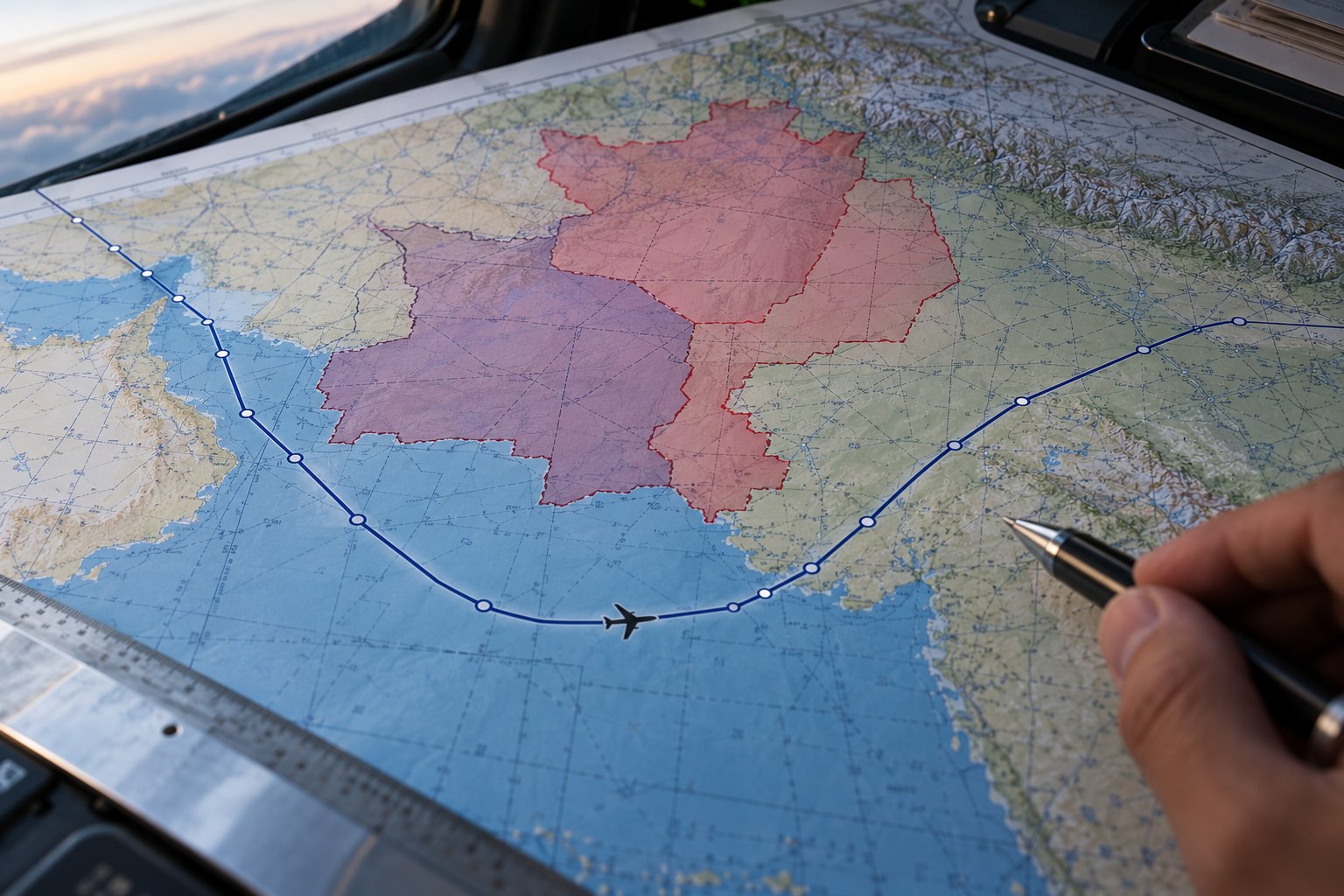
Pakistan has extended its airspace ban on Indian aircraft to 24 November 2026, through a fresh Notice to Airmen (NOTAM), its airports authority announced on 17 October. The ban, first imposed in April 2025, spans both of Pakistan's flight information regions and covers military flights. India closed its own airspace to Pakistani airlines on 30 April 2025.
Syllabus: Prelims · Current Affairs & IR; GS2 · India & its Neighbourhood; GS2 · International Institutions
Why this matters for UPSC
GS2 India and its neighbourhood, and international institutions: Prelims can ask what a NOTAM and a flight information region are and what Article 1 and Article 9 of the Chicago Convention provide; Mains, whether airspace closures fit the Convention.
Why it matters
For a passenger on an Indian airline, the ban can mean a longer journey on some international routes, because the aircraft has to fly around Pakistan instead of across it. Each extra hour in the air burns more fuel and keeps crew and aircraft busy for longer, a cost the airline bears and can pass on through fares. The closure also shows how a State's control of its own sky becomes a lever in a dispute: it is announced by a routine notice, renewed periodically, and its burden falls on travellers and airlines on the other side.
Prelims pointers
- Article 5: non-scheduled flights of other contracting States may enter or cross a State's territory non-stop, and stop for non-traffic purposes, without prior permission, subject to the Convention's terms.
- Article 6, Chicago Convention: no scheduled international air service may operate over or into a State's territory without that State's permission or authorisation.
- Article 9: in an emergency or for public safety, a State may temporarily restrict flying over all or part of its territory, without distinction of nationality among other States' aircraft.
- Article 9(c): a State may require an aircraft entering a prohibited or restricted area to land as soon as practicable at a designated airport within its territory.
- Article 8: an aircraft capable of flying without a pilot may be flown pilotless over a contracting State only with that State's special authorisation.
- Article 7: a State may refuse other States' aircraft cabotage, the carriage of passengers, mail or cargo for hire between two points within its territory.
- NOTAM distribution (ICAO): Class I NOTAMs go out by telecommunication; Class II NOTAMs are distributed by other means, such as publication.
Practise a UPSC-style question
With reference to the Convention on International Civil Aviation, 1944, consider the following statements:
1. Under it, a State's sovereign airspace extends over its land areas and its exclusive economic zone.
2. It treats aircraft used in military, customs and police services as state aircraft and does not apply to them.
Which of the statements given above is/are correct?
- (a) 1 only
- (b) 2 only
- (c) Both 1 and 2
- (d) Neither 1 nor 2
Show the answer
Answer: (b) 2 only
Answer: (b) 2 only. Sovereign airspace lies over land and territorial waters, and state aircraft fall outside the treaty.
Statement 1: incorrect. Article 2 defines a State's territory as its land areas and the territorial waters adjacent to them, not an exclusive economic zone.
Statement 2: correct. Article 3 applies the Convention to civil aircraft only and deems aircraft in military, customs and police services to be state aircraft.
Eliminate: Judge statement 2 first: Article 3 is the treaty's best-known split between civil and state aircraft, so statement 2 is correct. Out: (a), (d).
Eliminate: Judge statement 1: territory means land areas and territorial waters, so statement 1 is incorrect. Out: (c).
Trap: Wrong scope. Statement 1 stretches sovereign airspace from territorial waters out to the much wider exclusive economic zone.
Remember: Chicago Convention: sovereignty over airspace above land and territorial waters (Articles 1 and 2); state aircraft excluded (Article 3).
More from the 19 October 2026 edition
- Supreme Court orders portal and rules protocol on autism stem-cell therapy Sci-Tech
- Kolkata pandal stampede: NDMA's crowd management guide and what failed National
- Police accountability: Supreme Court panel opens portal on Jantar Mantar violence Polity
- Gwalior temple truck crash: CSP removed, eight police suspended, inquiry ordered National
- CAQM orders PTZ cameras with live feeds at polluting NCR industries Environment
- Section 44A: RBI sanctions Emirates NBD branches' merger with RBL Bank Economy
- FSSAI issues notices over misleading labels on coffee-flavoured milk drinks National
- India–New Zealand FTA due in force on 20 October; origin rules notified Economy
- Section 125A: Supreme Court allows private complaints over false nomination affidavits Polity