
Greater India Society at 100: India's cultural links across Asia
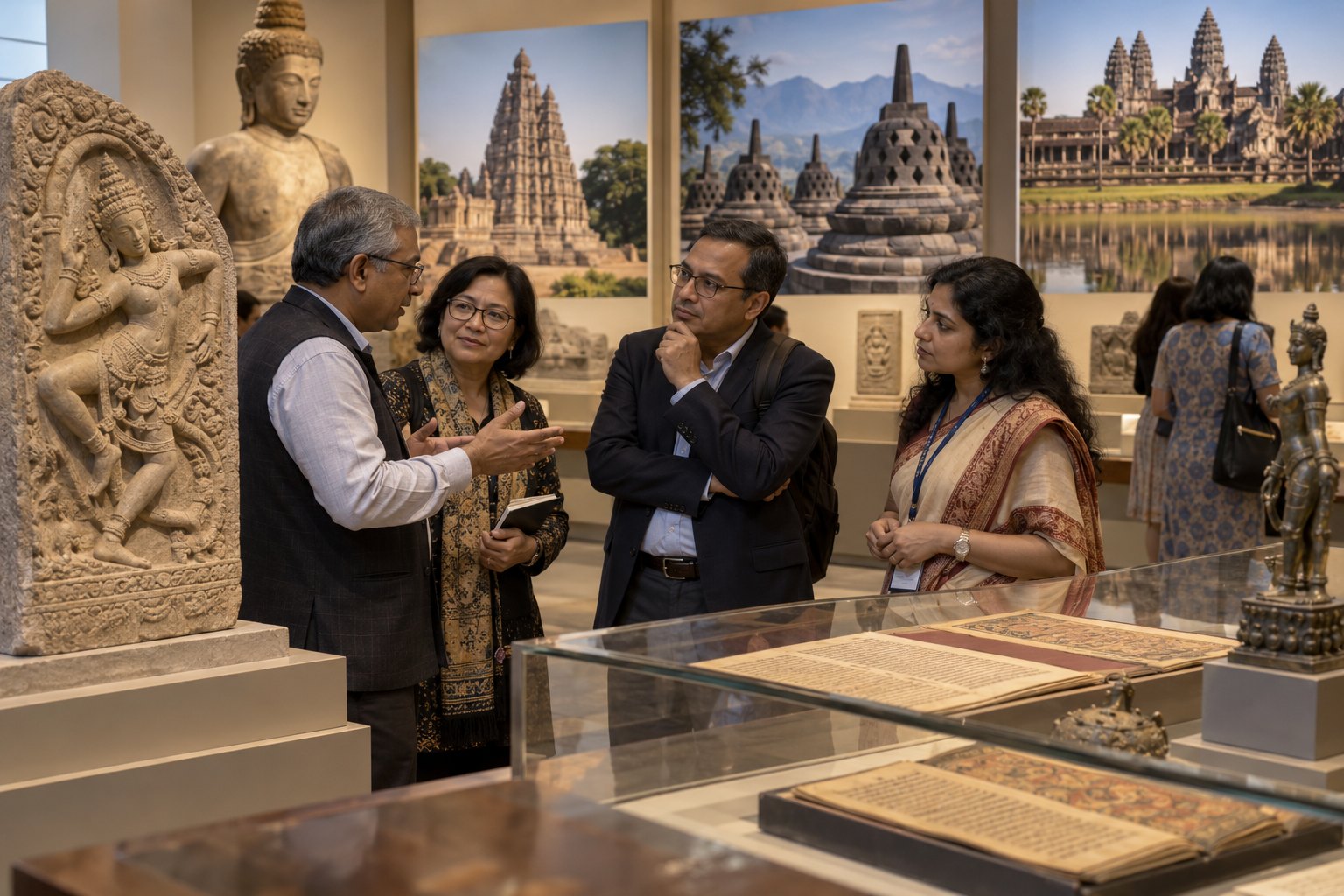
The Indira Gandhi National Centre for the Arts opened a three-day international conference in New Delhi on 14 October 2026, marking the centenary of the Greater India Society, or Brihattar Bharat Parishad, founded in Calcutta in 1926. Held under the Ministry of Culture's Brihattar Bharat Scheme (2026-2031), it gathers scholars and envoys from 50 nations, per IGNCA.
Syllabus: GS1 · Art & Culture; Prelims · History & Culture; GS2 · Foreign Policies & the Diaspora
Why this matters for UPSC
GS1 Art and Culture: Prelims can ask where Angkor, Borobudur and Nalanda stand and what UNESCO's Memory of the World Programme covers; GS2 Mains, about cultural heritage as soft power in India's ties with Asia.
Why it matters
A student in Cambodia reading a Sanskrit inscription at Angkor and an Indian tourist walking the terraces of Borobudur are looking at one shared past. When countries document that past together, a palm-leaf text in Nepal or an inscription in Vietnam becomes easier to find, protect and read. A joint UNESCO nomination lets the countries that share a tradition seek its listing together rather than one at a time. For India, these old ties give a base of goodwill in its dealings with Southeast and East Asia, so culture becomes a working part of diplomacy. The risk is that heritage talk turns into claims of influence; presenting it as two-way exchange keeps partner countries on board.
Prelims pointers
- IGNCA: launched on 19 November 1985; its trust was constituted and registered in New Delhi on 24 March 1987.
- Memory of the World Programme: launched by UNESCO in 1992 to preserve archive holdings and library collections and widen access to them.
- Convention for the Safeguarding of the Intangible Cultural Heritage: adopted by UNESCO's General Conference at its 32nd session in Paris, 2003.
- Angkor: Siem Reap province, Cambodia; the Archaeological Survey of India is among the bodies that carried out conservation there.
- Borobudur: Kedu Valley, Central Java, Indonesia; 72 openwork stupas, each with a Buddha statue, ring its three circular platforms.
- Nalanda Mahavihara, Bihar: founded in the 5th century CE; inscribed on UNESCO's World Heritage List in 2016.
- Gyan Bharatam Mission: announced in the Union Budget 2025-26; a Ministry of Culture effort to survey, digitise and build a National Digital Repository of manuscripts.
Practise a UPSC-style question
With reference to Angkor, consider the following statements:
1. Angkor Archaeological Park lies in the Siem Reap province of Thailand.
2. Angkor holds the remains of successive capitals of the Khmer Empire from the 9th to the 15th century.
3. The Archaeological Survey of India is among the bodies that carried out conservation work at Angkor.
Which of the statements given above is/are correct?
- (a) 1 and 2 only
- (b) 2 and 3 only
- (c) 1 and 3 only
- (d) 1, 2 and 3
Show the answer
Answer: (b) 2 and 3 only
Answer: (b) 2 and 3 only. Angkor is in Cambodia, not Thailand; the other two statements hold.
Statement 1: incorrect. Angkor Archaeological Park lies in the Siem Reap province of Cambodia, as UNESCO's World Heritage listing states.
Statement 2: correct. UNESCO describes Angkor as the remains of the different capitals of the Khmer Empire from the 9th to the 15th century.
Statement 3: correct. UNESCO names the Archaeological Survey of India among the bodies that carried out conservation and restoration at Angkor between 1907 and 1992.
Eliminate: Statement 1 is wrong because Siem Reap is a Cambodian province. Out: (a), (c), (d).
Trap: Swapped attribution. The province is right but the country is swapped for a neighbour, the commonest map trap UPSC sets.
Remember: Angkor: Siem Reap, Cambodia; Khmer capitals of the 9th-15th centuries; ASI helped conserve it.
More from the 14 October 2026 edition
- Cooperation Ministry mandates uniform audit report for Multi-State societies Economy
- CCEA approves strategic buyer for 60.72% of IDBI Bank Economy
- India approved to join Southern Indian Ocean Fisheries Agreement Economy
- India–Mauritius tax treaty gets principal purpose test against treaty shopping Economy
- Cabinet extends National Social Assistance Programme to 2030-31, renames it National
- Indian Navy to end first command of CMF's Combined Task Force 154 Defence
- Putin signs law ratifying India-Russia temporary labour agreement World & IR
- India rejects UN Indigenous Peoples Rapporteur's reference, cites Forest Rights Act World & IR
- India tells UNGA Third Committee UN rights bodies must shun selectivity World & IR
- 158 refugees get citizenship in Ahmedabad, 126 under the CAA Polity
- India-Canada reset: PMs back early CEPA to double trade by 2030 World & IR
- Union Territory of Ladakh: India rejects China's objection to standard names World & IR