
Putin signs law ratifying India-Russia temporary labour agreement
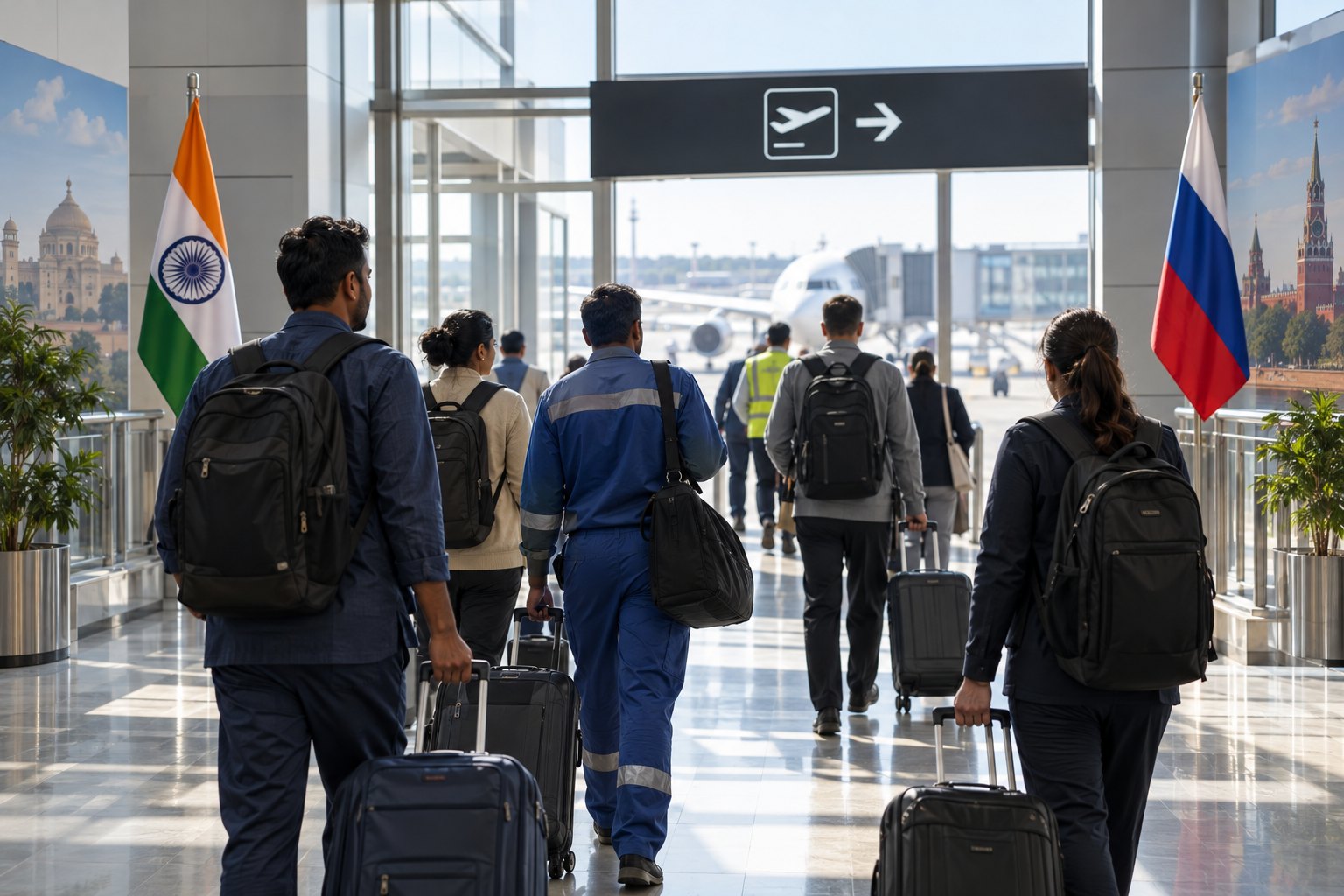
Vladimir Putin signed a law on 12 October 2026 ratifying the India-Russia agreement on temporary labour activity, after both chambers of Russia's Federal Assembly passed it. The pact frames how citizens of each country may work temporarily in the other. It was signed, with a pact on combating irregular migration, during Putin's December 2025 state visit to New Delhi.
Syllabus: Prelims · Current Affairs & IR; GS2 · Groupings & Agreements; GS2 · Foreign Policies & the Diaspora
Why this matters for UPSC
GS2 international relations: India-Russia ties and agreements involving India. Prelims can ask about ratification, treaty-making under the Union List, the Emigration Act, 1983 and India's labour mobility partners; Mains, about migration governance and protecting Indian workers abroad.
Why it matters
For an Indian construction or textile worker eyeing a job in Russia, the agreement replaces guesswork with written rules: a legal permit, the same treatment as local staff and a claim under local law if the employer shuts down. For Indian families, more legal jobs abroad mean more remittances sent home. For Russia, where millions of posts will open as staff retire, Indian workers keep building sites and factories running. The companion pact on irregular migration matters because workers who travel through unlicensed agents are the ones most often cheated or stranded. The larger question is how India turns its young workforce into a managed flow of skills abroad while keeping its citizens safe.
Prelims pointers
- Article 253: notwithstanding the Union-State division of legislative powers, Parliament may make any law for the whole or any part of India to implement a treaty, agreement or convention.
- Union List: Entry 14 covers entering into and implementing treaties with foreign countries; Entry 19 covers admission into, emigration and expulsion from India, passports and visas.
- Article 73(1)(b): the Union's executive power extends to rights, authority and jurisdiction the Government of India exercises by virtue of any treaty or agreement.
- Under the Emigration Act, 1983, Protectors of Emigrants grant emigration clearance, and recruiting agents need a registration certificate under Sections 11 and 12.
- State Duma: 450 members elected for five years; it also oversees the Russian Government and appoints and dismisses the head of the Central Bank.
- MEA lists Migration and Mobility Partnership Agreements with France and Finland, comprehensive partnerships with Germany and Austria, an MoU with the UK and an arrangement with Australia.
- Japan (2021) partners India on the Specified Skilled Worker system; Israel's 2023 temporary-employment agreement has protocols for construction and home-based caregivers, and since 2026 for commerce, restaurants and manufacturing.
- The Declaration on Strategic Partnership between India and Russia dates to October 2000, Putin's first state visit to India.
Practise a UPSC-style question
With reference to the India-Russia agreement on temporary labour activity of citizens, consider the following statements:
1. It was signed during the Indian Prime Minister's visit to Moscow for the India-Russia Annual Summit.
2. In Russia, the law ratifying it was adopted by the State Duma and approved by the Federation Council before the President signed it.
Which of the statements given above is/are correct?
- (a) 1 only
- (b) 2 only
- (c) Both 1 and 2
- (d) Neither 1 nor 2
Show the answer
Answer: (b) 2 only
Answer: (b) 2 only. The pact was signed in New Delhi, and Russia's ratification law passed both chambers before the President signed it.
Statement 1: incorrect. The agreement was signed in New Delhi during President Putin's state visit to India for the 23rd Annual Summit in December 2025.
Statement 2: correct. The State Duma adopted the ratification law on 1 October 2026, the Federation Council approved it on 2 October and Putin signed it on 12 October.
Eliminate: Statement 1 moves the signing from New Delhi to Moscow, so it is wrong. Out: (a), (c).
Eliminate: Statement 2 follows the order the law took through Russia's Federal Assembly, so it is right. Out: (d).
Trap: Swapped attribution. India and Russia take turns hosting the Annual Summit, so placing this signing in Moscow sounds natural.
Remember: Signed in New Delhi, December 2025; Russia ratified on 12 October 2026.
More from the 14 October 2026 edition
- Cooperation Ministry mandates uniform audit report for Multi-State societies Economy
- CCEA approves strategic buyer for 60.72% of IDBI Bank Economy
- India approved to join Southern Indian Ocean Fisheries Agreement Economy
- India–Mauritius tax treaty gets principal purpose test against treaty shopping Economy
- Greater India Society at 100: India's cultural links across Asia National
- Cabinet extends National Social Assistance Programme to 2030-31, renames it National
- Indian Navy to end first command of CMF's Combined Task Force 154 Defence
- India rejects UN Indigenous Peoples Rapporteur's reference, cites Forest Rights Act World & IR
- India tells UNGA Third Committee UN rights bodies must shun selectivity World & IR
- 158 refugees get citizenship in Ahmedabad, 126 under the CAA Polity
- India-Canada reset: PMs back early CEPA to double trade by 2030 World & IR
- Union Territory of Ladakh: India rejects China's objection to standard names World & IR