
India tells UNGA Third Committee UN rights bodies must shun selectivity
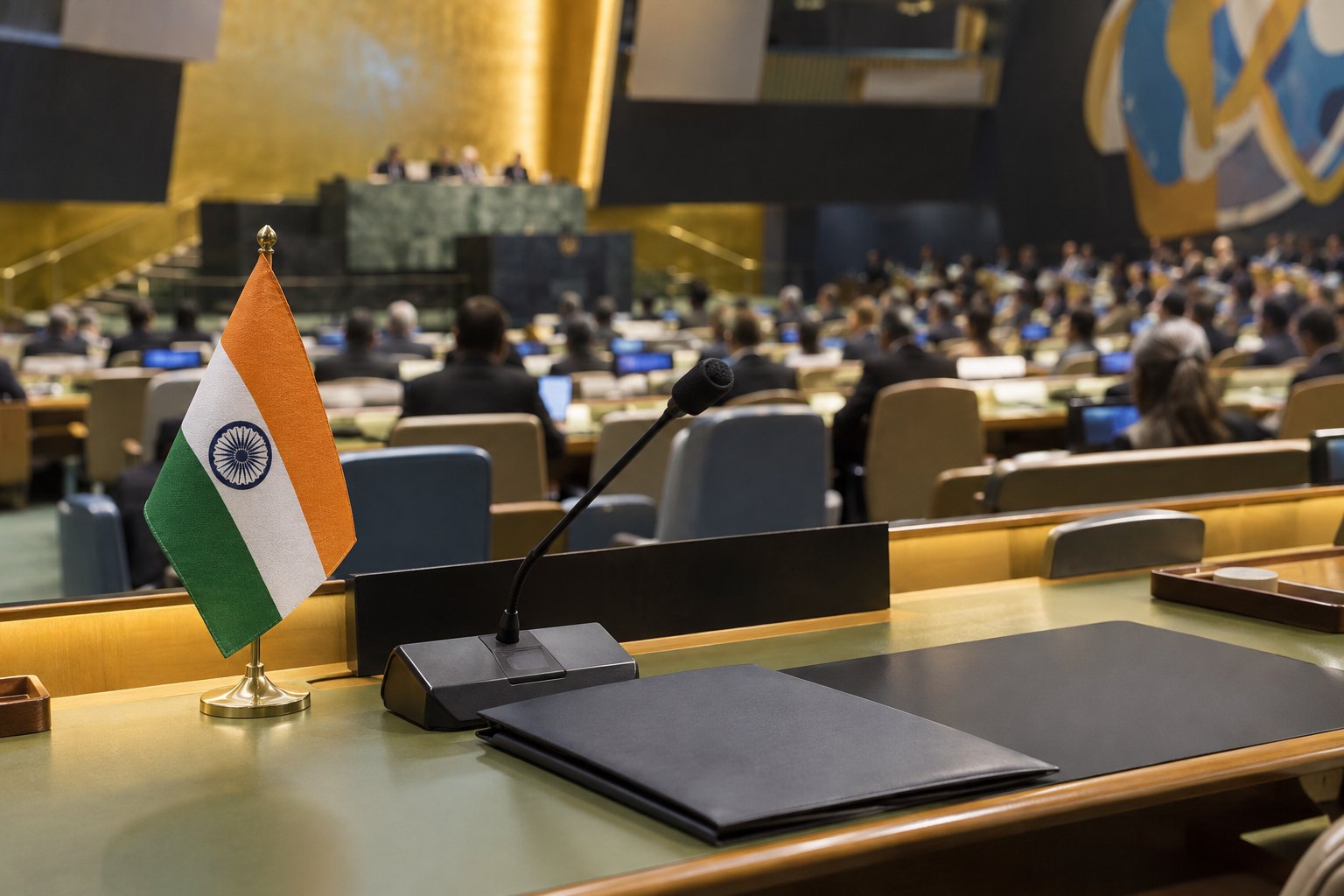
India told the UN General Assembly's Third Committee on 12 October 2026, in its debate on the Human Rights Council's report, that UN human rights mechanisms should rise above politicisation and selectivity and respect cultural and historical context. A day later, the General Assembly elected 15 countries, including Nepal and Japan, to the 47-member Council for 2027-2029.
Syllabus: Prelims · Current Affairs & IR; GS2 · Groupings & Agreements; GS2 · International Institutions
Why this matters for UPSC
GS2, important international institutions: Prelims can ask how the Human Rights Council is elected, its 47 seats and term limits, and what the Third Committee handles; Mains, about selectivity in UN human rights scrutiny and India's stand.
Why it matters
When a UN body questions how a government treats protesters, journalists or forest communities, the government can engage, dispute the facts or call it interference. India chose to engage the system while warning against selective scrutiny, and to answer a critical report with its own data. That choice matters for India's standing as a sitting Council member: its arguments carry more weight when it is seen to cooperate. For people in the countries reviewed, the Council and its experts are often the only international forum that hears their complaints, so the fairness and credibility of those mechanisms decide whether that forum is trusted by governments and citizens alike.
Prelims pointers
- Resolution 60/251 was adopted on 15 March 2006; the Commission on Human Rights was abolished in June 2006 through the Economic and Social Council.
- Council seats by region: African 13, Asia-Pacific 13, Eastern European 6, Latin American and Caribbean 8, Western European and other 7.
- Council members serve three years and cannot be re-elected immediately after two consecutive terms.
- The General Assembly may suspend a Council member committing gross and systematic violations by a two-thirds majority of members present and voting.
- Resolution 60/251 obliges every elected Council member to be reviewed under the universal periodic review during its own term of membership.
- The Council holds at least three sessions a year, of at least ten weeks in all, and special sessions with one-third of members' support.
- Six Main Committees: First (disarmament), Second (economic and financial), Third (social, humanitarian, cultural), Fourth (decolonisation), Fifth (budget), Sixth (legal).
- OHCHR's mandate rests on General Assembly resolution 48/141 of 20 December 1993, which created the post of High Commissioner for Human Rights.
Practise a UPSC-style question
With reference to the UN Human Rights Council, consider the following statements:
1. It was created in 2006 by a resolution of the UN Security Council.
2. It replaced the Commission on Human Rights and is based in Geneva.
3. It is a subsidiary organ of the UN General Assembly.
Which of the statements given above is/are correct?
- (a) 1 and 2 only
- (b) 2 and 3 only
- (c) 1 and 3 only
- (d) 1, 2 and 3
Show the answer
Answer: (b) 2 and 3 only
Answer: (b) 2 and 3 only. The Council is the General Assembly's creation, so statement 1 fails.
Statement 1: incorrect. General Assembly resolution 60/251 of 15 March 2006 created the Council; the Security Council had no part in it.
Statement 2: correct. Resolution 60/251 set up the Council, based in Geneva, in replacement of the Commission on Human Rights.
Statement 3: correct. The same resolution makes the Council a subsidiary organ of the General Assembly, to which it reports every year.
Eliminate: Judge statement 1 first: the General Assembly, not the Security Council, created the Council, so statement 1 is incorrect. Out: (a), (c), (d).
Trap: Swapped attribution. The founding resolution is pinned on the Security Council, the UN organ students most often link with big decisions.
Remember: Human Rights Council: GA resolution 60/251, 2006, Geneva, replaced the Commission on Human Rights.
More from the 14 October 2026 edition
- Cooperation Ministry mandates uniform audit report for Multi-State societies Economy
- CCEA approves strategic buyer for 60.72% of IDBI Bank Economy
- India approved to join Southern Indian Ocean Fisheries Agreement Economy
- India–Mauritius tax treaty gets principal purpose test against treaty shopping Economy
- Greater India Society at 100: India's cultural links across Asia National
- Cabinet extends National Social Assistance Programme to 2030-31, renames it National
- Indian Navy to end first command of CMF's Combined Task Force 154 Defence
- Putin signs law ratifying India-Russia temporary labour agreement World & IR
- India rejects UN Indigenous Peoples Rapporteur's reference, cites Forest Rights Act World & IR
- 158 refugees get citizenship in Ahmedabad, 126 under the CAA Polity
- India-Canada reset: PMs back early CEPA to double trade by 2030 World & IR
- Union Territory of Ladakh: India rejects China's objection to standard names World & IR