
India-Canada reset: PMs back early CEPA to double trade by 2030
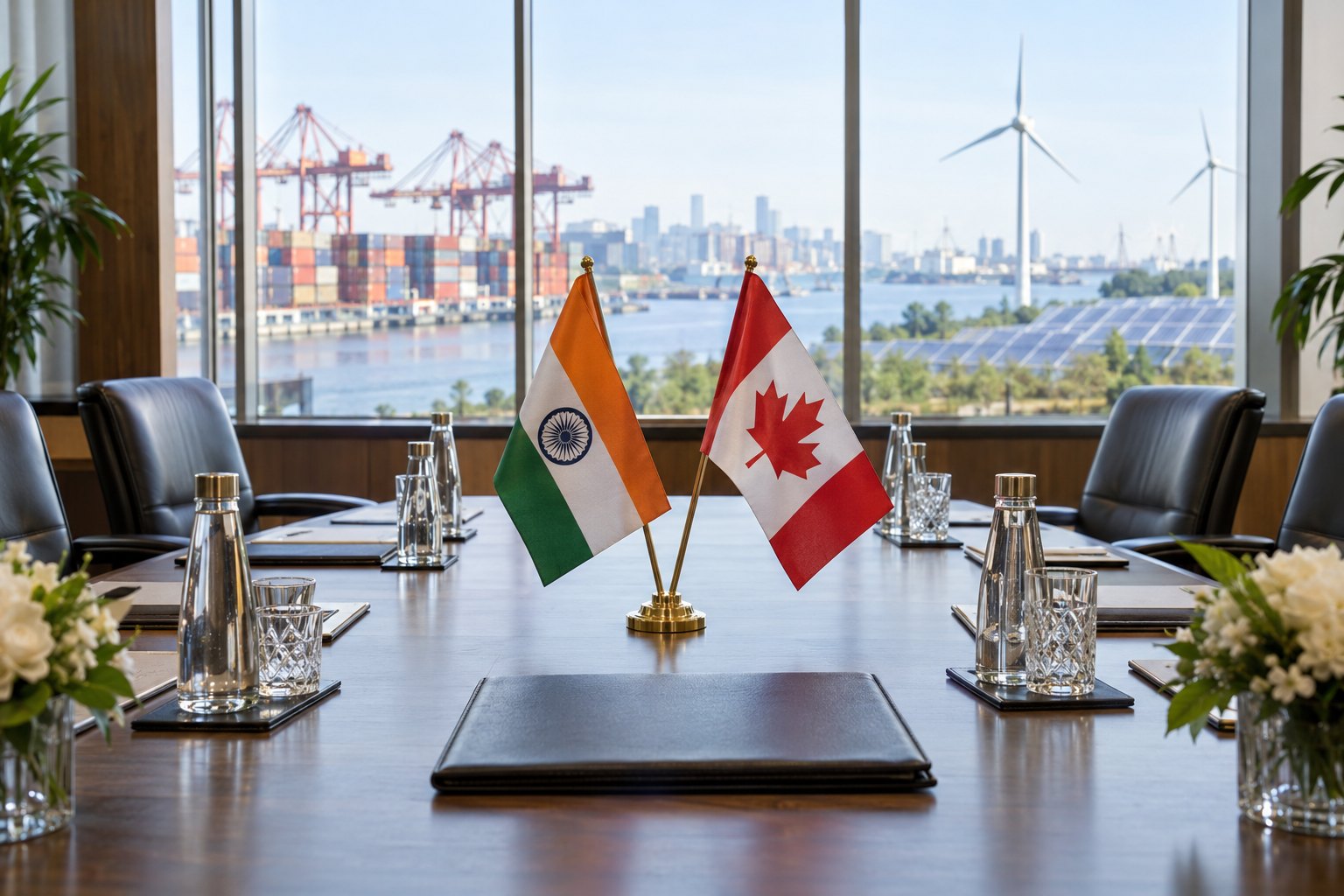
Prime Minister Narendra Modi and Canadian Prime Minister Mark Carney spoke on 13 October 2026, agreeing to work for concrete outcomes in trade, energy, technology, security and people-to-people ties. Canada's readout says both reaffirmed concluding the Comprehensive Economic Partnership Agreement at the earliest opportunity, backing efforts to double two-way trade by 2030, ahead of Modi's December visit to Canada.
Syllabus: GS3 · Indian Economy & Growth; Prelims · Current Affairs & IR; GS2 · Groupings & Agreements
Why this matters for UPSC
GS2 (bilateral relations and agreements involving India): Prelims can ask what a Comprehensive Economic Partnership Agreement covers and which groupings Canada is joining; Mains, whether trade and energy ties can rebuild a strained partnership.
Why it matters
An Indian student in Toronto, a pharmaceutical exporter and a buyer of Canadian pulses all gain when the two governments keep talking. Canada hosts over 425,000 Indian students, by the Ministry of Commerce and Industry's count of March 2026. A CEPA that lowers duties would cut costs for traders on both sides, though Indian pulse growers could face more competition. Canada also offers energy India wants: heavy oil, which it already supplies, liquefied natural gas, which India intends to buy, and, under a CAD 2.6 billion contract of March 2026, uranium for nuclear power. The larger question is whether trade and energy can rebuild trust that a security dispute broke in 2023.
Prelims pointers
- India-Canada CEPA: aims at a free trade area by eliminating or reducing tariffs and progressively liberalising trade in goods and services (MEA, Lok Sabha, 31 July 2026).
- WTO: regional trade agreements are an exception to non-discrimination; GATT 1994 Article XXIV covers free trade areas in goods, GATS Article V services agreements.
- International Solar Alliance: launched at COP21 in Paris on 30 November 2015, with France co-chairing; headquarters in Gurugram, Haryana.
- Global Biofuels Alliance: launched on 9 September 2023 during India's G20 Presidency by India and eight countries, including Brazil and the USA; secretariat in India.
- Australia-Canada-India Technology and Innovation (ACITI) Partnership: agreed in Johannesburg on 22 November 2025; covers critical technologies, green energy, critical minerals and AI.
- Indian Ocean Rim Association: an inter-governmental body set up on 7 March 1997, with India a member since then; India backs Canada as a Dialogue Partner.
- G7: Canada, France, Germany, Italy, Japan, the United Kingdom and the United States; Canada hosted at Kananaskis in 2025, France at Evian in 2026.
Practise a UPSC-style question
With reference to the Indian Ocean Rim Association (IORA), consider the following statements:
1. Canada is one of its member states.
2. Its secretariat is located in Mauritius.
3. Japan and the United States are among its Dialogue Partners.
Which of the statements given above is/are correct?
- (a) 1 and 2 only
- (b) 2 and 3 only
- (c) 1 and 3 only
- (d) 1, 2 and 3
Show the answer
Answer: (b) 2 and 3 only
1 is incorrect: IORA's member states are countries of the Indian Ocean rim, India among them since 1997; Canada is not one, and India has backed Canada's interest in joining as a Dialogue Partner. 2 is correct: the IORA Secretariat is at Cybercity, Ebene, in Mauritius. 3 is correct: Japan (since 1999) and the United States (since 2012) are among IORA's Dialogue Partners.
More from the 14 October 2026 edition
- Cooperation Ministry mandates uniform audit report for Multi-State societies Economy
- CCEA approves strategic buyer for 60.72% of IDBI Bank Economy
- India approved to join Southern Indian Ocean Fisheries Agreement Economy
- India–Mauritius tax treaty gets principal purpose test against treaty shopping Economy
- Greater India Society at 100: India's cultural links across Asia National
- Cabinet extends National Social Assistance Programme to 2030-31, renames it National
- Indian Navy to end first command of CMF's Combined Task Force 154 Defence
- Putin signs law ratifying India-Russia temporary labour agreement World & IR
- India rejects UN Indigenous Peoples Rapporteur's reference, cites Forest Rights Act World & IR
- India tells UNGA Third Committee UN rights bodies must shun selectivity World & IR
- 158 refugees get citizenship in Ahmedabad, 126 under the CAA Polity
- Union Territory of Ladakh: India rejects China's objection to standard names World & IR