
India–UK JETCO sets up CETA committees and yearly tariff-use data swap
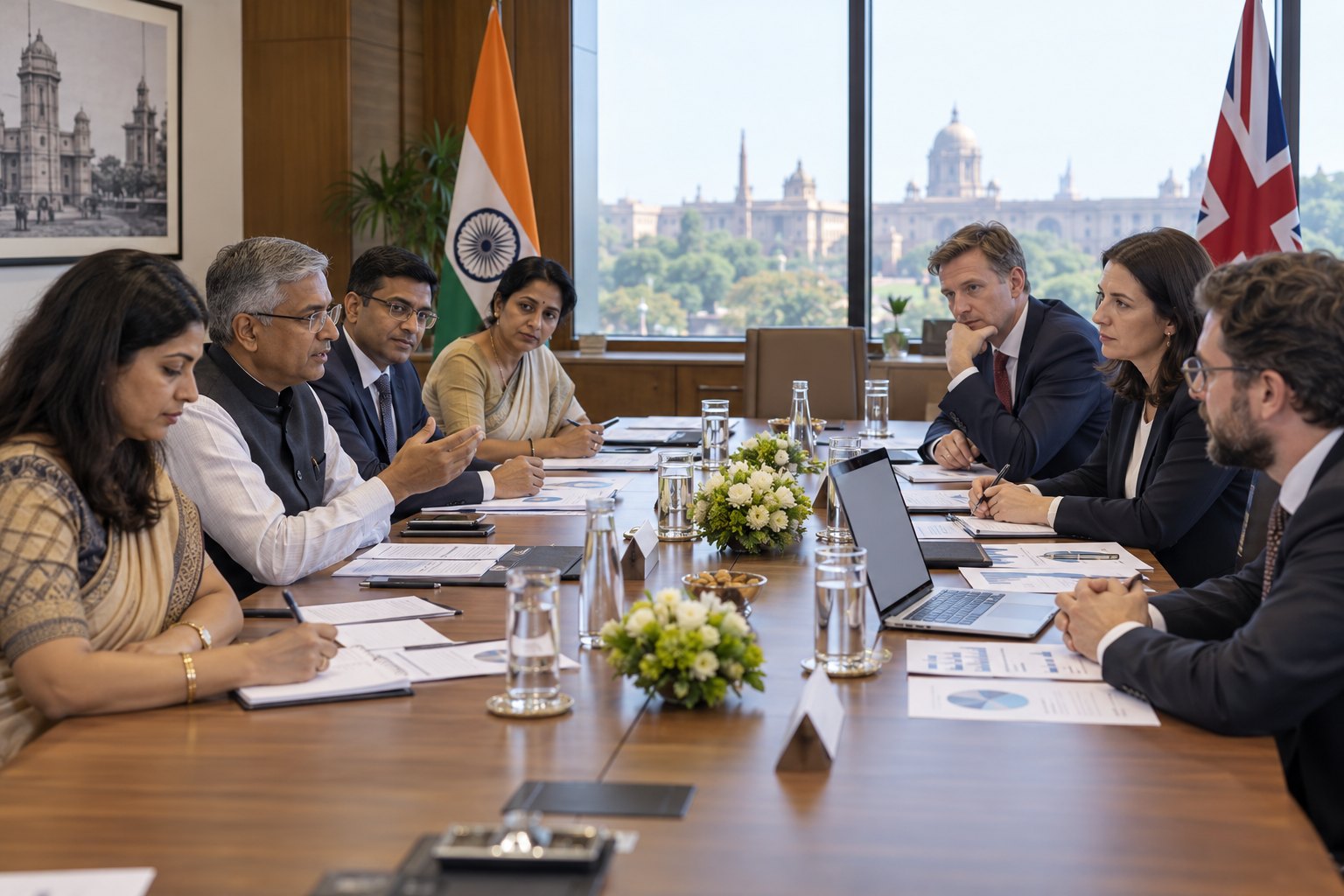
India and the United Kingdom agreed on 12 October 2026 to exchange yearly data on how businesses claim the lower tariffs of their Comprehensive Economic and Trade Agreement (CETA). Meeting in New Delhi for the 16th Joint Economic and Trade Committee (JETCO), they also set up CETA's committees and working groups. The 17th JETCO meets in the UK in 2027.
Syllabus: GS3 · Indian Economy & Growth; Prelims · Current Affairs & IR; GS2 · Groupings & Agreements
Why this matters for UPSC
GS2 (agreements involving India) and GS3 (trade and growth): Prelims can ask about rules of origin, a tariff-rate quota, the Double Contribution Convention and GIFT City; Mains, about why exporters under-use a free trade agreement.
Why it matters
A garment maker in Tirupur or a tea exporter in Assam gains from the pact only if it actually claims the lower UK tariff. Many small firms never do, because proving origin, filling in forms and reading tariff schedules costs time and money. The yearly data swap will show how much eligible trade really uses the agreement, and where firms get stuck, so that officials can fix the rules or help exporters. For a buyer in India, the same pact means cheaper Scotch whisky, salmon and some cars. The larger question is whether India's new trade agreements turn into exports and jobs, or stay on paper.
Prelims pointers
- Free trade agreement: members cut tariffs on each other's goods but keep their own tariffs on non-members; WTO rules permit it as an exception to most-favoured-nation treatment.
- Rules of origin: decide whether a good counts as made in a partner country and may claim the agreement's lower tariff.
- Self-certification: the exporter itself declares the origin of its goods instead of an authorised agency certifying it.
- Tariff-rate quota: a lower duty on imports up to a set quantity and a higher duty on imports beyond it.
- Double Contribution Convention: a posted worker keeps paying social security at home and is exempt from host-country contributions for a fixed period.
- GIFT City, Gandhinagar, Gujarat: hosts India's first International Financial Services Centre, regulated by the International Financial Services Centres Authority under the IFSCA Act, 2019.
- India's other trade pacts with developed partners include the Trade and Economic Partnership Agreement with EFTA and the Economic Cooperation and Trade Agreement with Australia.
Practise a UPSC-style question
With reference to the India–UK Comprehensive Economic and Trade Agreement (CETA), consider the following statements:
1. It gives Indian goods zero-duty access to the UK on about 99% of tariff lines.
2. Under it, UK goods get tariff cuts or elimination on 90% of India's tariff lines.
Which of the statements given above is/are correct?
- (a) 1 only
- (b) 2 only
- (c) Both 1 and 2
- (d) Neither 1 nor 2
Show the answer
Answer: (c) Both 1 and 2
1 is correct: the Ministry of Commerce and Industry says the CETA gives zero-duty access on about 99% of tariff lines, covering nearly all Indian exports to the UK. 2 is correct: per the British High Commissioner, UK goods get tariff reductions or elimination on 90% of India's tariff lines, covering 92% of current UK exports.
More from the 13 October 2026 edition
- India wants terrorist acts in UN crimes against humanity convention World & IR
- NHAI makes independent proof-checking of complex highway designs mandatory Economy
- UNGA adopts pandemic declaration; WHO Pandemic Agreement awaits PABS annex World & IR
- IPC Alert flags rising Famine risk in Sudan's Darfur and Kordofan World & IR
- IMF's World Economic Outlook lifts India's 2026-27 growth forecast to 7% Economy
- Tribal Affairs Ministry launches financial literacy drive for PVTG villages National
- ECI publishes Punjab's final electoral roll after Special Intensive Revision Polity
- RSETIs get uniform training standards under MoRD pact with RUDSETI academy Economy
- Lakshadweep declared fully literate under ULLAS literacy scheme National
- IMD dedicates WebGIS cyclone and marine warning system to the nation Sci-Tech
- Army signs five-year MoU with Food Corporation of India, launches Bharat Rice National
- PM-SETU: AM/NS India pacts to upgrade nine ITIs in Surat, Visakhapatnam Economy