
India, UK hold 8th Science Council, open genomics centre
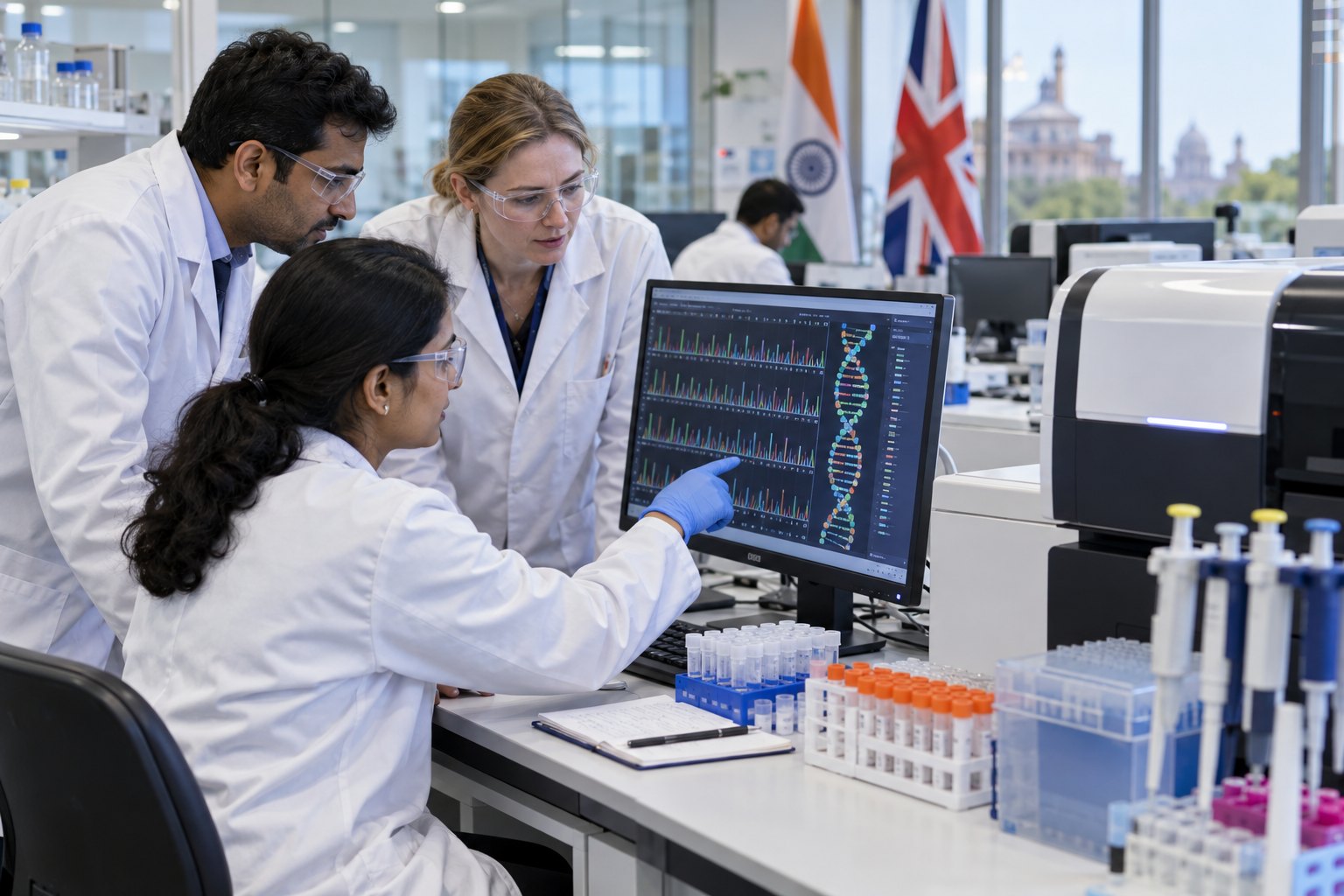
India and the UK held the 8th India–UK Science and Innovation Council meeting in New Delhi on October 12, 2026, co-chaired by India's Science and Technology Minister and the UK Business Secretary. They opened the BRIC-CDFD–ONT India Genomics Centre of Excellence. Separate talks explored cooperation on small modular reactors, space and Artificial Intelligence.
Syllabus: GS3 · Infrastructure; GS3 · IT, Space, Biotech & IPR; GS2 · Groupings & Agreements
Why this matters for UPSC
GS2 (bilateral relations: India–UK) and GS3 (science and technology, energy). Prelims can ask what small modular reactors and nanopore sequencing are, and which body runs ANRF or the Technology Development Board; Mains can ask about technology partnerships.
Why it matters
For an Indian startup making satellite parts or power electronics, the Council's programmes can bring a British research partner, shared money for a prototype and a way into UK supply chains. The new genomics centre puts long-read DNA sequencing in Indian hands, which helps scientists trace disease-causing microbes and study antimicrobial resistance, one of the joint research areas. Small modular reactors matter to factories and data centres that need steady, low-carbon power; the SHANTI Act, 2025 is meant to let more players build them. The larger issue is how India turns research into products: its own labs are strong, but commercialisation lags, and partners such as the UK offer industry links, finance and markets.
Prelims pointers
- Small modular reactors (SMRs): advanced fission reactors of up to about 300 MW(e) per unit, as the IAEA defines them, with modules built in factories and shipped to site.
- Anusandhan National Research Foundation: set up under the ANRF Act, 2023; the Prime Minister chairs its Governing Board; DST is its administrative department.
- Technology Development Board: statutory body under the Technology Development Board Act, 1995, under DST; it funds the commercialisation of indigenous technology.
- Centre for DNA Fingerprinting and Diagnostics (CDFD), Hyderabad: a DBT institute for DNA fingerprinting and diagnostics, now part of BRIC.
- Nanopore sequencing: reads DNA by the change in an electric current as a single strand passes through a nanoscale pore in a membrane.
- Innovate UK: the UK's national innovation agency, part of UK Research and Innovation, which funds business-led research and development.
- Principal Scientific Adviser to the Government of India: advises the Prime Minister and Cabinet on science and technology policy.
Practise a UPSC-style question
Consider the following statements about the 8th meeting of the India–UK Science and Innovation Council:
1. The genomics centre inaugurated at the meeting is a partnership with a United States sequencing company.
2. It was co-chaired by India's Minister for Science and Technology and the UK Business Secretary.
3. DST's joint industrial research programme with the UK is run with Innovate UK.
Which of the statements given above is/are correct?
- (a) 1 and 2 only
- (b) 2 and 3 only
- (c) 1 and 3 only
- (d) 1, 2 and 3
Show the answer
Answer: (b) 2 and 3 only
1 is incorrect: the partner is Oxford Nanopore Technologies, a British firm, with DBT's BRIC-CDFD. 2 is correct: India's Minister of State for Science and Technology and the UK Business Secretary co-chaired the meeting. 3 is correct: DST's collaboration with Innovate UK funds joint industrial R&D projects.
More from the 13 October 2026 edition
- India wants terrorist acts in UN crimes against humanity convention World & IR
- NHAI makes independent proof-checking of complex highway designs mandatory Economy
- UNGA adopts pandemic declaration; WHO Pandemic Agreement awaits PABS annex World & IR
- IPC Alert flags rising Famine risk in Sudan's Darfur and Kordofan World & IR
- IMF's World Economic Outlook lifts India's 2026-27 growth forecast to 7% Economy
- Tribal Affairs Ministry launches financial literacy drive for PVTG villages National
- ECI publishes Punjab's final electoral roll after Special Intensive Revision Polity
- RSETIs get uniform training standards under MoRD pact with RUDSETI academy Economy
- Lakshadweep declared fully literate under ULLAS literacy scheme National
- IMD dedicates WebGIS cyclone and marine warning system to the nation Sci-Tech
- Army signs five-year MoU with Food Corporation of India, launches Bharat Rice National
- PM-SETU: AM/NS India pacts to upgrade nine ITIs in Surat, Visakhapatnam Economy