
India, Bangladesh trade talks resume; Dhaka seeks post-LDC tariff preferences
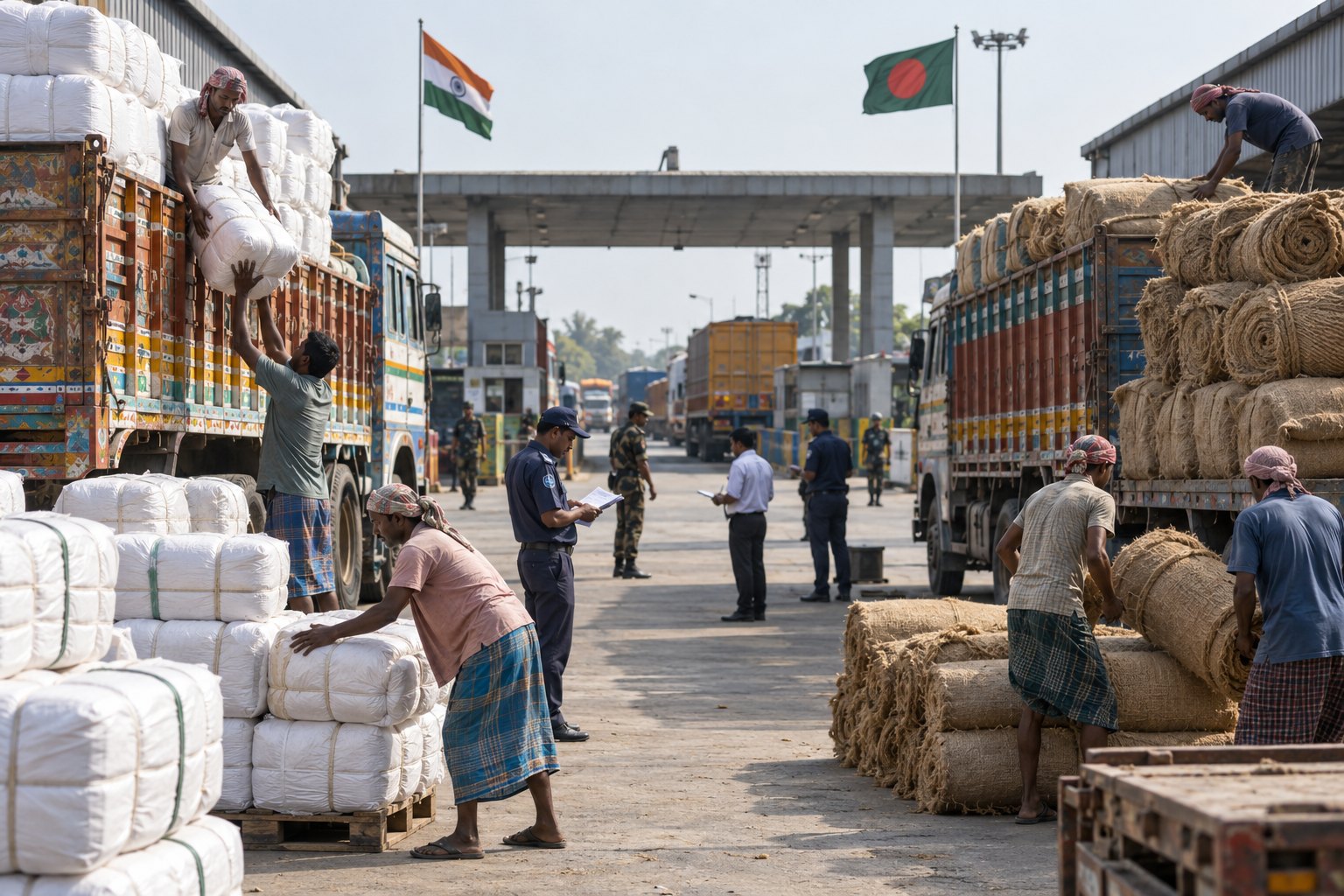
India and Bangladesh held the 16th meeting of their Joint Working Group on Trade in New Delhi on 8-9 October 2026, the first since September 2023. Bangladesh sought withdrawal of Indian anti-dumping duties on jute products and PET film, and continued SAFTA benefits after its LDC graduation. India pressed Dhaka to lift land-port curbs on cotton yarn.
Syllabus: Prelims · Current Affairs & IR; GS3 · Infrastructure; GS2 · India & its Neighbourhood
Why this matters for UPSC
GS2 India and its neighbourhood, and GS3 trade. Prelims can ask about SAFTA, LDC graduation criteria, anti-dumping duty and the DGTR, and the States bordering Bangladesh; Mains, about land-port connectivity and trade normalisation.
Why it matters
A garment maker in Bangladesh or a fruit trader in Tripura depends on trucks crossing the border quickly. When goods barred from land ports must go by sea instead, costs and delays rise, and small traders lose most. Two-way trade was worth $12.36 billion in FY26, with India's exports making up $10.58 billion, so Dhaka is reluctant to open further while the gap is wide. Bangladesh's exit from the LDC list could also end tariff breaks its exporters now enjoy. The larger issue is whether neighbours can keep trade and connectivity running when politics sours and whether India's northeastern States can trade on equal terms with the rest of the country.
Prelims pointers
- SAFTA: South Asian Free Trade Area agreement, signed at the 12th SAARC Summit in Islamabad in 2004; in force from 1 January 2006.
- LDC list: kept by the UN; the Committee for Development Policy reviews it every three years on GNI per capita, the Human Assets Index and the Economic Vulnerability Index.
- Anti-dumping duty: DGTR, under the Ministry of Commerce and Industry, investigates and recommends; the Ministry of Finance imposes it under the Customs Tariff Act, 1975.
- Bureau of Indian Standards: national standards body under the Bureau of Indian Standards Act, 2016, in the Ministry of Consumer Affairs, Food and Public Distribution.
- Land Ports Authority of India: statutory body under the Land Ports Authority of India Act, 2010, under the Ministry of Home Affairs; runs integrated check posts.
- States bordering Bangladesh: West Bengal, Assam, Meghalaya, Tripura and Mizoram; Bangladesh's only other land neighbour is Myanmar.
- Petrapole, in West Bengal, faces Benapole in Bangladesh; Agartala, in Tripura, faces Akhaura.
- Negative list names the few goods barred from trade; a positive list names the only goods allowed.
Practise a UPSC-style question
With reference to the South Asian Free Trade Area (SAFTA), consider the following statements:
1. It was signed at the SAARC Summit held in Islamabad in 2004.
2. Myanmar is a contracting party to the SAFTA agreement.
3. It provides special and differential treatment, including longer tariff-cut timelines, for its least developed members.
Which of the statements given above is/are correct?
- (a) 1 and 2 only
- (b) 2 and 3 only
- (c) 1 and 3 only
- (d) 1, 2 and 3
Show the answer
Answer: (c) 1 and 3 only
1 is correct: SAFTA was signed at the 12th SAARC Summit in Islamabad in 2004 and came into force in 2006. 2 is incorrect: Myanmar is not a SAARC member; SAFTA's parties are the SAARC countries, including Bangladesh, India, Nepal and Bhutan. 3 is correct: Least Developed Contracting States get longer timelines and other special treatment, which is why Bangladesh worries about its LDC graduation.
More from the 13 October 2026 edition
- India wants terrorist acts in UN crimes against humanity convention World & IR
- NHAI makes independent proof-checking of complex highway designs mandatory Economy
- UNGA adopts pandemic declaration; WHO Pandemic Agreement awaits PABS annex World & IR
- IPC Alert flags rising Famine risk in Sudan's Darfur and Kordofan World & IR
- IMF's World Economic Outlook lifts India's 2026-27 growth forecast to 7% Economy
- Tribal Affairs Ministry launches financial literacy drive for PVTG villages National
- ECI publishes Punjab's final electoral roll after Special Intensive Revision Polity
- RSETIs get uniform training standards under MoRD pact with RUDSETI academy Economy
- Lakshadweep declared fully literate under ULLAS literacy scheme National
- IMD dedicates WebGIS cyclone and marine warning system to the nation Sci-Tech
- Army signs five-year MoU with Food Corporation of India, launches Bharat Rice National
- PM-SETU: AM/NS India pacts to upgrade nine ITIs in Surat, Visakhapatnam Economy