
C-STROKE ischaemic stroke atlas released; IIT Madras brain-mapping centre dedicated
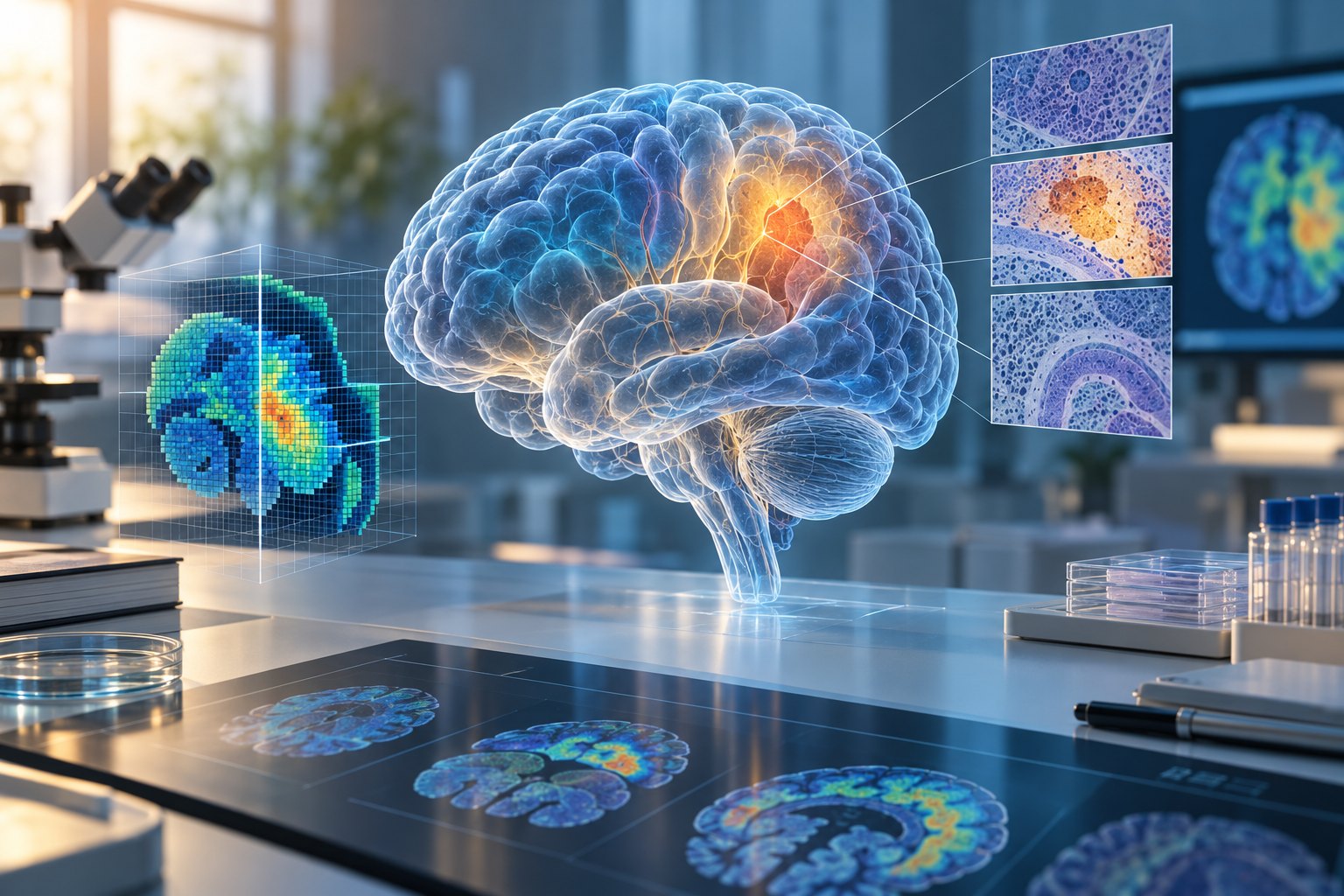
On 11 October 2026 the Prime Minister dedicated to the nation the Sudha Gopalakrishnan Brain Centre (SGBC) at IIT Madras and released C-STROKE, a human ischaemic stroke atlas of over 1,000 annotated microscopic sections from a stroke-affected brain. The SGBC aims to map more than 100 human brains, foetus to old age, into cellular-resolution 3D atlases.
Syllabus: Prelims · Science & Technology; GS3 · Science & Technology; GS3 · Indian Achievements in S&T
Why it matters
For a person having an ischaemic stroke, every minute without blood flow kills brain cells, and the main emergency treatments, such as thrombolysis, work by reopening the blocked artery. Researchers are still looking for medicines that protect the injured tissue around a blockage, and finding them needs a close look at what a stroke does to individual cells, which a hospital scan is too coarse to show. C-STROKE gives that view, section by section, from a real stroke-affected brain. The wider mission matters too: atlases of over 100 brains from foetus to old age would give scientists a reference for how a healthy brain grows and ages, against which stroke and neurodegenerative diseases such as dementia can be compared.
Prelims pointers
- Ischaemic stroke: a clot or narrowed artery blocks blood flow to part of the brain; most strokes, about two in three worldwide, are of this type.
- Haemorrhagic stroke: a blood vessel ruptures and bleeds into or around the brain; clot-dissolving drugs would worsen it, so a CT scan comes first.
- Thrombolysis: clot-dissolving drugs such as alteplase can reopen the blocked artery in an ischaemic stroke if given within about 4.5 hours of onset.
- Cellular resolution: detail fine enough to see single cells, a few micrometres; a routine clinical MRI scan resolves about a millimetre.
- Brainstem: midbrain, pons and medulla oblongata; it links the brain with the spinal cord and controls breathing, heart rate and sleep.
- Cerebellum: balance and coordination. Hypothalamus: body temperature, hunger, thirst and control of the pituitary gland. Occipital lobe: vision.
- National Brain Research Centre (NBRC), Manesar, Haryana: an autonomous neuroscience institute of the Department of Biotechnology.
- Human Brain Project: European Union flagship, 2013 to 2023. BRAIN Initiative: United States, launched 2013.
Practise a UPSC-style question
With reference to the Sudha Gopalakrishnan Brain Centre and its work, consider the following statements:
1. The centre, which aims to map over 100 human brains at cellular resolution, is part of the Indian Institute of Science, Bengaluru.
2. C-STROKE, a newly released atlas, is built from over 1,000 annotated microscopic sections of a single stroke-affected human brain.
Which of the statements given above is/are correct?
- (a) 1 only
- (b) 2 only
- (c) Both 1 and 2
- (d) Neither 1 nor 2
Show the answer
Answer: (b) 2 only
1 is incorrect: the SGBC is a centre of IIT Madras, Chennai, set up in 2022; its mission is to map more than 100 human brains as cellular-resolution 3D atlases from the foetal stage to old age. 2 is correct: C-STROKE, released at IIT Madras on 11 October 2026, holds over 1,000 annotated microscopic sections from one brain affected by ischaemic stroke.
More from the 11 October 2026 edition
- INS Sahyadri reaches Vladivostok for India-Russia naval exercise INDRA 2026 Defence
- Special Notified Zones: DGFT redefines who may trade rough diamonds Economy
- Draft National Steel Policy: 604 MT capacity, cleaner steel by 2047 Economy
- India, UK navies hold Exercise KONKAN-26 off Plymouth Defence
- Supreme Court: detain peaceful protesters only by procedure established by law Polity
- Delhi internet suspensions: how the Telecommunications Act, 2023 governs shutdowns Polity
- Right to protest: Supreme Court lets authorities regulate, not halt, Delhi transit Polity
- DGTR opens anti-dumping probe into Penicillin G imports from China Economy
- NBA disburses Rs 2.02 crore Access and Benefit-Sharing funds to States Environment
- Magnitude 7.7 earthquake strikes Panama on the Pacific Ring of Fire World & IR
- Navy's Next Generation Offshore Patrol Vessel 'Shreyas' launched at GRSE, Kolkata Defence