
Delhi internet suspensions: how the Telecommunications Act, 2023 governs shutdowns
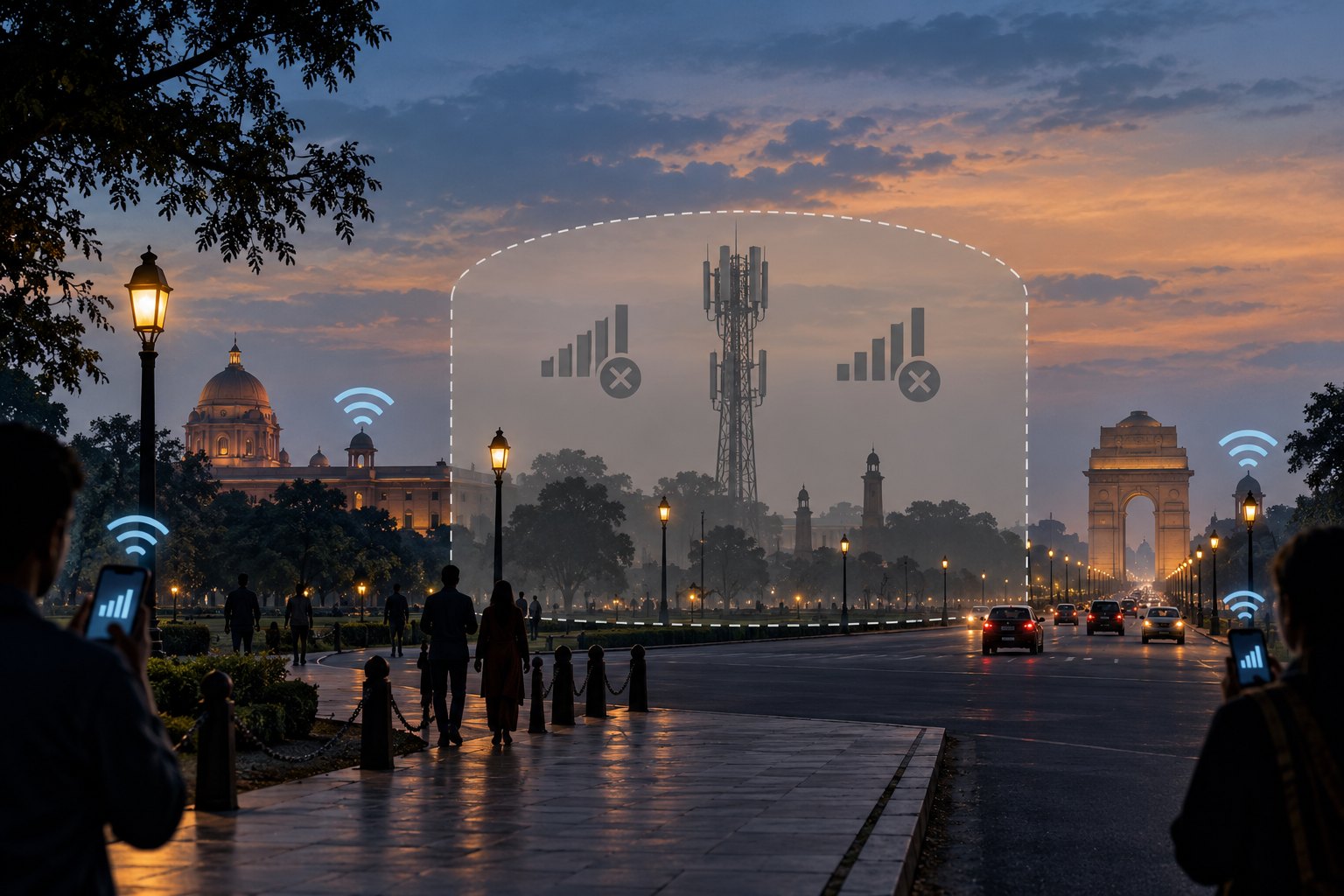
The Ministry of Home Affairs approved suspending mobile internet within 4 km of Delhi's Janpath–Kartavya Path crossing for 24 hours from 10 pm on 9 October 2026, ahead of a Jantar Mantar protest. A second order covered 500 metres around at least eight temporary jails on 10 October. The first invoked the Telecommunications Act, 2023 and its 2024 suspension Rules.
Syllabus: GS2 · Constitution; Prelims · Polity & Governance; GS2 · Governance & e-Governance
Why it matters
A shopkeeper in central Delhi who takes payments by phone, a commuter booking a cab, a reporter filing copy and a citizen trying to join or follow a protest all lose mobile data under such an order. So a shutdown is a question of fundamental rights: it restricts speech under Article 19(1)(a), peaceful assembly under Article 19(1)(b) and trade under Article 19(1)(g). The 500-metre order cited public order and preventing incitement, grounds the Constitution accepts. Against that, a shutdown silences everyone in the zone, and MediaNama observed that the 4-km order began the night it was dated, giving residents, businesses and journalists little warning. The 2024 Rules and the Anuradha Bhasin tests set the line: written reasons, publication, a defined area, a fixed end and review within five days.
Prelims pointers
- Section 20(2)(b), Telecommunications Act, 2023: on a public emergency or for public safety, the Centre or a State may suspend telecom services, for interests including public order and preventing incitement.
- Competent authority: the Union Home Secretary (Centre) or the State's Home Department Secretary; in unavoidable circumstances an authorised Joint Secretary may order, subject to confirmation within 24 hours.
- Each order must be published with reasons, fix the area and type of service, last at most 15 days, and issue only if no other reasonable means would work.
- An officer not below Superintendent of Police rank conveys the order to each operator's nodal officer; a copy reaches the review committee within 24 hours.
- Review committee: Cabinet Secretary (chair) and the Secretaries of Legal Affairs and Telecommunications; in a State, the Chief Secretary chairs. It meets within five days and may set orders aside.
- Article 19(1)(a), 19(1)(b) and 19(1)(g) protect speech, peaceful assembly and trade; public order is a ground in Article 19(2) and 19(3), while Article 19(6) cites the general public.
- Anuradha Bhasin v. Union of India (2020): internet suspensions must be proportionate, temporary, published and open to judicial review; Section 144 CrPC cannot suppress legitimate expression of grievance.
- Section 69A of the Information Technology Act, 2000 lets the Centre block specific online information or apps; Shreya Singhal v. Union of India (2015) upheld it.
Practise a UPSC-style question
With reference to the Telecommunications (Temporary Suspension of Services) Rules, 2024, consider the following statements:
1. A suspension order must be published and must clearly state the reasons for which it is issued.
2. A copy of each suspension order must be forwarded to the review committee within seven days of its issue.
3. No suspension order may be made unless its objective cannot be achieved by any other reasonable means.
Which of the statements given above is/are correct?
- (a) 1 and 2 only
- (b) 2 and 3 only
- (c) 1 and 3 only
- (d) 1, 2 and 3
Show the answer
Answer: (c) 1 and 3 only
1 is correct: the 2024 Rules require every suspension order to be published and to state its reasons clearly. 2 is incorrect: a copy must reach the review committee within 24 hours of the order, not seven days. 3 is correct: the Rules bar an order unless the issuing authority has considered that its objective cannot be achieved by any other reasonable means.
More from the 11 October 2026 edition
- INS Sahyadri reaches Vladivostok for India-Russia naval exercise INDRA 2026 Defence
- Special Notified Zones: DGFT redefines who may trade rough diamonds Economy
- C-STROKE ischaemic stroke atlas released; IIT Madras brain-mapping centre dedicated Sci-Tech
- Draft National Steel Policy: 604 MT capacity, cleaner steel by 2047 Economy
- India, UK navies hold Exercise KONKAN-26 off Plymouth Defence
- Supreme Court: detain peaceful protesters only by procedure established by law Polity
- Right to protest: Supreme Court lets authorities regulate, not halt, Delhi transit Polity
- DGTR opens anti-dumping probe into Penicillin G imports from China Economy
- NBA disburses Rs 2.02 crore Access and Benefit-Sharing funds to States Environment
- Magnitude 7.7 earthquake strikes Panama on the Pacific Ring of Fire World & IR
- Navy's Next Generation Offshore Patrol Vessel 'Shreyas' launched at GRSE, Kolkata Defence