
Geothermal energy: India's policy, provinces and first wells at Puga
Why in news: PIB's backgrounder of 2 November 2026 reviewed the 2025 policy and the first two geothermal wells commissioned at Puga Valley, Ladakh.
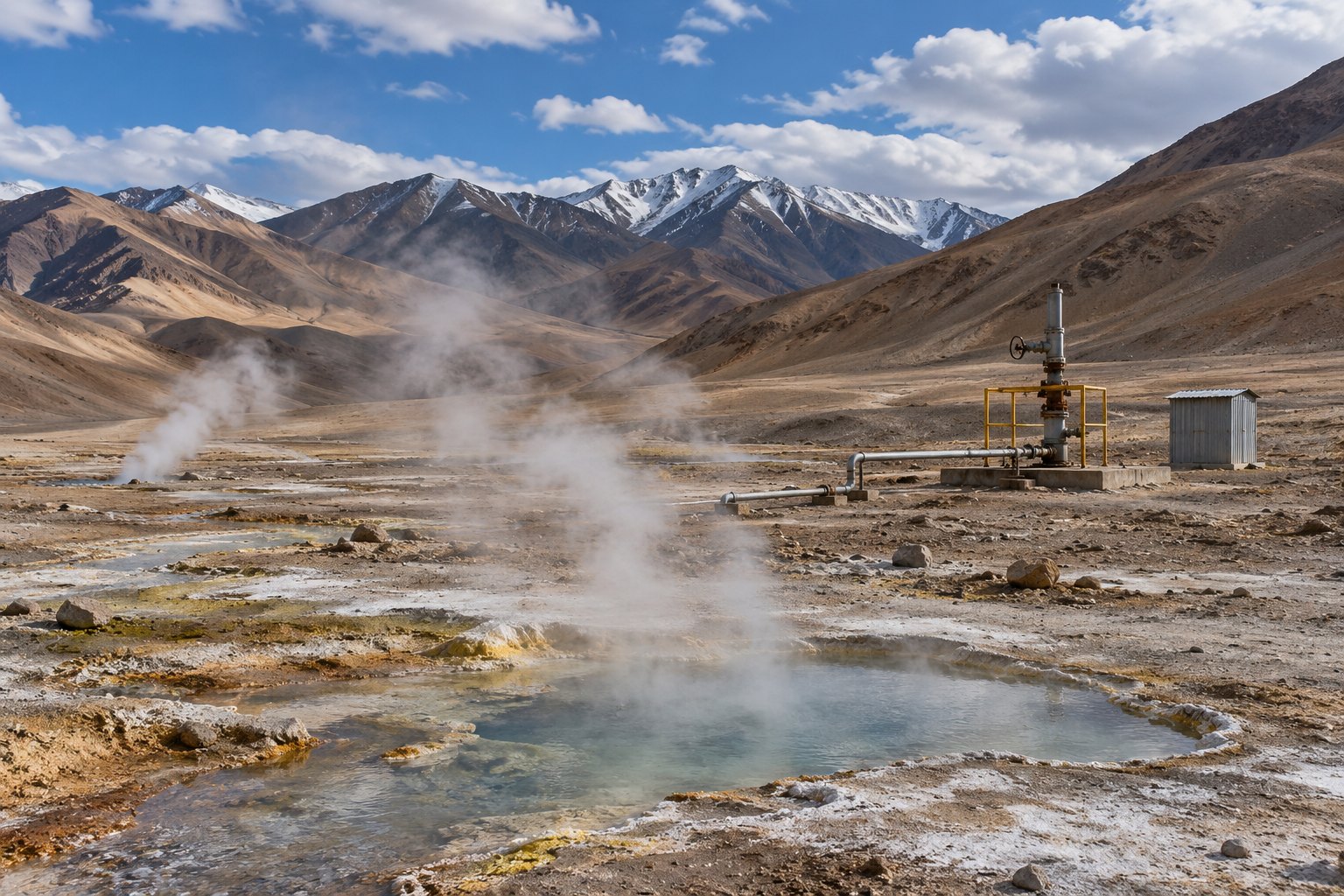
Geothermal energy is heat from the Earth's interior, brought up through wells to spin turbines or used directly for heating and cooling. Unlike solar and wind, it is available day and night. The Ministry of New and Renewable Energy (MNRE) notified a National Policy on Geothermal Energy in September 2025. A PIB backgrounder on 2 November 2026 reviewed its progress.
Syllabus: Prelims · Environment & Ecology; GS3 · Infrastructure; GS2 · Government Policies
Why this matters for UPSC
GS3 infrastructure and energy: renewable sources and the 2025 geothermal policy. Prelims can ask provinces, plant types and the nodal ministry; Mains, firm clean power.
In short
Geothermal energy is heat from the Earth's interior, tapped through wells for power or direct use. India's National Policy on Geothermal Energy, 2025 makes MNRE its nodal ministry.
Geothermal will stay a niche, steady complement to solar and wind; cheaper exploration, shared data and a proven Puga plant must come before scale.
Why it matters
A family in a remote, high-altitude settlement far from the grid gains most from a power source that runs through the night and in any weather. Solar panels go dark after sunset and wind turbines stall in calm air, so a grid built on them needs batteries or backup plants. Underground heat does not switch off, so a working geothermal plant can carry steady baseload demand and help keep the grid stable. The same heat can warm homes and greenhouses or dry fruit in cold regions, cutting the fuel burnt for heating. The obstacle is the cost and risk of finding a good reservoir, which is why early wells and pilot plants decide whether private developers will invest.
Prelims pointers
- India's 10 geothermal provinces, identified by GSI: the Himalayan, Naga-Lusai, Andaman-Nicobar, West Coast, Cambay Graben, Son-Narmada-Tapi (SONATA), Aravalli, Godavari, Mahanadi and South Indian Cratonic provinces.
- GSI sites by State: Puga and Chumathang in Ladakh; Manikaran in Himachal Pradesh; Bakreshwar in West Bengal; Manuguru in Telangana; Tattapani appears in both Himachal Pradesh and Chhattisgarh.
- GSI's 381 hot springs show surface temperatures of 35-89°C, whereas Himalayan reservoirs can reach about 200°C.
- The 2025 policy lists four power plant types: dry steam, flash steam, binary cycle and Organic Rankine Cycle; plants are modular and can be added in units.
- Geothermal plants have no fuel cost, only operation and maintenance expenses, and usually run at capacity utilisation factors above 80%, per the 2025 policy.
- Earth's crust is 5-8 km thick under oceans and 24-56 km under continents; the mantle, nearly 2,900 km, is the largest layer.
Practise a UPSC-style question
With reference to geothermal energy, consider the following statements:
1. Heat in the Earth's interior comes partly from the radioactive decay of elements such as uranium, thorium and potassium.
2. High-enthalpy geothermal resources are better suited to ground source heat pumps than to electricity generation.
3. A geothermal power plant condenses its spent water and pumps it back underground, helping recharge the reservoir.
Which of the statements given above is/are correct?
- (a) 1 and 2 only
- (b) 2 and 3 only
- (c) 1 and 3 only
- (d) 1, 2 and 3
Show the answer
Answer: (c) 1 and 3 only
Answer: (c) 1 and 3 only. Statement 2 reverses the uses of high- and low-enthalpy resources.
Statement 1: correct. PIB traces the interior's heat to radioactive decay of uranium, thorium and potassium, plus heat left from the Earth's formation.
Statement 2: incorrect. The 2025 National Policy on Geothermal Energy says high-enthalpy resources mainly generate electricity; low- and medium-enthalpy ones suit direct use and heat pumps.
Statement 3: correct. After generation the water is condensed and reinjected, which helps recharge the reservoir.
Eliminate: statement 2 wrongly gives high-enthalpy resources the heat-pump role. Out: (a), (b), (d).
Trap: Reversed direction. The statement pins the low-temperature use on high-enthalpy resources, which are the ones hot enough for power.
Remember: high enthalpy for power; low and medium enthalpy for heating, cooling and heat pumps.
More Explainers
- Zero FIR: Section 173 of the BNSS and where it stops Polity
- Enforcement Directorate's PMLA powers depend on a scheduled offence Polity
- Preventive detention: Article 22 and the National Security Act, 1980 Polity
- Prohibition of Child Marriage Act, 2006 and Bal Vivah Mukt Bharat National
- Liberalised Remittance Scheme (LRS) under FEMA, 1999 Economy
- Carbon sinks: why the Amazon now releases more carbon than it absorbs Environment
- Pharmacovigilance and materiovigilance: how India tracks harm from medicines and devices National
- UGC equity regulations, 2026, against discrimination in higher education Polity
- Space debris and India's Debris Free Space Mission goal for 2030 Sci-Tech
- Somnath temple: Prabhas Patan's jyotirlinga, its destruction and 1951 rebuilding National
- Food safety enforcement: FSSAI, State Commissioners and central licensing Polity
- Safe harbour for internet intermediaries under Section 79 of the IT Act Polity