
Carbon sinks: why the Amazon now releases more carbon than it absorbs
Why in news: A Nature study published online on 21 October 2026 finds the Amazon a net carbon source across 2010-2024.
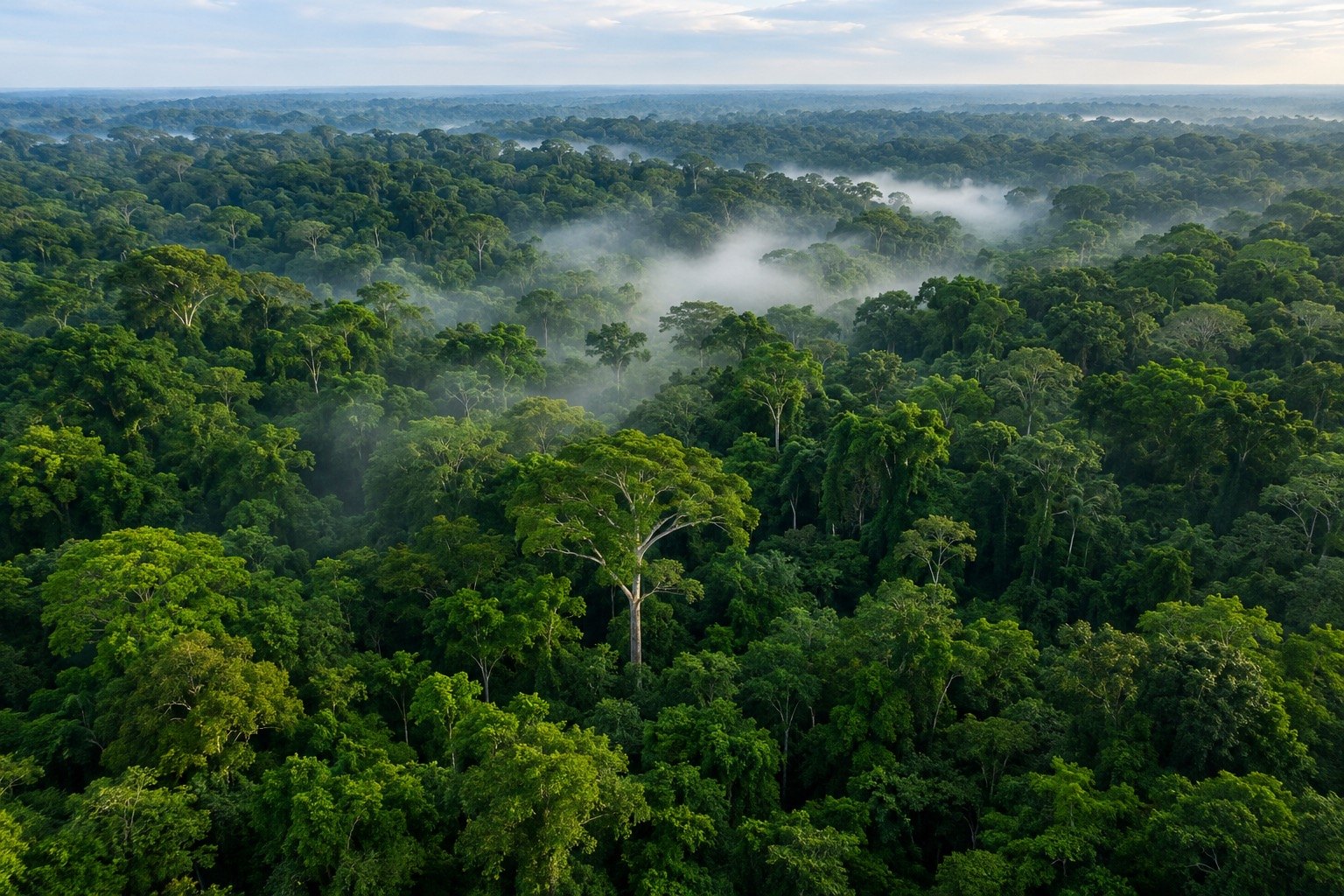
A carbon sink takes up more carbon dioxide than it gives off; a carbon source releases more. Land and ocean sinks have long absorbed about half of human emissions. A Nature study of aircraft measurements over 2010-2024 finds the Amazon a net source of 0.32 billion tonnes of carbon a year.
Syllabus: Prelims · Environment & Ecology; GS1 · World Physical Geography; GS3 · Environment & Conservation
Why this matters for UPSC
GS3 environment and GS1 geography: carbon sinks, the carbon budget and the Amazon Basin. Prelims can ask land and ocean sink shares; Mains, whether forest sinks can be relied upon.
In short
A carbon sink absorbs more carbon dioxide than it emits. Land and ocean sinks have long slowed warming, but the Amazon now emits more carbon than it absorbs.
Forest sinks are fragile allies; protecting the Amazon from clearing and fire must accompany, never replace, deep cuts in fossil-fuel emissions.
Why it matters
A rancher in Brazil who clears forest for pasture affects people far from the Amazon. When a large forest stops soaking up carbon, more of every country's emissions stays in the air, and the room left for growth before dangerous warming shrinks. Fewer trees also mean less rain over the Amazon, because the forest recycles its own moisture; drier forest burns more easily, which releases still more carbon. Countries that count on forests to balance their emissions, India among them through its plan to grow an extra forest sink, learn that a sink can fail if it is cleared, burnt or dried out.
Prelims pointers
- A petagram of carbon (PgC) equals one billion tonnes of carbon; fluxes in carbon terms are smaller than the same flux expressed as carbon dioxide.
- Natural sinks: over 2010-2019 land took up 31% and the ocean 23% of human CO2 emissions; the airborne share stayed near 44% for six decades.
- The ocean sink is measured more precisely than the land sink, which varies widely from region to region.
- The Amazon Basin covers about 5.9 million sq km, nearly 40% of South America, spans eight countries and holds about 20% of the planet's available freshwater.
- The Amazon Cooperation Treaty Organization (ACTO), seated in Brasilia, groups the eight Amazonian countries; Brazil's PRODES programme separately tracks clearing in the Brazilian Legal Amazon.
- El Nino and warming of the Tropical North Atlantic both cut rainfall and raise temperatures over the Amazon, making the forest more flammable.
Practise a UPSC-style question
With reference to natural carbon sinks, consider the following statements:
1. Over 2010-2019, the ocean took up a larger share of human carbon dioxide emissions than the land.
2. The share of yearly human carbon dioxide emissions that stays in the atmosphere has remained roughly stable at about 44% for six decades.
Which of the statements given above is/are correct?
- (a) 1 only
- (b) 2 only
- (c) Both 1 and 2
- (d) Neither 1 nor 2
Show the answer
Answer: (b) 2 only
Answer: (b) 2 only. The land, not the ocean, is the larger natural sink of human carbon dioxide.
Statement 1: incorrect. The IPCC Sixth Assessment Report (2021) found land took up 31% and the ocean 23% of human CO2 emissions in 2010-2019.
Statement 2: correct. The IPCC found the airborne share has stayed roughly stable at 44% over six decades, even as emissions grew.
Eliminate: statement 1 reverses the land and ocean shares. Out: (a), (c).
Eliminate: statement 2 matches the IPCC's stable airborne share. Out: (d).
Trap: Reversed direction. The ocean is often thought the bigger sink, so a student may accept statement 1 without recalling the land's 31% share.
Remember: Land 31%, ocean 23%, atmosphere about 44% of human CO2 emissions (IPCC, 2010-2019).
More Explainers
- Zero FIR: Section 173 of the BNSS and where it stops Polity
- Enforcement Directorate's PMLA powers depend on a scheduled offence Polity
- Preventive detention: Article 22 and the National Security Act, 1980 Polity
- Prohibition of Child Marriage Act, 2006 and Bal Vivah Mukt Bharat National
- Liberalised Remittance Scheme (LRS) under FEMA, 1999 Economy
- Pharmacovigilance and materiovigilance: how India tracks harm from medicines and devices National
- UGC equity regulations, 2026, against discrimination in higher education Polity
- Space debris and India's Debris Free Space Mission goal for 2030 Sci-Tech
- Somnath temple: Prabhas Patan's jyotirlinga, its destruction and 1951 rebuilding National
- Food safety enforcement: FSSAI, State Commissioners and central licensing Polity
- Safe harbour for internet intermediaries under Section 79 of the IT Act Polity
- Article 33: why police cannot protest like other citizens Polity