
Somnath temple: Prabhas Patan's jyotirlinga, its destruction and 1951 rebuilding
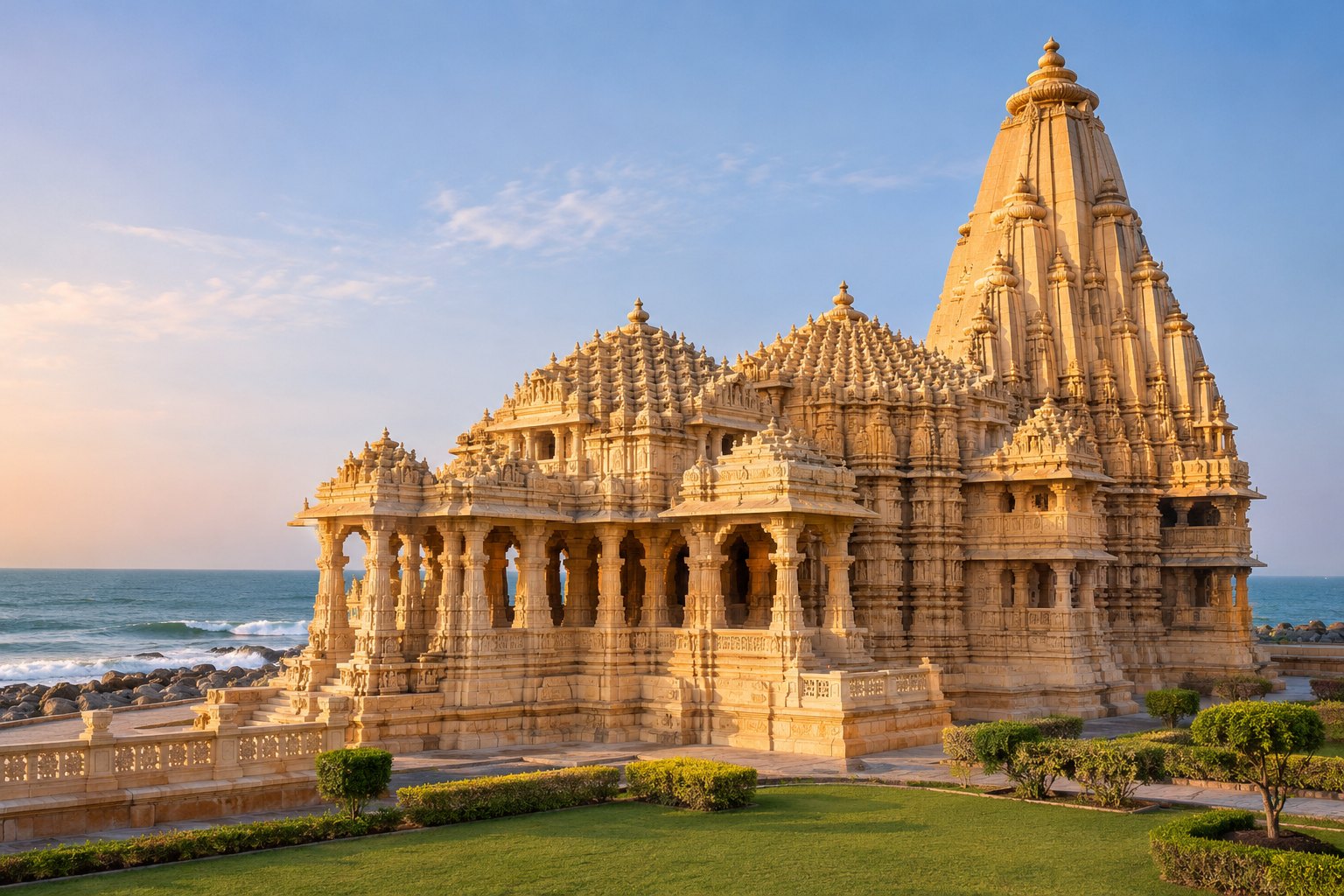
Somnath, on Gujarat's Saurashtra coast, is revered as the first of Shiva's twelve jyotirlingas. The first recorded attack, by Mahmud of Ghazni in January 1026, began centuries of ruin and rebuilding. The present temple was consecrated on 11 May 1951. The year 2026 marks a thousand years since that first attack and 75 years since the temple reopened.
Syllabus: GS1 · Art & Culture; Prelims · History & Culture; GS1 · Post-independence India
Why this matters for UPSC
GS1 Indian culture: temple architecture and medieval history of Gujarat. Prelims can ask the jyotirlinga, the Solanki temples and Modhera; Mains, how Somnath records history.
In short
Somnath at Prabhas Patan is the first of Shiva's twelve jyotirlingas. Its destruction from 1026 and rebuilding up to 1951 make it a layered record of faith, patronage and architecture.
Somnath is best studied as layered evidence: recorded raids, royal restorations, a 1951 temple and the Solanki tradition that shaped western Indian building.
Why it matters
A pilgrim at Prabhas Patan today walks into a temple that is barely 75 years old, standing on a site worshipped for many centuries. That gap is why Somnath matters to a student of Indian culture. Its story shows how a sacred place survives: rulers and devotees rebuilt it after each raid, a Maratha queen kept worship alive nearby, and leaders of independent India chose to rebuild it with public support. It also shows how historians separate evidence from belief, since some early temples rest on tradition while the later raids and repairs are recorded. Western India's Solanki temples, Modhera above all, teach how a regional building style grew within the wider north Indian form.
Prelims pointers
- NCERT dates the Modhera Sun temple in Gujarat to 1026 and credits it to Raja Bhimdev I of the Solanki dynasty.
- Modhera's surya kund is a rectangular stepped tank with 108 miniature shrines carved between its steps.
- In nagara temples the whole structure usually stands on a stone platform with steps, without the elaborate boundary walls of South Indian temples.
- White marble marks the Jain temples of Mount Abu, built in the tenth to twelfth centuries; Ranakpur's marble temple dates from the fifteenth century.
- Samlaji in Gujarat has grey schist sculptures of the sixth to eighth centuries CE, mixing earlier regional traditions with a post-Gupta style.
- The Shiva Purana and Nandi Upapurana describe Shiva present in twelve forms and places as the jyotirlingas, the Shree Somnath Trust notes.
Practise a UPSC-style question
With reference to the Somnath temple, consider the following statements:
1. It stands at Prabhas Patan on the Saurashtra coast of Gujarat.
2. The Dwadasha Jyotirlinga Stotram places Somnath last among the twelve jyotirlingas.
3. Ahilyabai Holkar, the Maratha queen of Indore, built a new temple at Somnath in the eighteenth century.
Which of the statements given above is/are correct?
- (a) 1 and 2 only
- (b) 2 and 3 only
- (c) 1 and 3 only
- (d) 1, 2 and 3
Show the answer
Answer: (c) 1 and 3 only
Answer: (c) 1 and 3 only. The location and Ahilyabai's temple are right; the Stotram puts Somnath first, not last.
Statement 1: correct. PIB places Somnath at Prabhas Patan near Veraval, on the Saurashtra coast of Gujarat.
Statement 2: incorrect. The Dwadasha Jyotirlinga Stotram names Somnath first among the twelve jyotirlingas, PIB notes.
Statement 3: correct. Ahilyabai Holkar of Indore built a temple at Somnath in 1782, per the Shree Somnath Trust; PIB says the eighteenth century.
Eliminate: statement 2 is surely wrong, since Somnath is the first jyotirlinga, which removes every option holding 2. Out: (a), (b), (d).
Trap: Near-miss figure. The statement keeps the familiar Stotram and the count of twelve but moves Somnath from first place to last.
Remember: Somnath, Prabhas Patan, is the first of the twelve jyotirlingas.
More Explainers
- Zero FIR: Section 173 of the BNSS and where it stops Polity
- Enforcement Directorate's PMLA powers depend on a scheduled offence Polity
- Preventive detention: Article 22 and the National Security Act, 1980 Polity
- Prohibition of Child Marriage Act, 2006 and Bal Vivah Mukt Bharat National
- Liberalised Remittance Scheme (LRS) under FEMA, 1999 Economy
- Carbon sinks: why the Amazon now releases more carbon than it absorbs Environment
- Pharmacovigilance and materiovigilance: how India tracks harm from medicines and devices National
- UGC equity regulations, 2026, against discrimination in higher education Polity
- Space debris and India's Debris Free Space Mission goal for 2030 Sci-Tech
- Food safety enforcement: FSSAI, State Commissioners and central licensing Polity
- Safe harbour for internet intermediaries under Section 79 of the IT Act Polity
- Article 33: why police cannot protest like other citizens Polity