
IN-SPACe report finds India's satellite supply chain heavily import-dependent
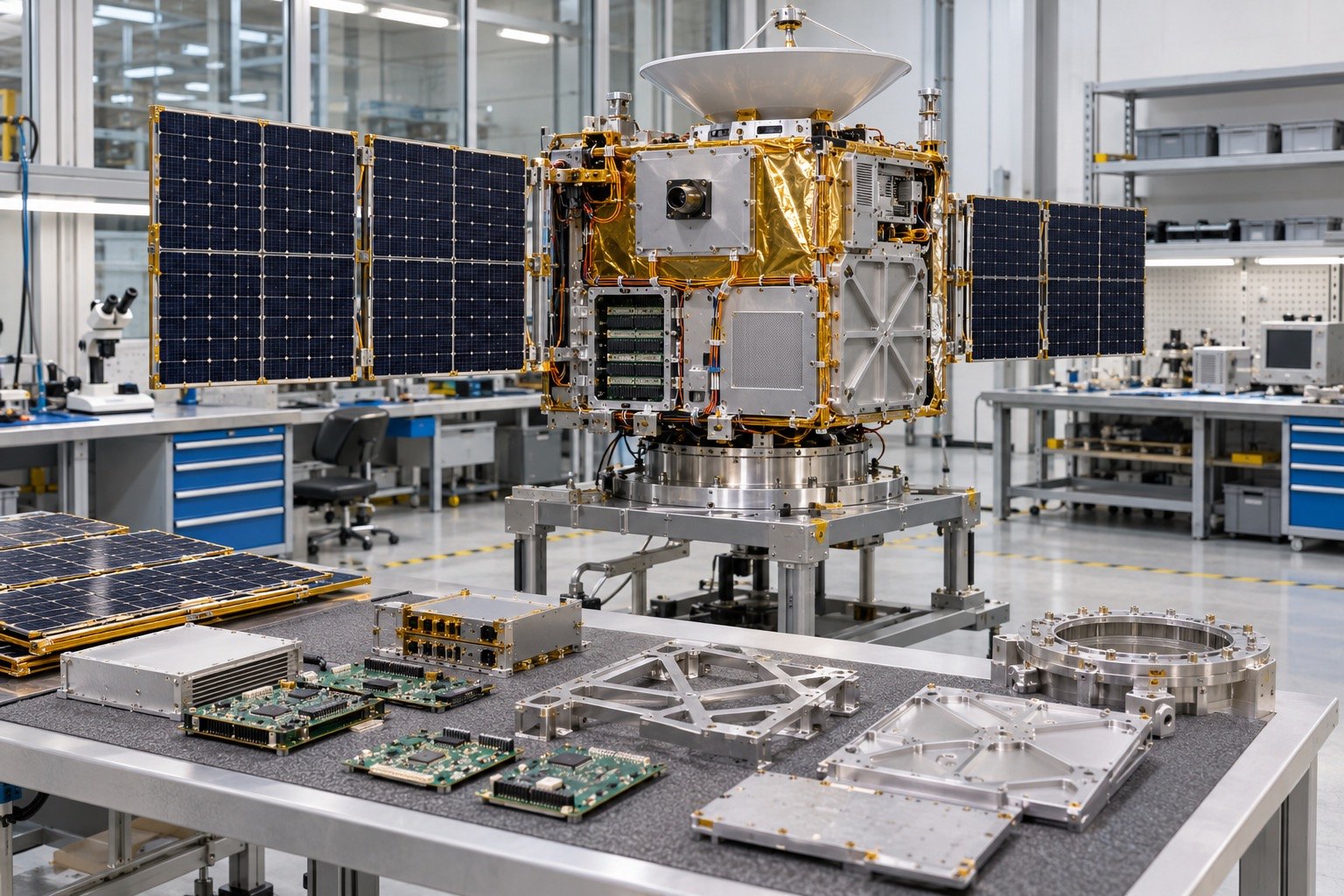
IN-SPACe, the autonomous space regulator-promoter under the Department of Space, made public a report on 25 November 2026 that finds India's satellite supply chain highly dependent on imports for critical parts. Private firms' share of the work is largely confined to structural assemblies and propulsion components. The report also cites long waits for parts and thin testing facilities.
Syllabus: GS3 · Liberalisation & Industry; GS3 · Indian Achievements in S&T; GS3 · IT, Space, Biotech & IPR
Why this matters for UPSC
GS3 science and technology: space sector reforms and indigenisation of technology. Prelims can ask IN-SPACe, NSIL and ISRO roles and FDI routes; Mains, import dependence in satellites.
Why it matters
A satellite start-up that waits more than a year for a critical part cannot give its customer a firm delivery date, and the order can go to a foreign rival. Without local testing and certification, even a good Indian part struggles to win buyers abroad. So Indian firms stay assemblers of parts made elsewhere, and much of the value of each satellite is earned outside the country. Jobs in skilled engineering and quality work grow slowly for the same reason. If the gaps close, the same firms could sell components and whole satellite systems to other countries, which the report sees as possible within the next decade.
Prelims pointers
- Under the Indian Space Policy 2023, IN-SPACe is the single window agency that authorises space activities of both government entities and non-government entities (NGEs).
- IN-SPACe is an autonomous Government organisation that authorises and promotes; NSIL is a Public Sector Undertaking under the Department of Space that commercialises publicly funded space technology.
- Under the Space Policy 2023, the Department of Space must ensure continuous earth observation capability and plans remote sensing systems with all stakeholders.
- Under the policy, ISRO moves out of manufacturing operational space systems; mature systems pass to industry while ISRO focuses on advanced R&D.
- FDI in space after the Cabinet's February 2024 amendment: automatic route up to 74% for satellites, 49% for launch vehicles and spaceports, 100% for components and subsystems.
- Above those ceilings, space FDI goes through the government route; before the amendment, FDI in setting up and operating satellites came through the government approval route alone.
- IN-SPACe authorisation is needed to disseminate high-resolution remote sensing data, meaning a ground sampling distance of 30 cm or finer.
Practise a UPSC-style question
With reference to the report "Supply Chain Landscape of Satellite Manufacturing in India", consider the following statements:
1. It was prepared and released by NewSpace India Limited (NSIL).
2. It maps suppliers subsystem by subsystem as a descriptive study, not as a statistical survey.
Which of the statements given above is/are correct?
- (a) 1 only
- (b) 2 only
- (c) Both 1 and 2
- (d) Neither 1 nor 2
Show the answer
Answer: (b) 2 only
Answer: (b) 2 only. IN-SPACe, not NSIL, brought out the report, and it is a descriptive map.
Statement 1: incorrect. The Indian National Space Promotion and Authorisation Centre (IN-SPACe), an autonomous body under the Department of Space, published it in November 2026.
Statement 2: correct. The report splits a satellite into major subsystems, names the parts and materials each needs, and lists Indian and foreign suppliers; it is not a statistical survey.
Eliminate: statement 1 credits the wrong body, so options with 1 go. Out: (a), (c).
Eliminate: statement 2 describes the report's method correctly. Out: (d).
Trap: Swapped attribution. NSIL and IN-SPACe both sit under the Department of Space, so the publisher is easy to swap.
Remember: IN-SPACe published the satellite supply chain report; NSIL is the commercial PSU.
More from the 27 November 2026 edition
- MIB tells Netflix to keep Pakistan-origin content off Indian streams Polity
- India's pavilion wins Visitors' Lion at the 61st Venice Biennale National
- BRO track widening at Sheshnag Lake on Amarnath route draws protests Environment
- Supreme Court directs FSSAI to mandate front-of-pack nutrient warnings National
- Supreme Court sets aside Bihar remission notification; Article 21 covers victims Polity
- European Parliament objects to EU listing of two Alang ship recycling yards Environment
- Jharkhand resolution seeks withdrawal of MMDR amendment curbing State mineral taxes Polity
- RBI's half-yearly reserves report: 84% of its gold now held in India Economy
- Election Commission orders Form 8 fix for wrong roll entries after SIR Polity
- IASST Guwahati develops bivalent antivenom against two North-East pit vipers Sci-Tech
- Colombo Security Conclave: six-nation Indian Ocean security grouping meets in Male World & IR
- USTR finds India's excess capacity actionable under Section 301, proposes tariffs Economy