
Supreme Court directs FSSAI to mandate front-of-pack nutrient warnings
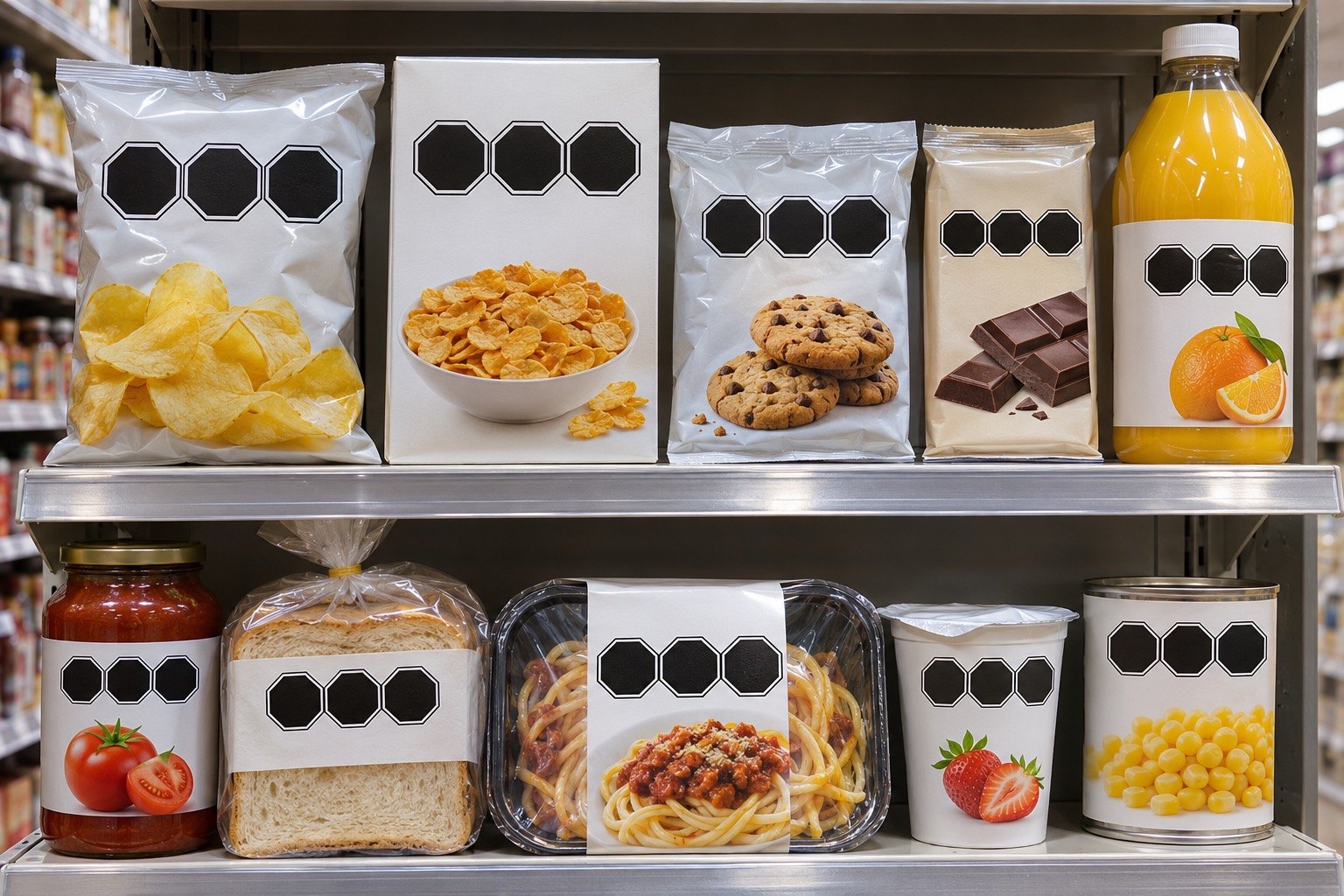
On 26 November 2026 the Supreme Court gave the Food Safety and Standards Authority of India (FSSAI) a labelling direction. Packaged food must carry a separate warning hexagon for each nutrient of concern, such as sugar and fat. Consumers in India, the Court held, deserve at least the protection enjoyed in the United States and the United Kingdom.
Syllabus: Prelims · Current Affairs & IR; Prelims · Polity & Governance; GS2 · Statutory & Regulatory Bodies
Why this matters for UPSC
GS2 governance and health: FSSAI and food labelling under the Food Safety and Standards Act, 2006. Prelims can ask which body sets labelling rules; Mains, front-of-pack warnings and consumer rights.
Why it matters
A parent picking up a packet of biscuits rarely reads the small table on the back. A warning symbol on the front for each nutrient of concern lets that shopper see at a glance that a snack is heavy in sugar or fat, and pick something else. Clear front labels may also lead food makers to change recipes, since few brands want a pack covered in warnings. The ruling places food labelling inside public health and the consumer's right to know what a family is eating.
Prelims pointers
- The Food Safety and Standards Act, 2006 declares it expedient in the public interest that the Union take the food industry under its control.
- The 2006 Act's definition of food covers packaged drinking water, alcoholic drink and chewing gum, but leaves out animal feed, drugs and cosmetics.
- The 2020 Regulations separately define a 'principal display panel': the part of a package likely to be displayed or examined by the customer under normal conditions of sale.
- In the 2020 Regulations, 'added sugars' are monosaccharides and disaccharides added to foods and beverages, a narrower group than total sugars.
- The 2006 Act also makes every food business operator ensure that a food's labelling, presentation and packaging do not mislead consumers.
Practise a UPSC-style question
Consider the following statements about the Food Safety and Standards Authority of India (FSSAI):
1. It was established under the Food Safety and Standards Act, 2006.
2. Its parent Act declares it expedient in the public interest that the States take the food industry under their control.
3. It notified the Labelling and Display Regulations, 2020 for pre-packaged food.
Which of the statements given above is/are correct?
- (a) 1 and 2 only
- (b) 2 and 3 only
- (c) 1 and 3 only
- (d) 1, 2 and 3
Show the answer
Answer: (c) 1 and 3 only
Answer: (c) 1 and 3 only. FSSAI comes from the 2006 Act and makes the labelling rules, and that Act places the food industry under the Union.
Statement 1: correct. The Food Safety and Standards Act, 2006 was enacted to establish FSSAI to lay down science-based standards for articles of food.
Statement 2: incorrect. The 2006 Act declares it expedient in the public interest that the Union, not the States, take the food industry under its control.
Statement 3: correct. The Labelling and Display Regulations, 2020, issued by FSSAI under the 2006 Act, cover the labelling of pre-packaged food.
Eliminate: statement 2 is incorrect, since the Act names the Union. Out: (a), (b), (d).
Trap: Wrong scope. The question hands the Union's declared control of the food industry to the States.
Remember: FSS Act, 2006 = FSSAI; the food industry is under Union control.
More from the 27 November 2026 edition
- MIB tells Netflix to keep Pakistan-origin content off Indian streams Polity
- India's pavilion wins Visitors' Lion at the 61st Venice Biennale National
- BRO track widening at Sheshnag Lake on Amarnath route draws protests Environment
- Supreme Court sets aside Bihar remission notification; Article 21 covers victims Polity
- European Parliament objects to EU listing of two Alang ship recycling yards Environment
- Jharkhand resolution seeks withdrawal of MMDR amendment curbing State mineral taxes Polity
- RBI's half-yearly reserves report: 84% of its gold now held in India Economy
- Election Commission orders Form 8 fix for wrong roll entries after SIR Polity
- IASST Guwahati develops bivalent antivenom against two North-East pit vipers Sci-Tech
- IN-SPACe report finds India's satellite supply chain heavily import-dependent Sci-Tech
- Colombo Security Conclave: six-nation Indian Ocean security grouping meets in Male World & IR
- USTR finds India's excess capacity actionable under Section 301, proposes tariffs Economy