
RBI's half-yearly reserves report: 84% of its gold now held in India
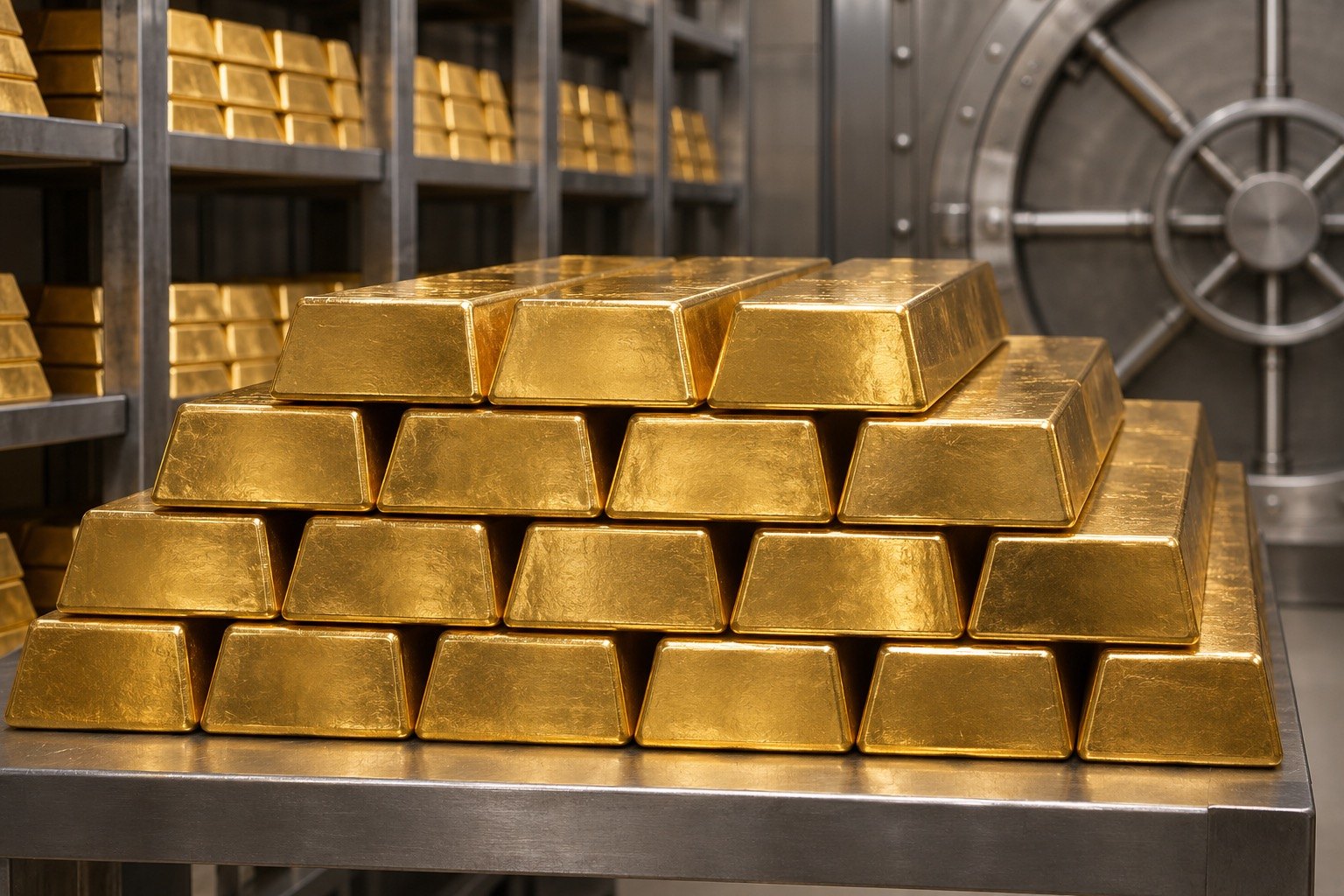
The Reserve Bank of India (RBI) held 740.13 of its 880.52 metric tonnes of gold in India at end-September 2026, its half-yearly report on managing foreign exchange reserves showed on 25 November. The other 140.39 tonnes sat with the Bank of England and the Bank for International Settlements. Total reserves grew by about US$47 billion over the half-year.
Syllabus: GS3 · Indian Economy & Growth; Prelims · Current Affairs & IR; Prelims · Economy & Social Development
Why this matters for UPSC
GS3 economy: foreign exchange reserves and how the RBI manages them. Prelims can ask the four components and custodians; Mains, reserve safety and composition.
Why it matters
An importer paying for oil or machinery needs dollars to be available at a steady rupee rate, and reserves are the RBI's buffer for that. Where the buffer sits matters as much as its size. Assets parked abroad can be frozen by another government, as Russia's were in 2022, while gold in the RBI's own vaults stays under its control. Gold also swings in price, so the reserves can shrink on paper with no sale at all. Putting safety and liquidity ahead of return, and spreading holdings across currencies, gold and IMF assets, is how the country keeps the capacity to pay its foreign bills in a shock.
Prelims pointers
- India's foreign exchange reserves have four components: foreign currency assets, gold, Special Drawing Rights and the Reserve Tranche Position in the IMF.
- The Reserve Bank of India Act, 1934 is the overarching legal framework for deploying reserves in foreign currency assets and gold.
- Safety and liquidity are the twin objectives of reserve management in India; return optimisation is kept in view within that framework.
- The broad strategy for reserves, including currency composition and investment policy, is decided in consultation with the Government of India.
- Permitted deployment: deposits with other central banks and the BIS, deposits with commercial banks overseas, sovereign debt of up to 10 years' residual maturity, and certain derivatives.
- SDR holdings are shown as a separate component, not within foreign currency assets; FCA also excludes IIFC (UK) bonds and sums lent under SAARC and ACU currency swaps.
Practise a UPSC-style question
With reference to India's foreign exchange reserves, consider the following statements:
1. Foreign currency assets are kept in several major currencies, but the reserves are expressed in US dollar terms.
2. The reserves are made up of foreign currency assets, gold, Special Drawing Rights and the Reserve Tranche Position in the IMF.
3. Sums the RBI lends under the SAARC currency swap arrangement are counted within its foreign currency assets.
Which of the statements given above is/are correct?
- (a) 1 and 2 only
- (b) 2 and 3 only
- (c) 1 and 3 only
- (d) 1, 2 and 3
Show the answer
Answer: (a) 1 and 2 only
Answer: (a) 1 and 2 only. The four components are counted, but swap lending is kept out of foreign currency assets.
Statement 1: correct. The RBI's report says FCA sit in currencies such as the dollar, euro, pound and yen, yet reserves are stated in US dollars.
Statement 2: correct. The RBI's reserves table has four columns: FCA, gold, SDR and the Reserve Tranche Position in the IMF.
Statement 3: incorrect. The RBI's notes leave amounts lent under the SAARC and Asian Clearing Union swap arrangements out of FCA.
Eliminate: Statement 3 is false, so every option carrying 3 goes; statements 1 and 2 stand. Out: (b), (c), (d).
Trap: Wrong scope. A loan to a neighbour's central bank looks like a foreign asset, so it seems to belong in FCA; the RBI keeps it out.
Remember: Four components: FCA, gold, SDRs and the IMF reserve tranche.
More from the 27 November 2026 edition
- MIB tells Netflix to keep Pakistan-origin content off Indian streams Polity
- India's pavilion wins Visitors' Lion at the 61st Venice Biennale National
- BRO track widening at Sheshnag Lake on Amarnath route draws protests Environment
- Supreme Court directs FSSAI to mandate front-of-pack nutrient warnings National
- Supreme Court sets aside Bihar remission notification; Article 21 covers victims Polity
- European Parliament objects to EU listing of two Alang ship recycling yards Environment
- Jharkhand resolution seeks withdrawal of MMDR amendment curbing State mineral taxes Polity
- Election Commission orders Form 8 fix for wrong roll entries after SIR Polity
- IASST Guwahati develops bivalent antivenom against two North-East pit vipers Sci-Tech
- IN-SPACe report finds India's satellite supply chain heavily import-dependent Sci-Tech
- Colombo Security Conclave: six-nation Indian Ocean security grouping meets in Male World & IR
- USTR finds India's excess capacity actionable under Section 301, proposes tariffs Economy