
NHAI standardises toll plaza design for barrier-less MLFF tolling
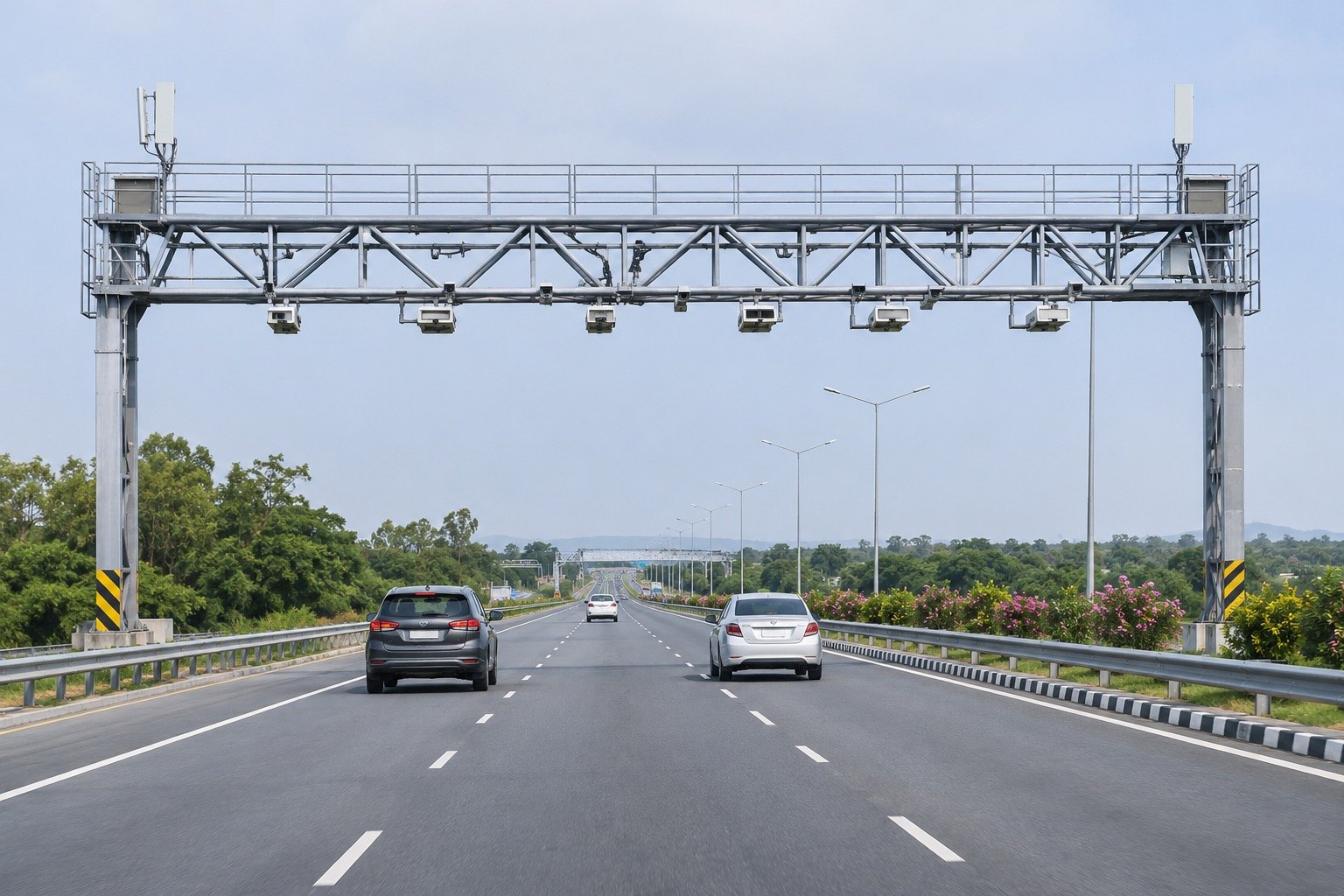
The National Highways Authority of India (NHAI) on 6 November 2026 issued guidelines standardising toll plaza design for barrier-less Multi-Lane Free Flow (MLFF) tolling on four-lane and wider National Highways. They fix a uniform plaza layout, fewer tolling lanes, gantry placement, lighting and signage. The guidelines apply to every future and under-construction highway project.
Syllabus: Prelims · Current Affairs & IR; GS3 · Infrastructure; GS2 · Governance & e-Governance
Why this matters for UPSC
GS3 infrastructure: roads and technology in National Highway toll collection. Prelims can ask how MLFF identifies vehicles; Mains, how tolling becomes seamless.
Why it matters
A bus driver on a National Highway today slows down, joins a queue and waits at the boom barrier before speeding up again. Each stop burns fuel and adds minutes, and sudden braking near a plaza raises the risk of crashes. If every new highway plaza is built for free flow, that driver can keep moving while cameras and the tag settle the fee. Contractors and highway engineers must now plan plazas to one national pattern, so drivers meet the same signs and lanes everywhere. The larger shift is from a toll booth that stops traffic to a digital system that enforces payment later, which works only if tags carry balance and number plates can be read.
Prelims pointers
- MLFF combines Automatic Number Plate Recognition with FASTag-based electronic toll collection, so fees are collected while vehicles move.
- Conventional plazas make vehicles stop or slow at a barrier; MLFF uses overhead gantries across the highway with no physical barrier.
- Working MLFF sites: Choryasi (NH-48, Surat-Bharuch, Gujarat), Mundka (Delhi), Daulatpura (Rajasthan) and Gharaunda (NH-44, Panipat-Jalandhar).
- Unpaid MLFF fees bring an e-Notice: normal fee within 72 hours, twice the rate after that; grievances also within 72 hours.
- An unpaid e-Notice can get the FASTag blacklisted and block other vehicle-related services on VAHAN.
- NHAI's earlier, separate guidelines set common DPR standards for high-speed, access-controlled highway corridors that are not Expressways.
Practise a UPSC-style question
With reference to Multi-Lane Free Flow (MLFF) tolling on National Highways, consider the following statements:
1. It uses Automatic Number Plate Recognition and FASTag to collect user fees without vehicles stopping.
2. A user who does not pay an e-Notice within 72 hours is charged twice the normal user fee.
Which of the statements given above is/are correct?
- (a) 1 only
- (b) 2 only
- (c) Both 1 and 2
- (d) Neither 1 nor 2
Show the answer
Answer: (c) Both 1 and 2
Answer: (c) Both 1 and 2. MLFF pairs camera-based plate reading with FASTag, and late e-Notice payment doubles the fee.
Statement 1: correct. NHAI's MLFF system combines ANPR with electronic toll collection through FASTag, so vehicles pass toll points without stopping.
Statement 2: correct. The normal fee is due inside 72 hours of the notice; after that, NHAI charges twice the rate for the vehicle category.
Eliminate: statement 1 is correct, the core of MLFF. Out: (b), (d).
Eliminate: statement 2 is correct, the e-Notice rule. Out: (a).
Trap: Near-miss figure. A student may think the doubled fee applies from the first hour or after a longer grace period; the 72-hour line decides it.
Remember: MLFF = ANPR + FASTag; e-Notice unpaid after 72 hours costs double.
Explainers on this topic
More from the 7 November 2026 edition
- Centre orders weekly rice stock disclosure, doubles OMSS rice sale target Economy
- MeitY approves 12 more ECMS projects; approved investment reaches Rs 77,051 crore Economy
- Supreme Court settles Himachal's Bhakra-Beas power dues with Punjab, Haryana Polity
- Supreme Court: OBC creamy layer income ruling will not apply retrospectively Polity
- UNESCO's Memory of the World Asia-Pacific Register adds Mahabharata, Arthashastra, Rajatarangini National
- CAQM serves show-cause notices on Punjab DCs and SSPs over stubble burning Environment
- Kerala notifies Calicut University garden as Biodiversity Heritage Site Environment
- CERT-In names AI-assisted 'CRAFTY FALCON' group attacking financial firms' payment APIs Sci-Tech
- Home Ministry exemption order now requires visas for six persecuted minorities Polity