
CAQM serves show-cause notices on Punjab DCs and SSPs over stubble burning
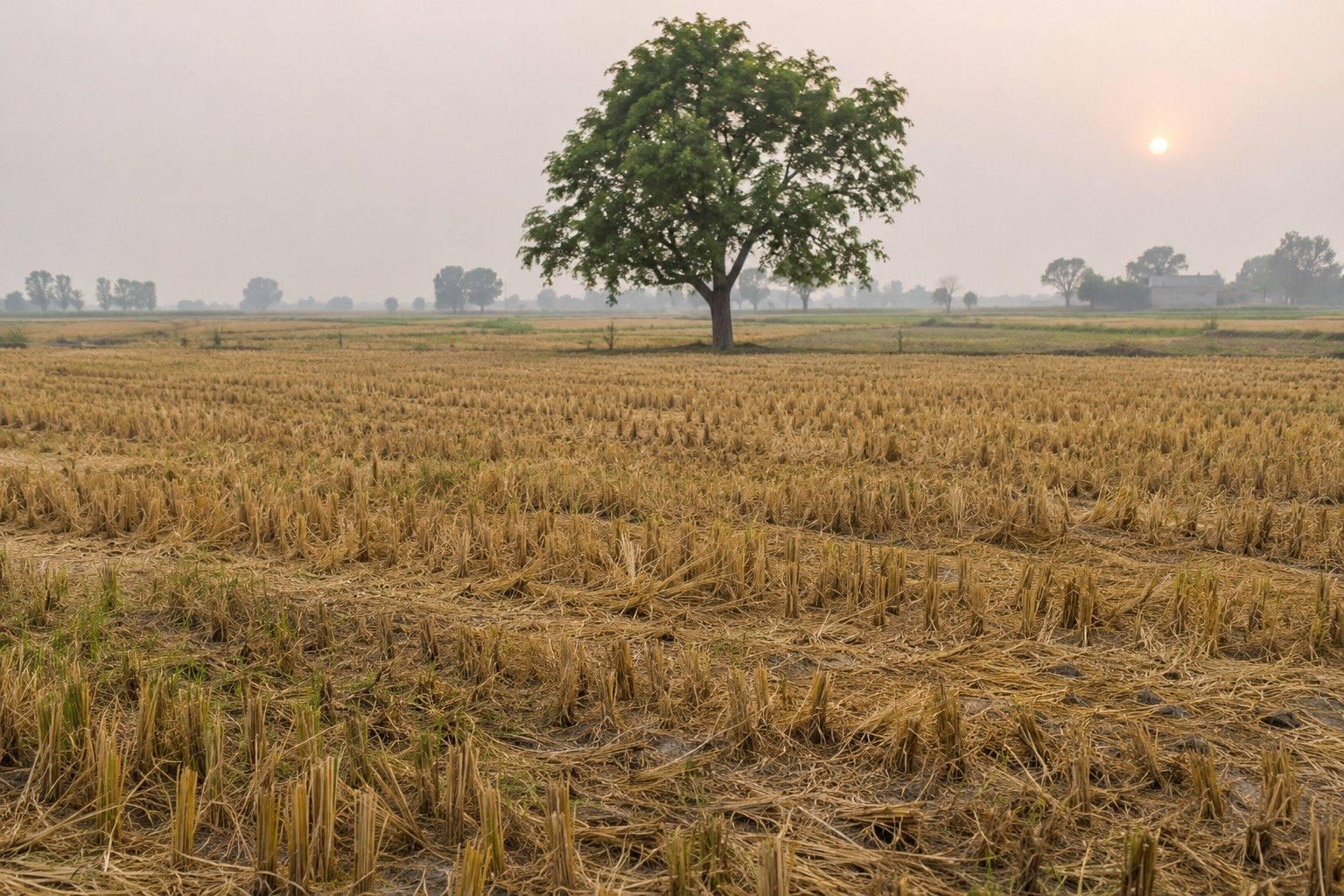
On 4 November 2026 the Commission for Air Quality Management in National Capital Region and Adjoining Areas issued show-cause notices over paddy stubble burning. They went to the Deputy Commissioners and Senior Superintendents of Police of five Punjab districts. With earlier notices, officers in nine districts must explain why action under the CAQM Act, 2021 should not follow.
Syllabus: Prelims · Environment & Ecology; GS2 · Statutory & Regulatory Bodies; GS3 · Environment & Conservation
Why this matters for UPSC
GS3 environment: air pollution and stubble burning; GS2 statutory bodies and accountability. Prelims can ask the CAQM Act's penalties and farmer exemption; Mains, officials' accountability for farm fires.
Why it matters
A district collector or police chief in Punjab can now be personally answerable for fires lit on farms in the district. That changes where officials spend effort in the harvest weeks: field inspections, evening patrols and the work of nodal officers matter, because a record of inaction can become the basis of a criminal complaint. Farmers themselves are not prosecuted under this law, so the pressure falls on the administration that is meant to offer machines, storage and alternatives to burning. For families in Delhi and the towns around it, the smoke is one part of the winter haze, so firmer enforcement in Punjab can ease, though not end, the season's worst air days.
Prelims pointers
- The CAQM is constituted by the Union Ministry of Environment, Forest and Climate Change under the CAQM Act, 2021, for the National Capital Region and adjoining areas.
- The Commission's written directions bind any person, officer or authority, and can order an industry closed or electricity and water supply stopped.
- The CAQM Act, 2021 requires the Commission to give an action plan for tackling stubble burning and to monitor the measures States take against it.
- In April 2025 the Supreme Court asked Punjab, Haryana and Uttar Pradesh to form Chief Secretary-led committees to monitor implementation of CAQM directions.
- Three agencies, three jobs: the Central Pollution Control Board issues the Air Quality Index bulletin; IITM's Decision Support System estimates sources; ICAR-Indian Agricultural Research Institute counts farm fires by satellite.
- Since 2021, NCR States, Delhi and Punjab report farm fires using a standard satellite protocol developed by ISRO, adopted on the Commission's direction.
Practise a UPSC-style question
With reference to the Commission for Air Quality Management in National Capital Region and Adjoining Areas Act, 2021, consider the following statements:
1. Non-compliance with a direction of the Commission is punishable with imprisonment of up to three years, a fine, or both.
2. An offence under the Act is non-cognizable and a magistrate takes it up only on a complaint by the Commission or its authorised officer.
3. The Act's penal provision does not apply to a farmer for air pollution caused by stubble burning.
Which of the statements given above is/are correct?
- (a) 1 and 2 only
- (b) 2 and 3 only
- (c) 1 and 3 only
- (d) 1, 2 and 3
Show the answer
Answer: (b) 2 and 3 only
Answer: (b) 2 and 3 only. The jail term is wrong; the complaint route and the farmer exemption are right.
Statement 1: incorrect. The CAQM Act, 2021 allows imprisonment of up to five years, a fine of up to one crore rupees, or both.
Statement 2: correct. The offence is non-cognizable and triable by a Judicial Magistrate of the First Class, only on a complaint by the Commission or an officer it authorises.
Statement 3: correct. A proviso keeps farmers who cause pollution by stubble burning out of the penal provision; the Commission may collect environmental compensation from them instead.
Eliminate: Statement 1 gives three years, not the Act's five. Out: (a), (c), (d).
Trap: Near-miss figure. The jail term is shaved from five years to three, and the rest of the sentence reads exactly like the Act.
Remember: CAQM Act, 2021: up to 5 years, Rs 1 crore fine; farmers exempt from prosecution, liable to environmental compensation.
More from the 7 November 2026 edition
- Centre orders weekly rice stock disclosure, doubles OMSS rice sale target Economy
- MeitY approves 12 more ECMS projects; approved investment reaches Rs 77,051 crore Economy
- NHAI standardises toll plaza design for barrier-less MLFF tolling Economy
- Supreme Court settles Himachal's Bhakra-Beas power dues with Punjab, Haryana Polity
- Supreme Court: OBC creamy layer income ruling will not apply retrospectively Polity
- UNESCO's Memory of the World Asia-Pacific Register adds Mahabharata, Arthashastra, Rajatarangini National
- Kerala notifies Calicut University garden as Biodiversity Heritage Site Environment
- CERT-In names AI-assisted 'CRAFTY FALCON' group attacking financial firms' payment APIs Sci-Tech
- Home Ministry exemption order now requires visas for six persecuted minorities Polity